Ontology, Knowledge Graph, Semantic Layer: What’s the Difference?
Lorem ipsum dolor sit amet, consectetur adipiscing elit. Suspendisse varius enim in eros elementum tristique. Duis cursus, mi quis viverra ornare, eros dolor interdum nulla, ut commodo diam libero vitae erat. Aenean faucibus nibh et justo cursus id rutrum lorem imperdiet. Nunc ut sem vitae risus tristique posuere.

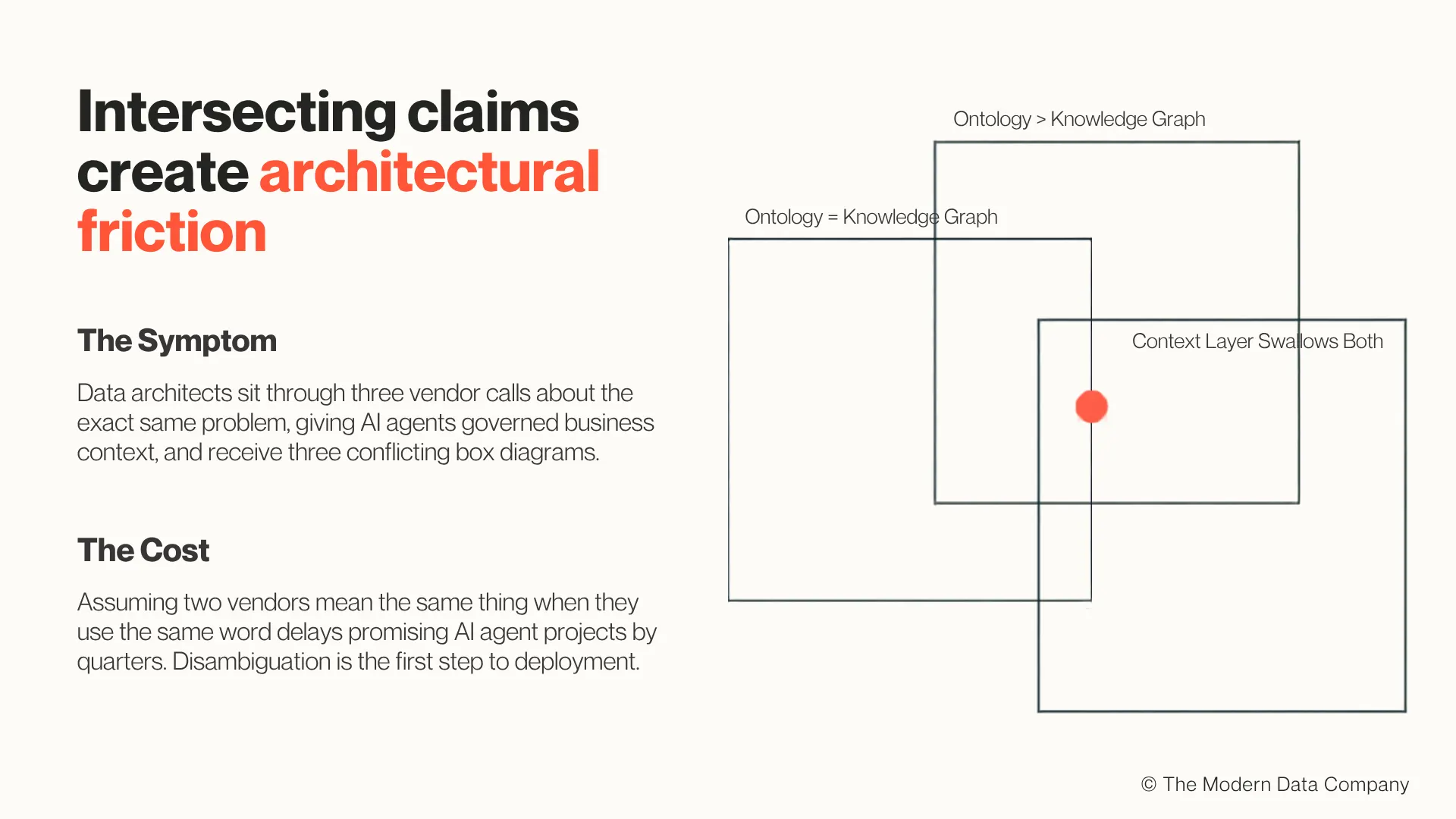
In one week, a data architect might sit through three vendor calls about the exact same problem: giving AI agents governed business context. Each vendor draws a different box diagram. In one, “ontology” sits above “knowledge graph.” In another, they are the same box. In a third, “context layer” swallows both, and “semantics” is just the label on the lid.
Picking the wrong layer, or assuming two vendors mean the same thing when they use the same word, is how a promising AI agent project gets delayed for a quarter. Before comparing the four terms head-to-head, each one needs a precise definition on its own.
Understanding the Foundations
All of these notions solve different parts of the same underlying problem: making sure any data-consuming entity, be it an AI agent or a human, means the same thing when they both say “customer.”
What Is an Ontology?
An ontology, a formal, machine-readable specification of the concepts in a domain and the rules governing how those concepts relate, defines what a “customer” or a “claim” is at a structural level, independent of any specific dataset.
The W3C’s Web Ontology Language (OWL) is the standard most enterprise ontologies are built on, because it lets software reason over those definitions rather than just store them.
What Is a Knowledge Graph?
A knowledge graph is the data-centric counterpart to an ontology: a network of specific entities, connected by relationships that can be traversed and queried.
Where an ontology defines what “customer” means in the abstract, a knowledge graph stores the fact that customer 4471 filed claim 88291 last Tuesday. This review of knowledge management frames the relationship further: a knowledge graph is achieved through formal semantics, and ontology is the foundation that formal semantics rests on.
What Is a Context Layer?
A context layer is the newest of the four terms, and the one still settling into a shared definition across vendors. In practice, it is the architectural tier that sits between raw enterprise data and the AI agents consuming it, combining governed metric definitions, entity relationships, access rules, and decision history into one surface an agent can query.
The problem it solves is a simple one: a human analyst brings institutional knowledge to every query, and an AI agent does not, so the meaning of data has to travel with the data itself instead of living in someone’s head or a forgotten wiki page.
What Does “Semantics” Mean Here?
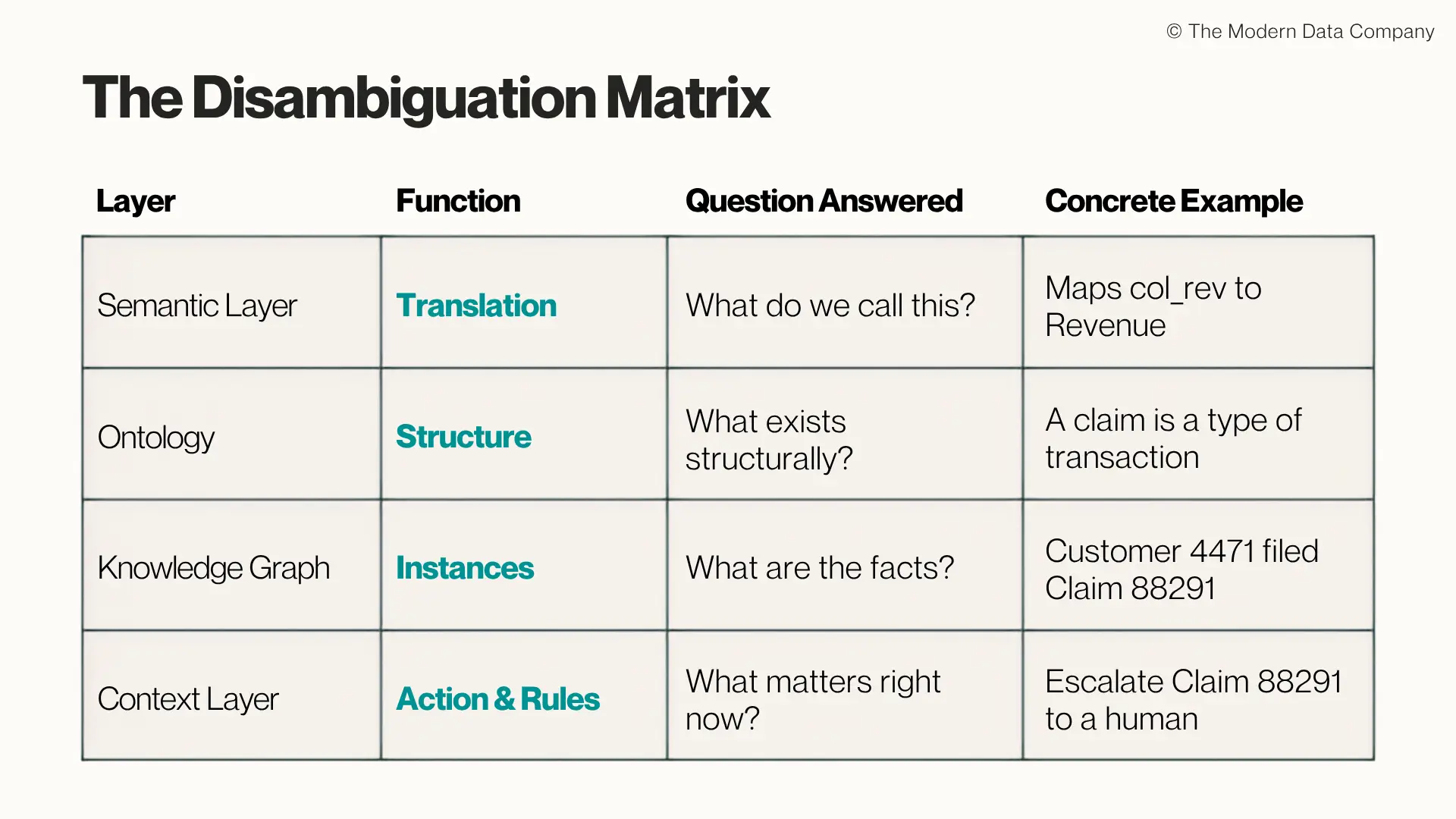
Used loosely, “semantics” usually means one of two things: the broader discipline of assigning formal meaning to data, or its most common architectural expression, the semantic layer, a translation tier that maps technical column names to business-friendly terms like “revenue” or “active customer.”
That second, narrower sense is the one most often confused with ontology and knowledge graph, because all three claim to define what a business term means.
Ontology vs. Knowledge Graph: What’s the Difference?
The cleanest way to separate the two: an ontology governs structure; a knowledge graph stores instances.
- “A claim is a type of financial transaction” is ontology.
- “Claim 88291 belongs to customer 4471” is a knowledge graph fact.
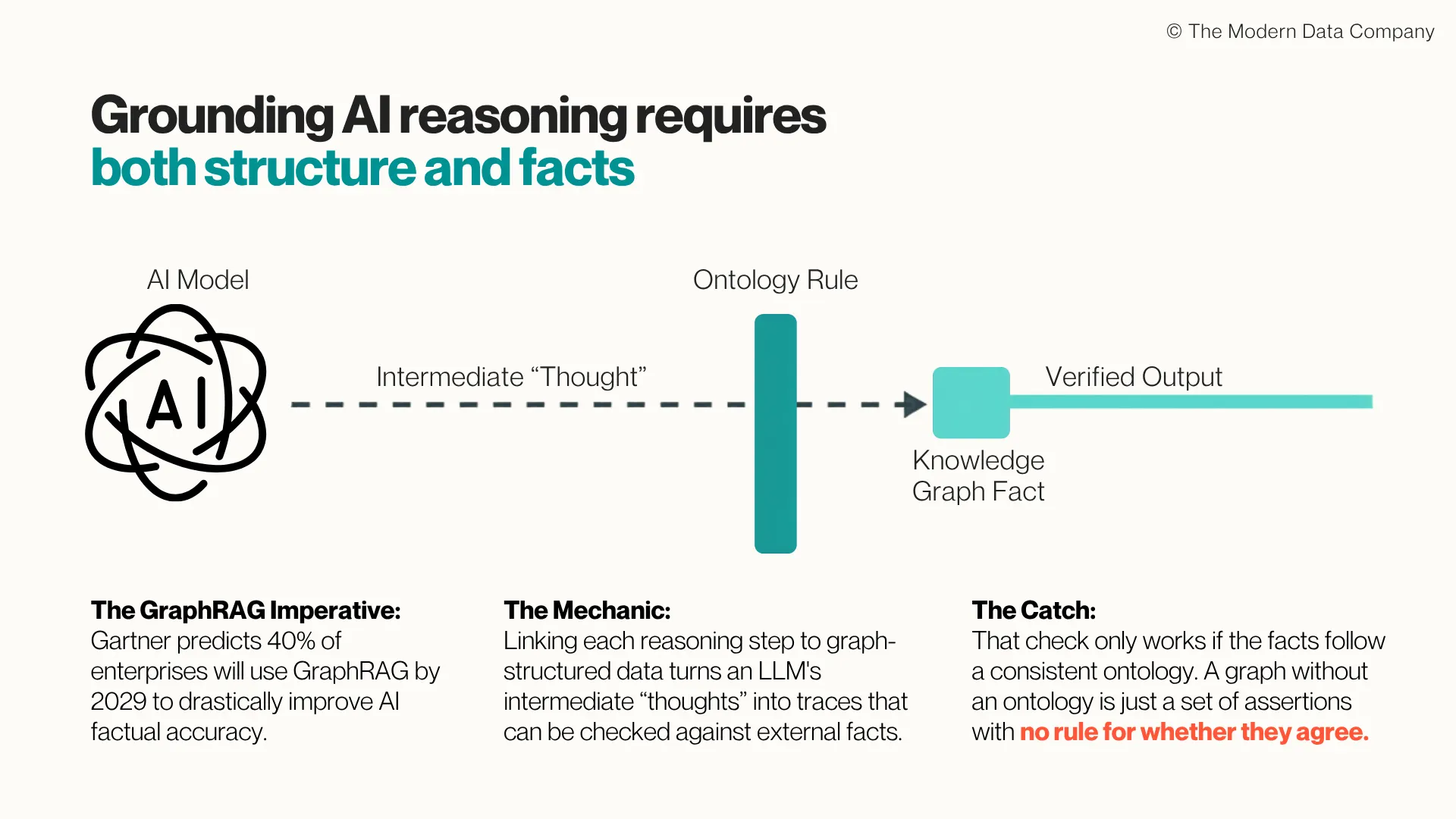
The pairing matters enough that Gartner names GraphRAG, which combines knowledge graphs with large language models, as a top data and analytics trend for 2026, predicting 40% of enterprises will use the technique by 2029 specifically to improve factual accuracy.
That accuracy gain depends on the ontology underneath the graph, not the graph alone. Researchers grounding large language model reasoning in knowledge graphs found that linking each reasoning step to graph-structured data turns an LLM’s intermediate “thoughts” into traces that can be checked against external facts, rather than accepted on faith.
That check only works if the graph’s facts follow a consistent ontology. A knowledge graph without one is just a set of assertions with no rule for whether they agree with each other.
Knowledge Graph vs. Context Layer: What’s the Difference?
A knowledge graph answers what exists and how it connects. A context layer answers a broader question: what matters right now, for this specific decision.
A knowledge graph might store that a customer has an open support ticket and a lapsed contract. A context layer adds the missing piece: whether that specific combination means offering a renewal discount or escalating to a human, given the rules and precedents that apply to this business.
That gap is why knowledge graphs alone rarely fix enterprise AI’s accuracy problem. A graph can tell an agent that two entities are related without telling it which relationship is authoritative right now, or what governance rule applies to acting on it.
A context layer closes that gap by packaging the graph’s facts together with the rules, access policy, and decision history an agent needs to act on them safely.
Why Do Teams Use These Terms Interchangeably?
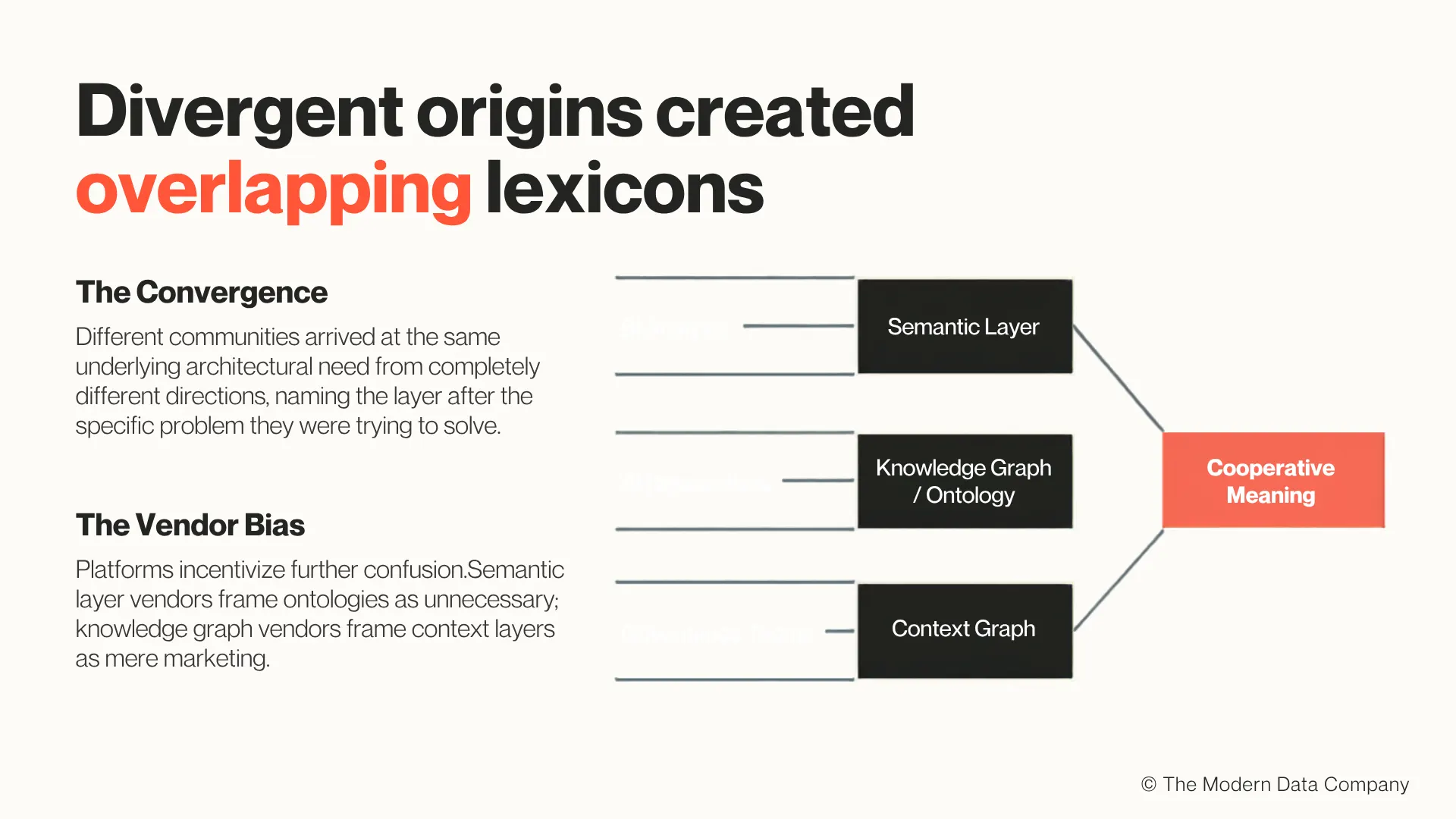
Part of the confusion is genuine overlap. Animesh Kumar’s analysis of knowledge graph implementations suggests that the same underlying need goes by several names: semantic layer, ontology layer, context graph, knowledge graph, because different communities arrived at it from different directions.
BI analysts came from reporting. AI researchers came from reasoning. Governance teams came from compliance. Each group built a version of the same layer and named it after the problem they were solving.
The terminology is also shaped by where different platforms start. Semantic layer vendors tend to define the problem through business meaning and metric logic. Knowledge graph vendors tend to emphasize entities, relationships, and ontology. Data platforms may take a broader view that includes governance, quality, lineage, and operational context.
These aren’t necessarily competing definitions. The capabilities overlap, and increasingly they are being combined into a broader architecture for giving AI the meaning and context it needs to use enterprise data correctly.
Neither claim is entirely wrong, and neither is entirely factual. The terms overlap in function even when they differ in formality and scope.
What Does Each Layer Require in Practice?
A Shared Vocabulary Across Layers
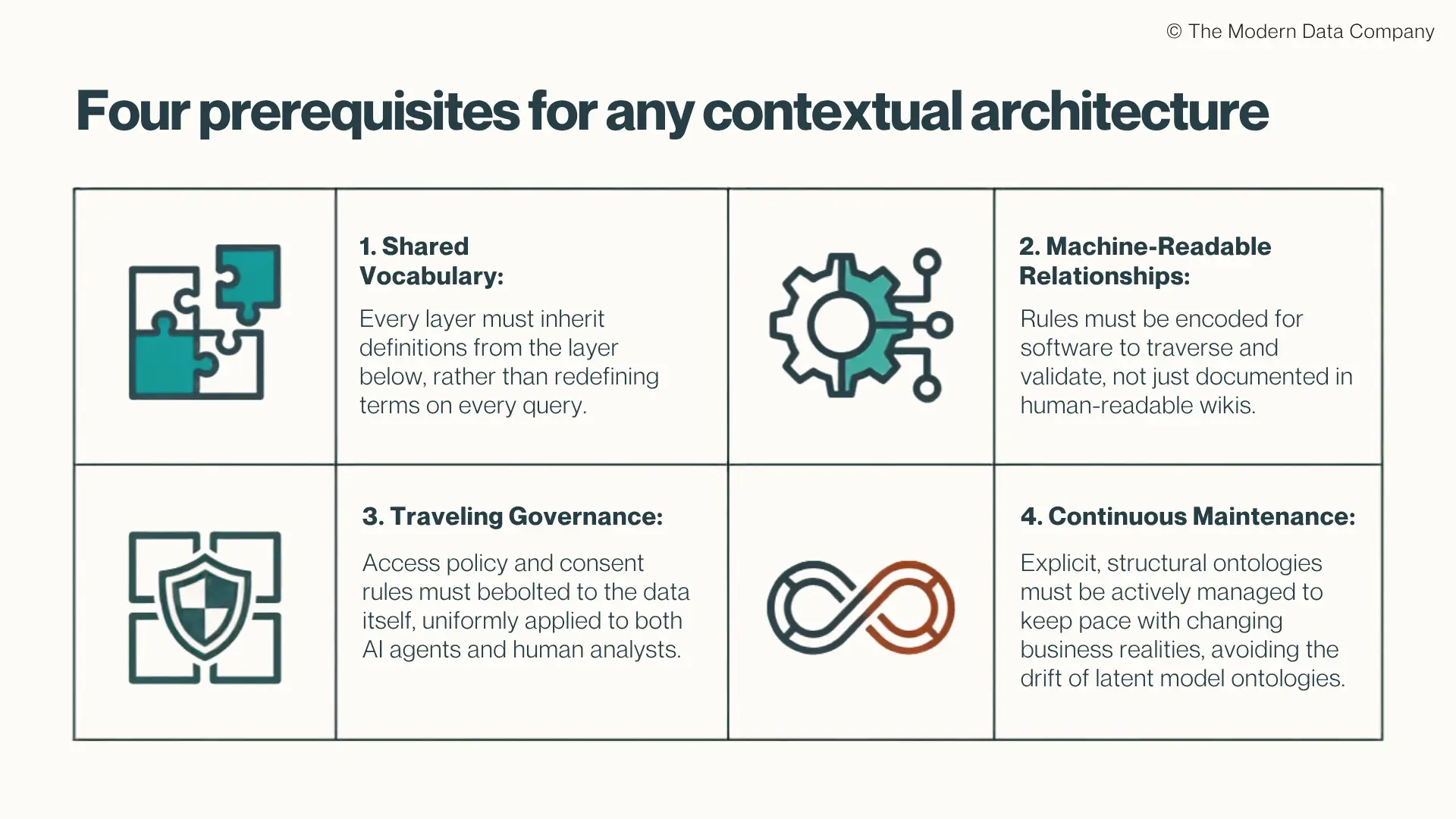
Four requirements hold regardless of which term a given vendor prefers, starting here. Whichever layer defines “active customer” first, every other layer needs to inherit that definition rather than redefine it.
Retrieval-augmented generation performs best when it pulls from structured catalogs and semantic layers or knowledge graphs that already carry these shared definitions, rather than reconstructing them from loosely organized documents on every query.
Machine-Readable Relationships
Documentation that exists in a wiki is not machine-readable. An ontology or knowledge graph has to encode relationships, such as which entities can connect and through what kind of link, in a form software can traverse and validate, not just a form a human can read.
Governance That Travels With the Data
Access policy and consent rules cannot be bolted on after the ontology or graph is built. They need to be attached to the data itself, so that a request from an AI agent is checked against the same rules as a request from a human analyst.
Continuous Maintenance Instead of a One-Time Build
An ontology built once and never revisited drifts from the business it describes within a year. Our work on ontology scope makes a useful distinction here: a model’s own pretrained understanding of a domain, its latent ontology, is fixed at training time, while the explicit, structural ontology an enterprise builds and governs has to keep pace with a business that keeps changing. Only the second one is correctable without retraining anything.
How DataOS Couples “Meaning” to Data
DataOS treats these four concepts as complementary rather than competing. Every data product it exposes carries its own governed semantic layer, defining what a metric or entity means, alongside the relationships a knowledge graph would represent and the access rules a context layer requires, packaged as one unit rather than four separate systems an agent has to reconcile on its own.
That packaging is what keeps the four layers from drifting apart. Because data products are organized as a composable ecosystem rather than a single monolithic model, a new entity or relationship can be added to one product without forcing a rebuild of the ontology underneath every other product.
The foundational semantic modeling built into the platform is the single place a term like “active customer” is defined, so an ontology, a knowledge graph, and a context layer built on top of it all inherit the same answer instead of arguing about whose definition wins.
How to Choose the Right Layer for Your AI Architecture
Start with the question you are actually trying to answer, not the term a vendor used in their pitch deck.
- If the problem is inconsistent metric definitions across dashboards, the gap is a semantic layer.
- If the problem is an AI agent that cannot tell how two records relate, the gap is a knowledge graph, governed by an ontology precise enough for the graph to reason over.
- If the problem is an agent that has the facts but still makes the wrong call because it lacks the rules, precedents, and access policy behind those facts, the gap is a context layer.
Most enterprises need pieces of all four eventually. The mistake is buying them as four separate, uncoordinated projects instead of one architecture where each layer inherits its definitions from the one below it.





.webp)