Customer 360 AI for Personalization at Scale
Lorem ipsum dolor sit amet, consectetur adipiscing elit. Suspendisse varius enim in eros elementum tristique. Duis cursus, mi quis viverra ornare, eros dolor interdum nulla, ut commodo diam libero vitae erat. Aenean faucibus nibh et justo cursus id rutrum lorem imperdiet. Nunc ut sem vitae risus tristique posuere.

A returning shopper opens your app at 8:02 p.m. Nine minutes earlier, she abandoned a cart on your website. An AI agent has about three seconds to decide what she sees next: a discount, a recommendation, or nothing at all. If the system pulls from a customer profile that was last refreshed at 2 a.m., it has no idea the cart exists, and the moment is gone.
This is far from a hypothetical and is, in fact, the daily reality inside most enterprises that built a Customer 360 view for dashboards and are now trying to hand it to AI agents that operate at machine speed.
In this article, we’re going to understand how to optimize this handover to AI agents by first attending to the underlying foundation of your Customer 360.
What Is Customer 360 AI?
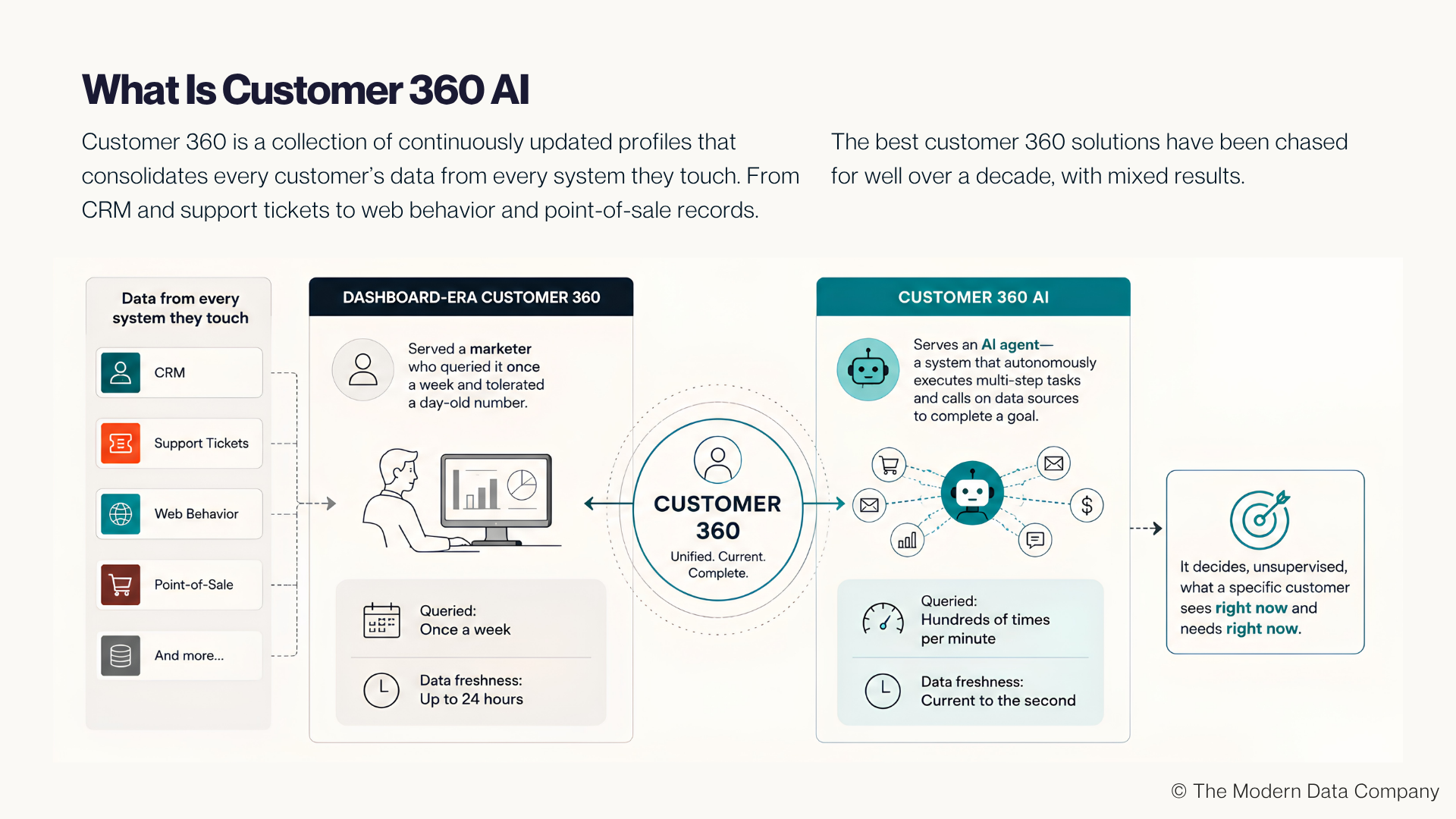
Customer 360 is a collection of continuously updated profiles that consolidates every customer’s data from every system they touch. From CRM and support tickets to web behavior and point-of-sale records. The best customer 360 solutions have been chased for well over a decade, with mixed results.
What has changed today in the AI era is who reads that complete customer profile.
A dashboard-era Customer 360 served a marketer who queried it once a week and tolerated a day-old number.
A Customer 360 AI implementation serves an AI agent instead, a system that autonomously executes multi-step tasks and calls on data sources to complete a goal without step-by-step human instruction.
That agent queries the profile hundreds of times a minute, and it needs an answer current to the second, because it decides, unsupervised, what a specific customer sees right now and needs right now.
Why Traditional Customer 360 Breaks Under AI Agents
1. Timing of traditional Customer 360 doesn’t match AI scale
Traditional Customer 360 builds still update on a batch cycle: nightly if the company under-invested, hourly if it invested well. That cadence was fine when a human was reading the profile.
It fails the moment an AI agent has to act on something that happened in the last sixty seconds. By the time the batch runs, the moment it was supposed to act on has already passed.
2. Agents hallucinate over fragmented identity across Customer 360
The second break is identity. A single customer can look like five different people across a CRM, an e-commerce platform, a support desk, and a loyalty program. Reconciling those fragments into one identity is what identity resolution solves.
It unifies the profile once, governs it centrally, and lets every downstream system, human or AI, read from the same source. Skip that step, and an AI agent is not personalizing anything, but guessing which of five partial records is the right one.
3. Governance at AI speed is not deployable in traditional Customer 360
The third break is governance. One analyst querying a customer record once an hour is easy to govern: check the role, check consent, log the access.
Fifty AI agents querying thousands of records a minute is a different problem, and most governance models were never built to hold at that volume without either locking data down or leaking it.
The scale of the resulting gap shows up in industry research. Companies that lead on personalization grow revenue 10% points faster annually than laggards, according to the BCG Personalization Index. Yet only 10% of companies qualify as leaders, leaving an estimated $2 trillion in value on the table over the next three years (reported in 2025).
Businesses that are leaders in personalization achieve compound annual growth rates that are 10% higher than those of laggards, as well as higher shareholder returns. ~The BCG Personalization Index
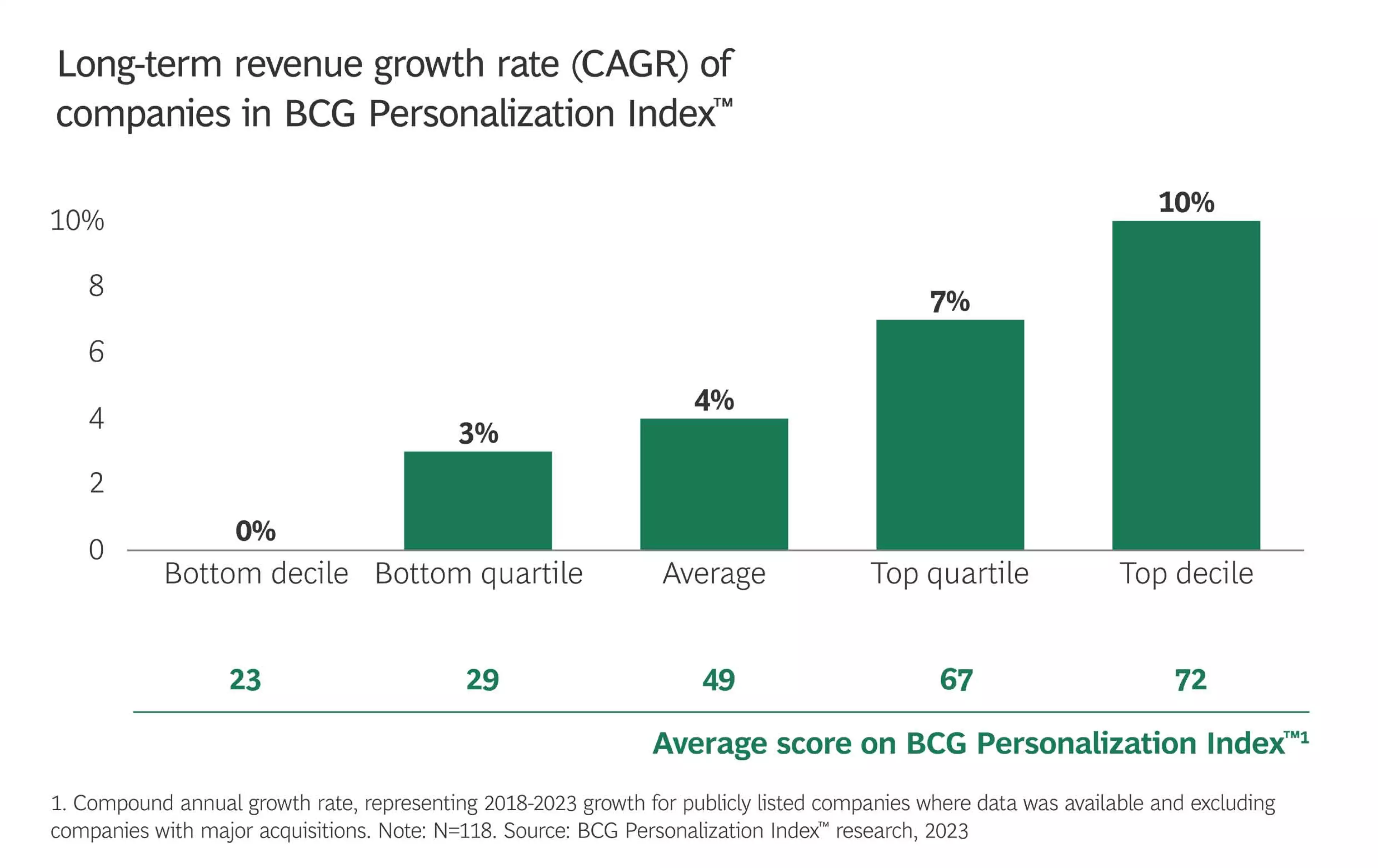
This gap is an infrastructure problem. It’s not that 90% of organizations do not want this degree of personalization, which renders a 10% contribution to the revenue growth rate. It’s an inability to achieve the same results due to data infrastructure constraints.
Is Personalization at Scale a Data Problem or a Model Problem?
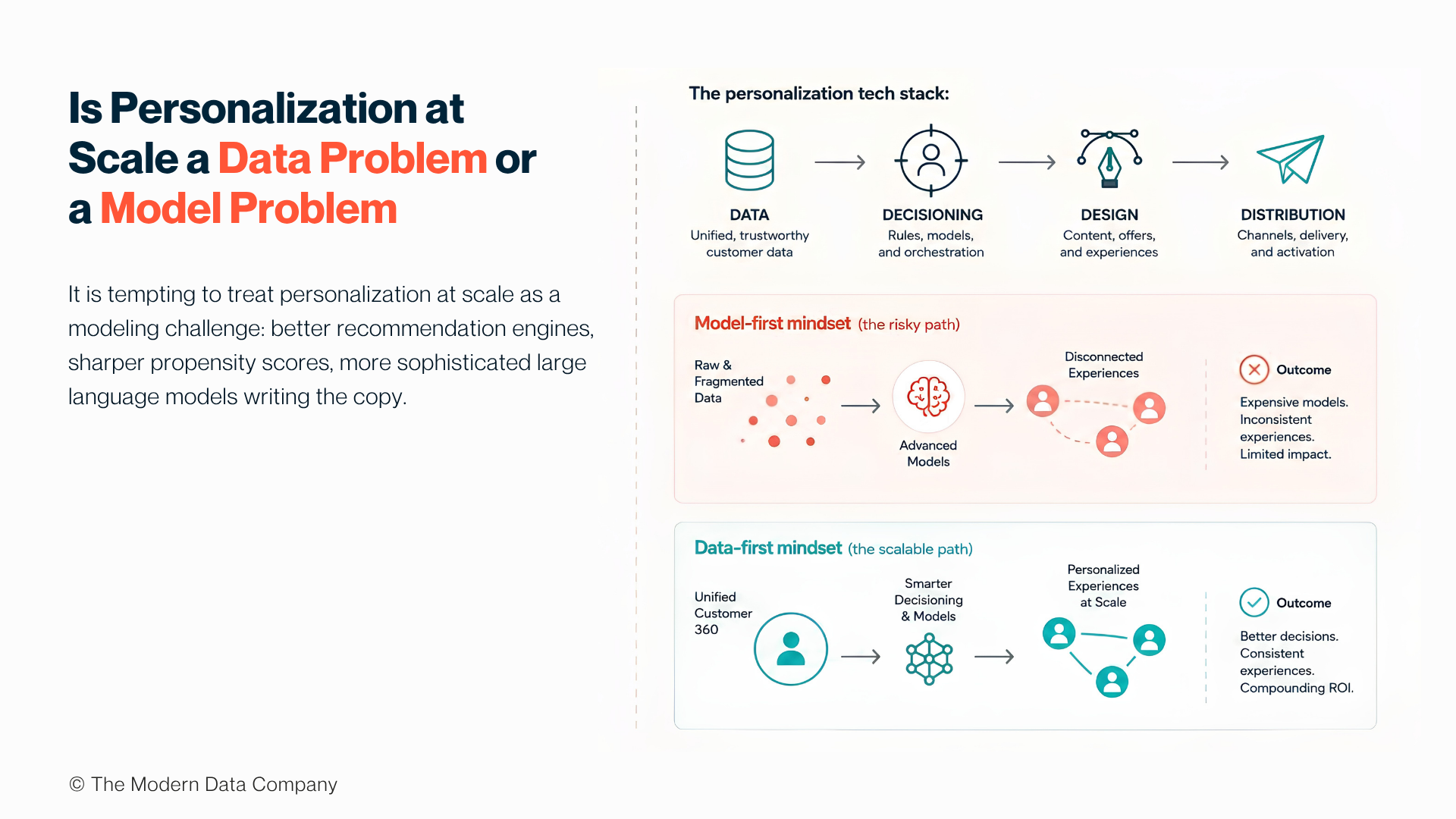
It is tempting to treat personalization at scale as a modeling challenge: better recommendation engines, sharper propensity scores, more sophisticated large language models writing the copy.
McKinsey’s research into personalization technology points the other way. Its “4D” framework, data, decisioning, design, and distribution, treats data architecture as the foundation that every other layer depends on, not an afterthought behind the model.
That matches what shows up in enterprise deployments. One large North American retailer generated $400 million in value from pricing improvements and a further $150 million from generative-AI-enabled targeted offers, but only after integrating its point-of-sale infrastructure with its marketing stack into a single, unified view of customer behavior. The model came second. The unified data came first.
Academic work on real-time personalization backs this up from a different angle. Researchers studying large-language-model recommenders found that retraining a model every time a customer’s interest shifts is impractical at enterprise scale.
The more workable path, they found, is feeding the model fresh, well-structured context at inference time rather than trying to bake every new signal into the weights. In practice, that “fresh, well-structured context” is exactly what a governed Customer 360 layer is supposed to supply.
Why AI Agents Misread Your Customer Data
Semantic drift is the largest contributing factor to miscommunicated data between customer data and AI agents. “Active customer” in the growth dashboard often means something different from “active customer” in the finance model, and neither matches what the support team means when they use the same phrase.
A human notices the mismatch and asks, but an AI agent does not. It queries whichever definition it finds first and returns a confident, wrong answer.
Modern Data 101’s research into enterprise AI context shows how a data product is only trustworthy to an agent when its schema, lineage, and business meaning travel with it as part of its specification, not as tribal knowledge that exists only in someone’s head.
A Customer 360 profile without that packaged context is a table an agent can query instead of an assumed definition it can trust.
The Four Data Layer Requirements for AI-driven Personalization in Customer 360
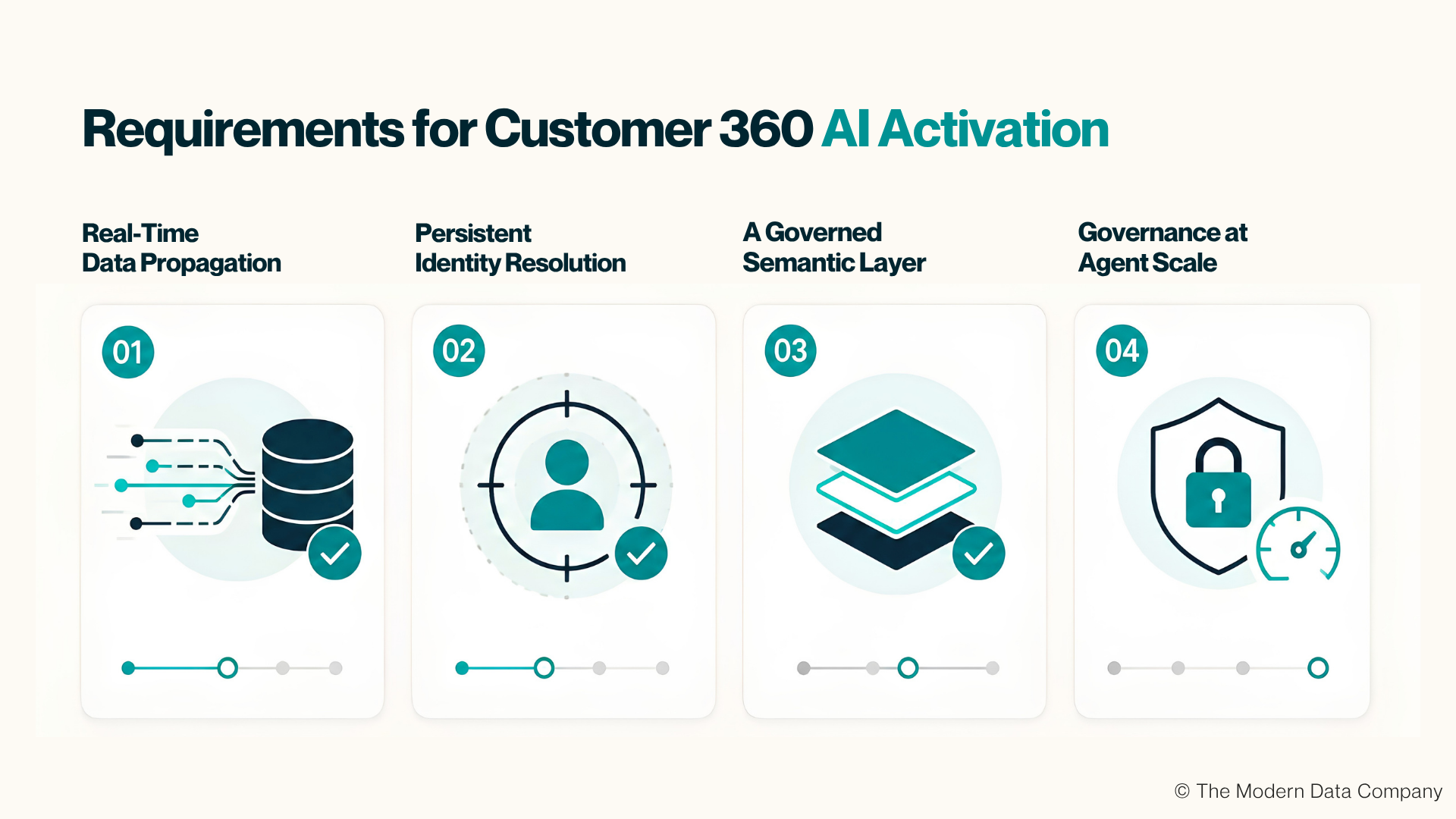
1. Real-Time Data Propagation
For Customer 360 AI to work, profile updates need to reach every consuming system within seconds of the interaction. Data products built for streaming ingestion, rather than nightly batch jobs, are what make this possible without rebuilding the pipeline for every new use case.
2. Persistent Identity Resolution
Deterministic and probabilistic matching need to run continuously. It is not a one-time onboarding project. The continuity ensures that the “golden record” an agent reads stays accurate as new signals arrive across channels.
3. A governed semantic layer
Business terms like “active customer,” “churn risk,” or “high-value segment” need one authoritative definition that every consumer, dashboard, application, or agent reads the same way. A semantic layer built into the data platform itself, rather than bolted onto one BI tool, is what keeps an AI agent from inventing its own interpretation.
4. Governance at Agent Scale
Access controls, consent checks, and audit logs have to operate at API speed and API volume, because the consumer of the data is no longer a person clicking through a dashboard once an hour.
Srinivas Mathkur’s analysis of this shift argues that data products are what make agent-scale governance enforceable, because policy and access controls are attached to the product itself rather than bolted on downstream.
Organizations that skip straight to buying a personalization tool without addressing these four tend to rediscover them the hard way. Even retailers chasing loyalty gains through customer data run into the same observability and governance gaps eventually.
Industry research on the topic found that 59% of brands cite a limited or fragmented tech stack as a pain point, and 41% point to a lack of centralized customer data specifically. That is another way of saying personalization at scale keeps breaking on the same four gaps.
How DataOS Enables AI Activation for Customer 360 at Scale
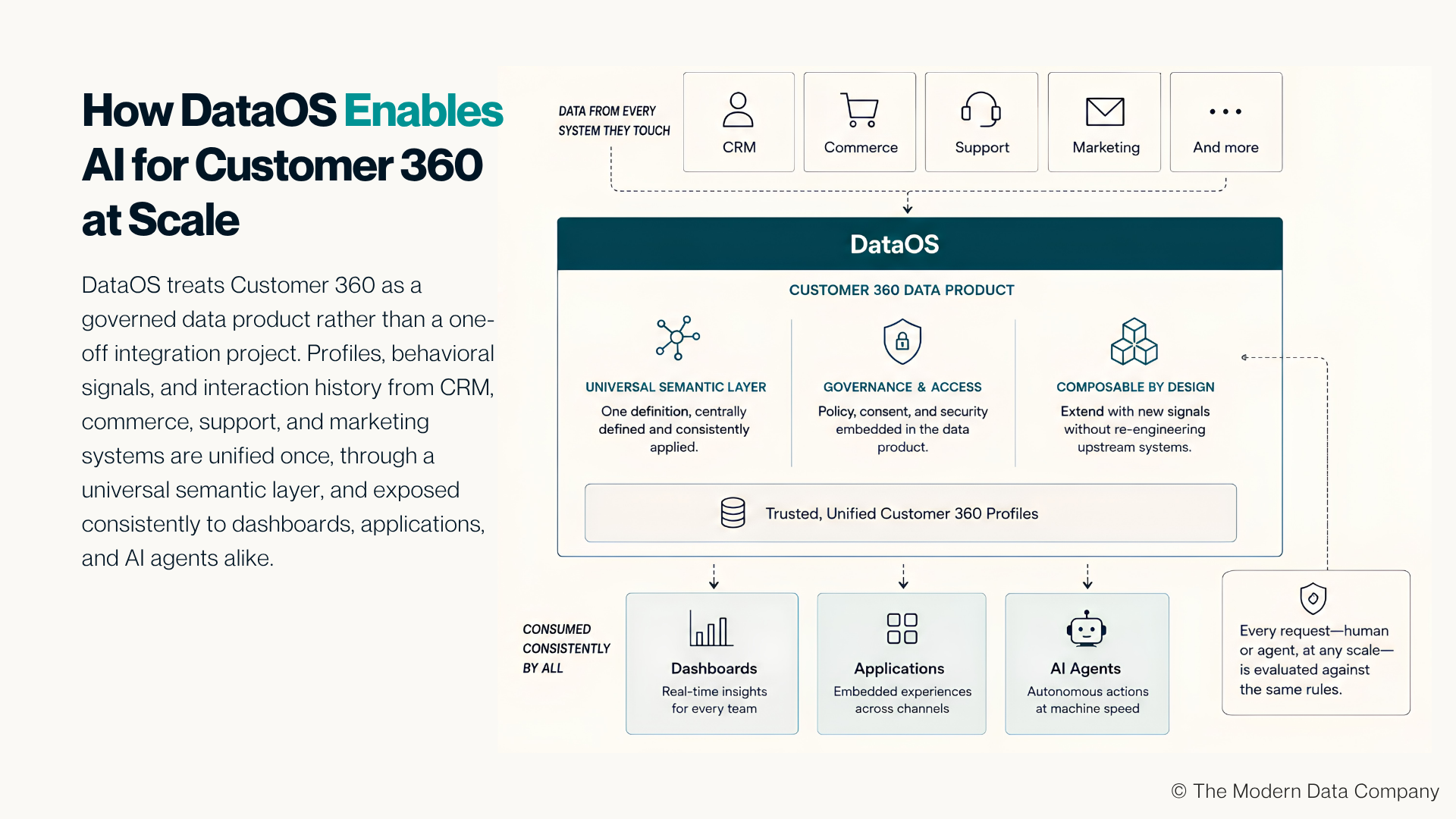
DataOS treats Customer 360 as a governed data product rather than a one-off integration project. Profiles, behavioral signals, and interaction history from CRM, commerce, support, and marketing systems are unified once, through a universal semantic layer, and exposed consistently to dashboards, applications, and AI agents alike.
That semantic layer is what resolves the definition problem described above: “active customer” or “churn risk” is defined once, centrally, and every consuming system inherits the same definition instead of reconstructing its own.
Governance, consent, and access policy are attached to the data product itself, so a request from an AI agent is checked against the same rules as a request from a human analyst, at whatever volume either one generates.
Agentic AI therefore shouldn't be given a special or looser standard for ROI. ~Niranjan Nilekani, as featured on CXO Insights
Because the underlying architecture is organized around composable data products rather than a single monolithic pipeline, teams can extend a Customer 360 profile, adding a new loyalty signal or a new support channel, without re-engineering everything upstream of it.
That is the difference between a Customer 360 that was built once and now gradually rots, and one that stays trustworthy as more systems, and more AI agents, start reading from it.
How to Audit Your Customer 360 for AI Readiness
The organizations pulling ahead are ensuring that Customer 360 data is fresh enough, identity-resolved enough, and clearly enough defined that an AI agent can act on it without a human double-checking the answer first.
Before evaluating another personalization vendor or fine-tuning another recommendation model, the more useful audit is architectural: can your current Customer 360 answer a query in seconds, resolve identity across every channel automatically, and hand an AI agent a definition it can trust without asking?
If the answer is no, that is where the roadmap needs to start.




.webp)
.webp)