Categories


TL;DR
MCP (Model Context Protocol) connects one AI agent to tools and data. A2A (Agent2Agent) connects AI agents to each other. MCP is vertical (agent to systems); A2A is horizontal (agent to agent). They are complementary, not competing, and most enterprise agent systems will run both. Neither checks whether the data is correct or consistently defined. That is the data layer's job, so governed data products and a semantic layer decide how far both protocols take you.
What is MCP? Is MCP a server or a protocol?
MCP is a protocol: an open standard for how an AI application asks outside systems for data, actions, and instructions. An "MCP server" is simply a program that speaks that protocol.
From first principles: a model only knows its training data, so it needs live data and actions. Without a standard, ten AI apps and twenty systems need up to 200 custom connectors. MCP turns multiplication into addition: wrap each system once as a server, build each app's client once.
The MCP specification defines three roles. The host is the AI application the user works in. Inside it, each client holds a one-to-one connection with a server. Servers expose tools (actions), resources (data), and prompts (templates) over JSON-RPC 2.0. So an MCP server provides capabilities; an MCP client requests them for the host.
Is MCP just an API for LLMs?
No. An API exposes one system in its own shape. MCP is a uniform contract over many APIs, with built-in discovery: a client asks a server what it offers and gets an answer the model can reason over. The API still does the work; MCP makes it legible to agents, which is why teams use an MCP server instead of wiring every API into every model.
In short: MCP is a protocol that standardizes the vertical link between an agent and its tools and data.
What does A2A stand for and what is it used for?
A2A stands for Agent2Agent. In AI, it is an open protocol that lets agents built by different teams, vendors, or frameworks find each other, hand off tasks, and return results.
The need appears once two agents on different frameworks must cooperate without exposing prompts, memory, or tools. The A2A key concepts treat each remote agent as an opaque black box: you see what it can do, never how.
Four ideas carry the protocol:
- Agent Card: advertises identity, skills, endpoint, and authentication.
- Task: stateful work with a lifecycle.
- Message: one turn of conversation.
- Artifact: the result.
Google announced A2A in April 2025. In June 2025, the Linux Foundation launched the A2A project, backed by AWS, Microsoft, SAP, and others.
In short: A2A standardizes the horizontal link between peer agents, using Agent Cards and tasks.
What's the difference between MCP and A2A?
The difference is direction and counterpart. MCP connects an agent down to things that do not think, like databases and APIs. A2A connects it across to things that do: other agents.
Think of a head chef in a busy kitchen. When the chef reaches for the pantry, the oven, or the recipe binder, that is MCP: the chef is using tools and ingredients that do exactly what they are asked and nothing more.
When the chef turns to the pastry chef and says “I need a dessert for table six,” that is A2A: the chef is handing work to another expert who will decide for themselves how to get it done. One relationship is about using resources; the other is about coordinating with peers.
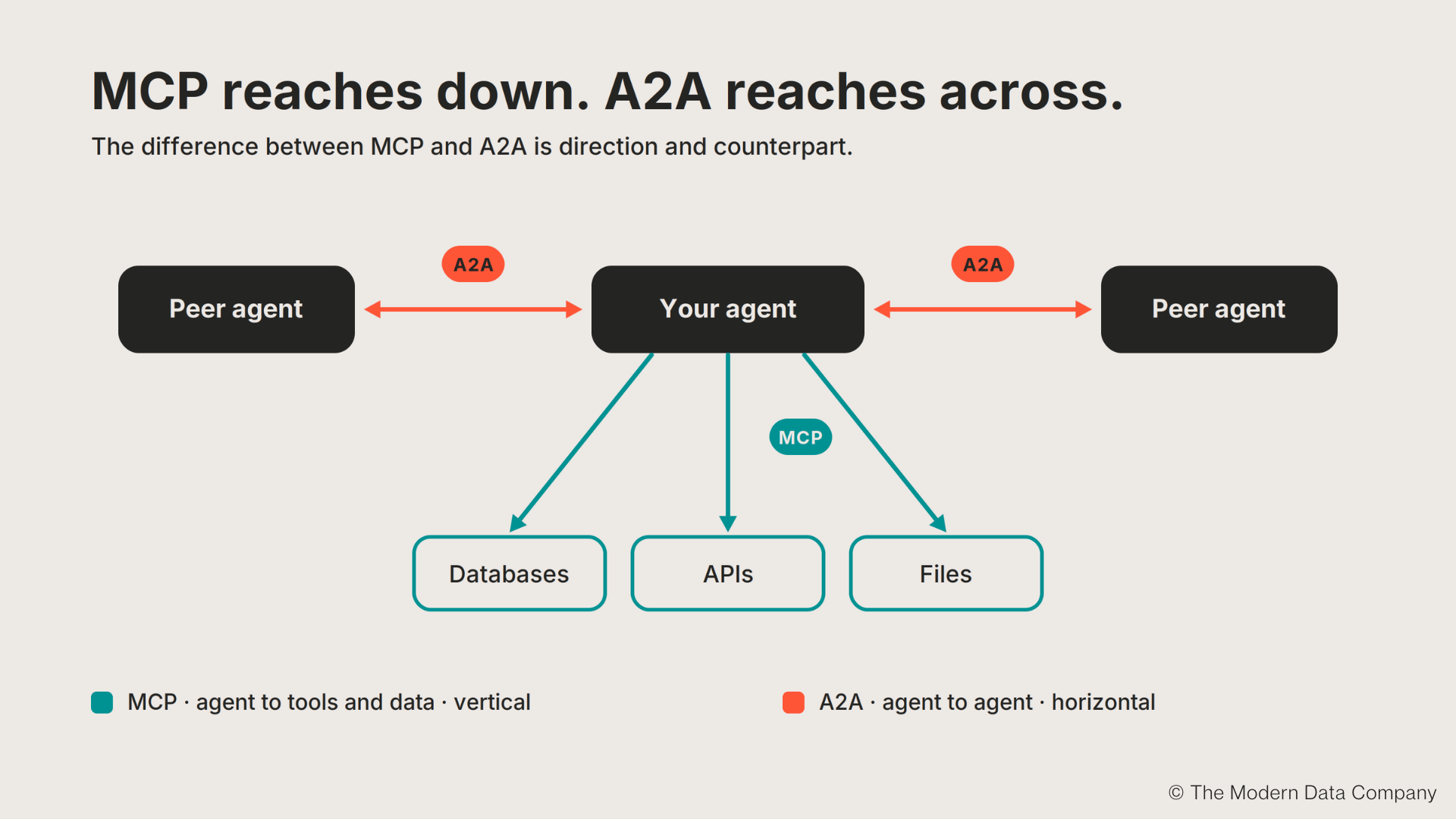
| Dimension | MCP | A2A |
|---|---|---|
| Connects | Agent to tools and data | Agent to agent |
| Direction | Vertical | Horizontal |
| Counterpart | Deterministic tool or data source | Autonomous, opaque agent |
| Discovery | Server lists its tools and resources | Agent Card |
| Unit of work | Tool call that returns a result | Task with a lifecycle that can pause for input |
| Created by | Anthropic, November 2024 | Google, April 2025 |
| Governed by | Agentic AI Foundation (Linux Foundation) | A2A project (Linux Foundation) |
A 2025 analysis of A2A and MCP integration frames A2A as horizontal and MCP as vertical, so the differences between Google's A2A and MCP are about scope, not rivalry.
Quick test: if the other end can reply, "I need more information," use A2A. If it just returns a result, use MCP.
In short: MCP is agent-to-tool; A2A is agent-to-agent. Ask whether the counterpart reasons for itself.
Can an MCP server talk to another MCP server? How MCP and A2A work together
Not directly. The MCP specification isolates servers and leaves cross-server interactions to the host. Coordinating independent agents is the gap A2A fills, so A2A complements MCP rather than replacing it.
One question, end to end:
- A finance agent is asked why Q3 Northeast margin fell.
- It uses MCP to query sales and margin data.
- It finds an unexplained freight spike, reads a logistics agent's Agent Card, and sends it an A2A task.
- The logistics agent checks carrier contracts over MCP and returns an artifact.
- The finance agent combines both answers. Neither agent ever saw the other's tools.
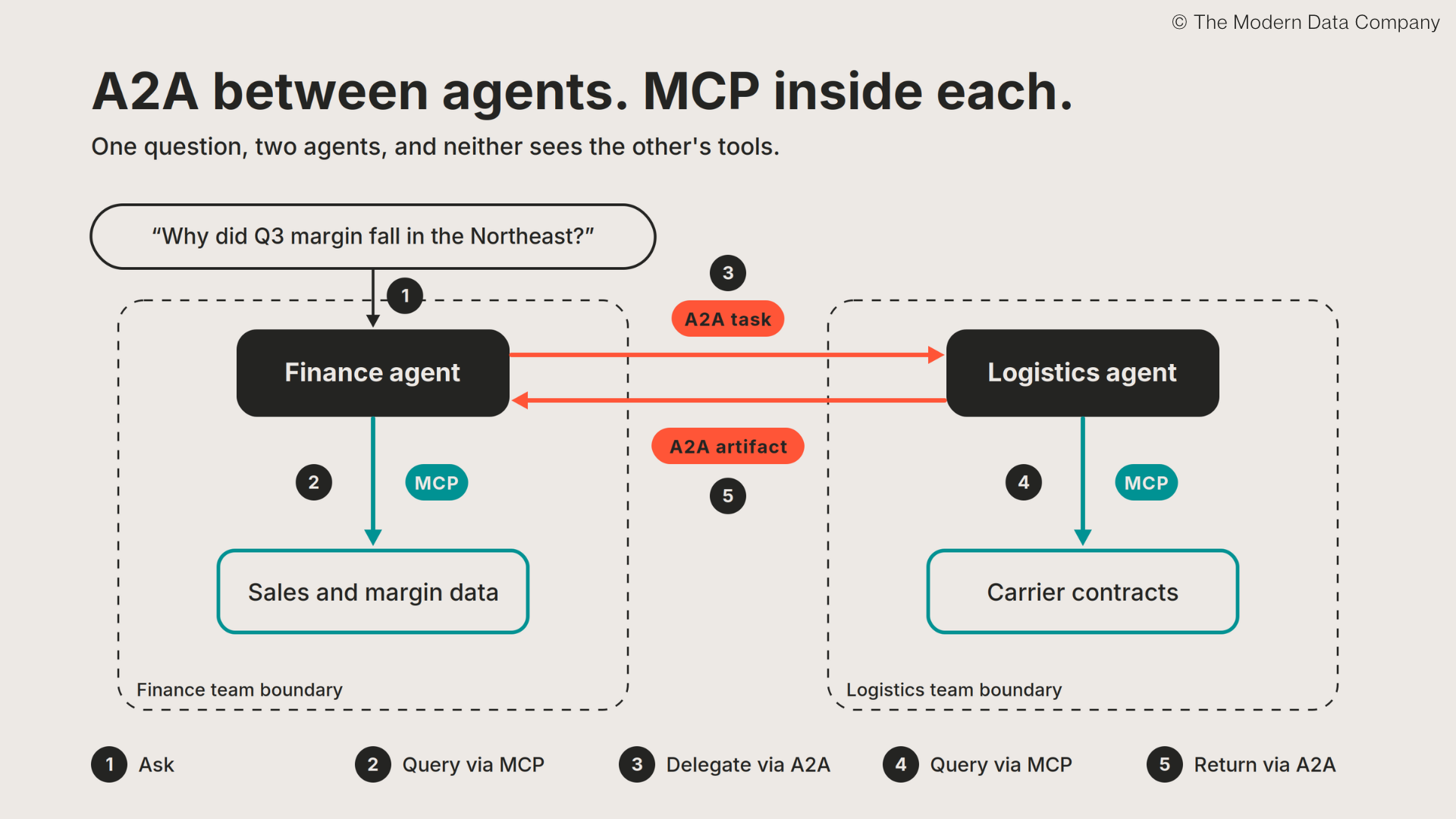
In short: MCP servers do not talk to each other. A2A connects agents; each uses MCP internally.
Where does the data layer fit in MCP and A2A?
Underneath both. MCP standardizes how agents reach data and A2A how they share results, but neither checks what the data means.
A protocol is a pipe, not a referee. If "active customer" means a 30-day login in one system and a paid subscription in another, MCP delivers both and A2A passes the contradiction on, compounding the error at each hop.
Evidence: Gartner predicts that through 2026, organizations will abandon 60% of AI projects unsupported by AI-ready data. Interim Modern Data Survey results show 57.3% of organizations are piloting or running AI agents, yet only 8.4% trust the data feeding their AI for production.
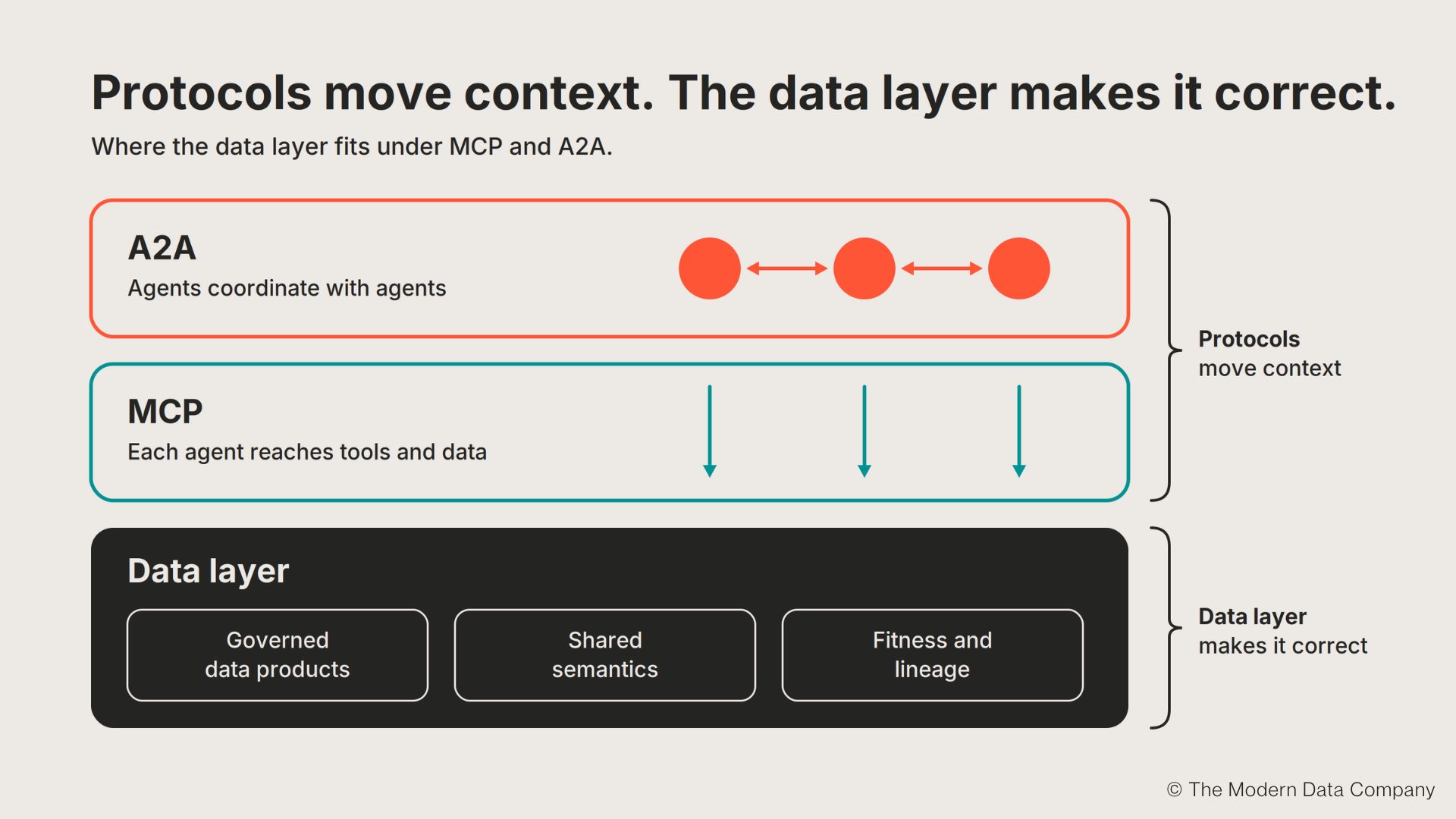
The data layer supplies what the protocols cannot:
- Governed data products with owners, quality checks, and versions, which is why agentic AI needs data productsrather than raw tables.
- Shared meaning through a semantic layer or ontology. See how ontology, knowledge graph, and semantic layer differ.
- Fitness signals an agent can read before acting, covered in how an AI agent tells when data is not fit for purpose.
In DataOS, data products are exposed through MCP with semantics and governance attached.
In short: MCP and A2A move context; the data layer makes it correct, so build it first.
When to use A2A vs MCP?
Use MCP when one agent needs to read from or act on a system. Use A2A when work crosses an ownership boundary: another team, vendor, or company.
| Situation | Use |
|---|---|
| Query a warehouse, data product, or internal API | MCP |
| Read documents or files for context | MCP |
| Delegate a specialist subtask to an agent another team owns | A2A |
| Long-running work that may pause for human or agent input | A2A |
| Cross-company work with private internals | A2A |
| Any multi-agent workflow over enterprise data | Both, on a governed data layer |
Every A2A hop adds tokens, so trace spend per agent with AI agent cost attribution.
In short: MCP within an agent's reach, A2A across agent boundaries, both for enterprise systems.
Frequently asked questions
Who invented MCP for AI?
Anthropic introduced the Model Context Protocol in November 2024. In December 2025, it donated MCP to the Agentic AI Foundation, a Linux Foundation fund co-founded by Anthropic, Block, and OpenAI.
Does ChatGPT use MCP?
Yes. The MCP maintainers list ChatGPT among clients with first-class MCP support, alongside Claude, Cursor, Gemini, Microsoft Copilot, and Visual Studio Code.
Do MCP servers need to be hosted?
No. An MCP server can run locally beside the host, over standard input and output, or remotely over HTTP. Local suits personal files and developer tools; remote suits shared enterprise data that needs central access control.