How Does an AI Agent Tell When Data Is Not Fit for Purpose
Lorem ipsum dolor sit amet, consectetur adipiscing elit. Suspendisse varius enim in eros elementum tristique. Duis cursus, mi quis viverra ornare, eros dolor interdum nulla, ut commodo diam libero vitae erat. Aenean faucibus nibh et justo cursus id rutrum lorem imperdiet. Nunc ut sem vitae risus tristique posuere.

It is the first day of October, and someone asks the analytics agent for September’s revenue. The monthly pipeline does not run until the 5th, so the latest closed month in the warehouse is August. The agent returns August’s number as “the latest,” or a partial September, and neither answer looks wrong.
An analyst would have stopped at the first line of that question. They know the pipeline’s schedule, so they know the period is not closed, and they would say so. The agent has no such memory, which turns the real question from “is the data good?” into “can the agent tell this data is unfit for this task?”
Can an AI Agent Know When Its Data Isn’t Fit for Purpose
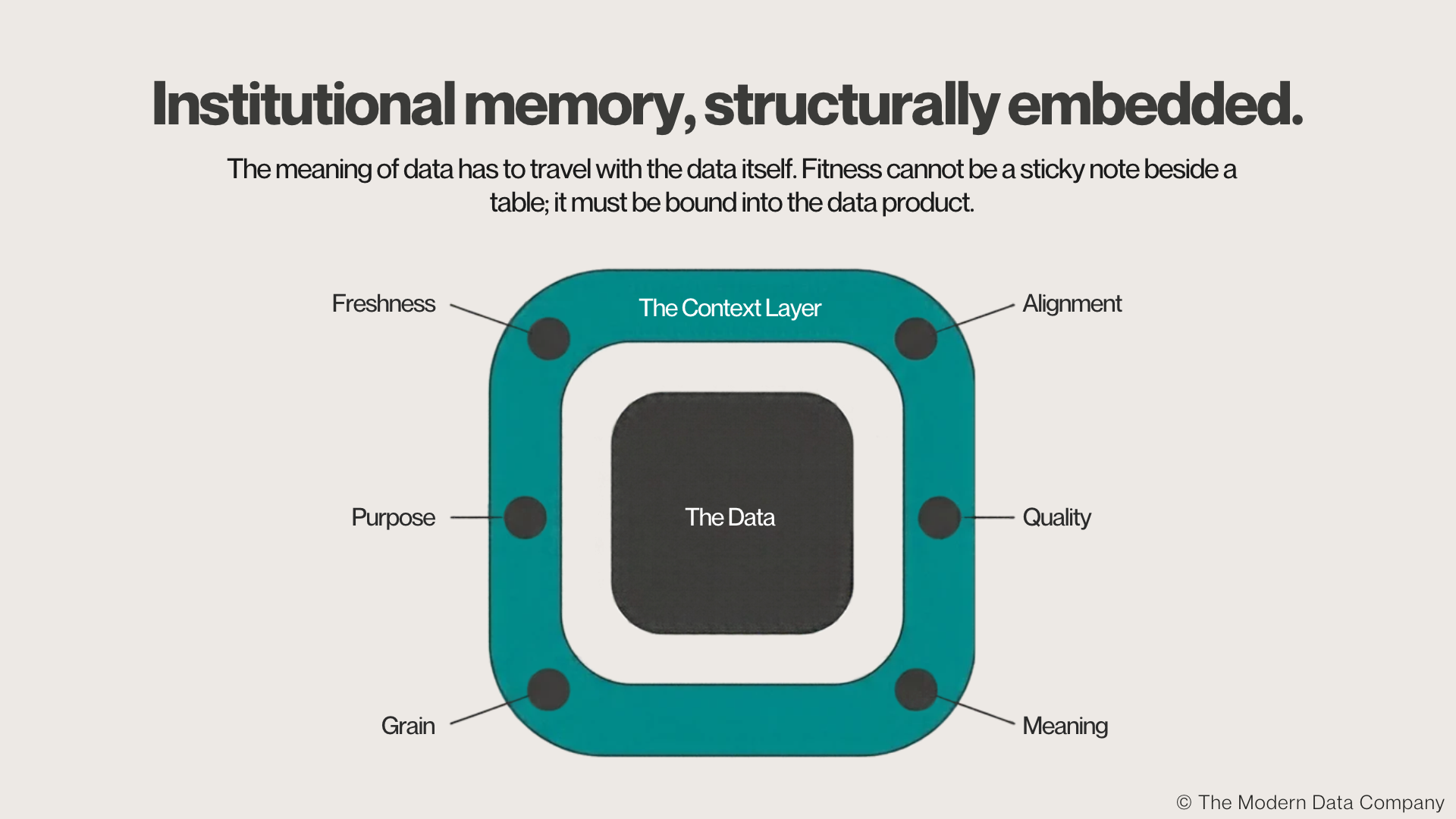
An AI Agent knows when its data isn’t fit for purpose only if the context layer- the tier between enterprise data and AI agents that carries definitions, quality status, and rules for use- records what an analyst knows. Today it mostly does not.
An agent has no institutional memory, so the meaning of data has to travel with the data itself. Most context layers describe the data with table names, columns, descriptions, and maybe a glossary. Fitness for purpose needs more than that.
Data that is fit for purpose meets the accuracy, timeliness, meaning, and coverage a specific question demands. Researchers at the University of Utah describe fitness for purpose as a relation among the data, the question, the operation being run, a community’s standards, and the consequences of error, which is why no dataset is simply fit or unfit. They also warn that fluency at the model layer can conceal fragility at the data layer.
What Does “Fit for Purpose” Imply
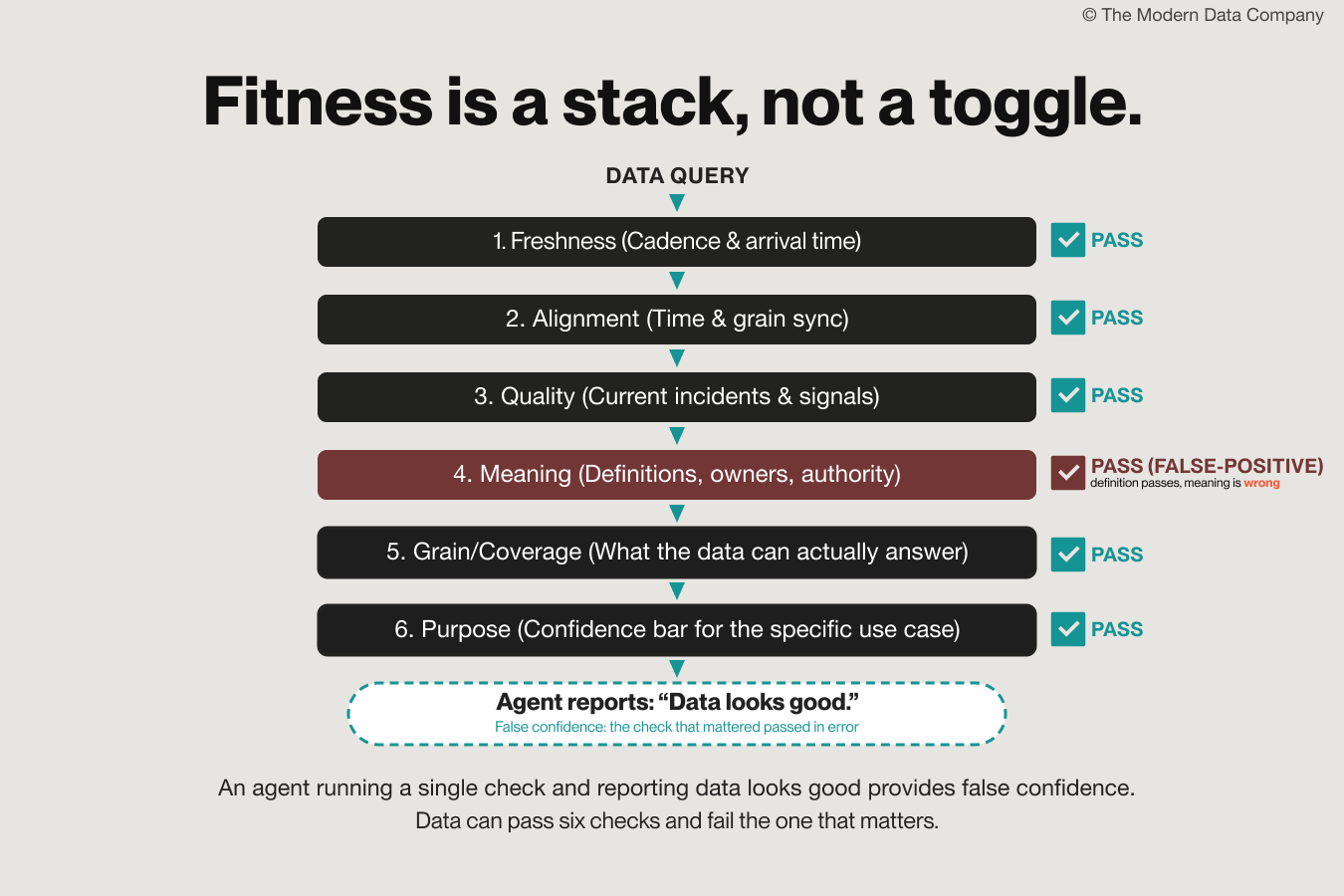
Fitness is a stack of checks, not a yes or no, and data can pass several of them while failing the one that matters. An agent that runs a single check and reports “data looks good” is giving false confidence. Six checks cover most analytical questions.
Why Is Freshness Relative Instead of Absolute
A rule like “updated in the last seven days means fresh” breaks on the first monthly pipeline. A monthly table loaded 20 days ago may be perfectly current, while a daily table loaded two days ago is stale. The real question is whether the expected run happened and whether the period being asked about is complete.
Freshness therefore has to be judged against a dataset’s cadence, its grain (the level of detail one row represents), and its expected arrival time, not a fixed threshold. Animesh Kumar, CTO and Co-founder of Modern Data, creates a clear distinction between AI-ready and analytics-ready data and lists freshness among the core requirements.
So a model is not reasoning about a world that no longer exists. What counts as fresh enough depends on the question.
Can Every Table Pass and the Answer Still Fail
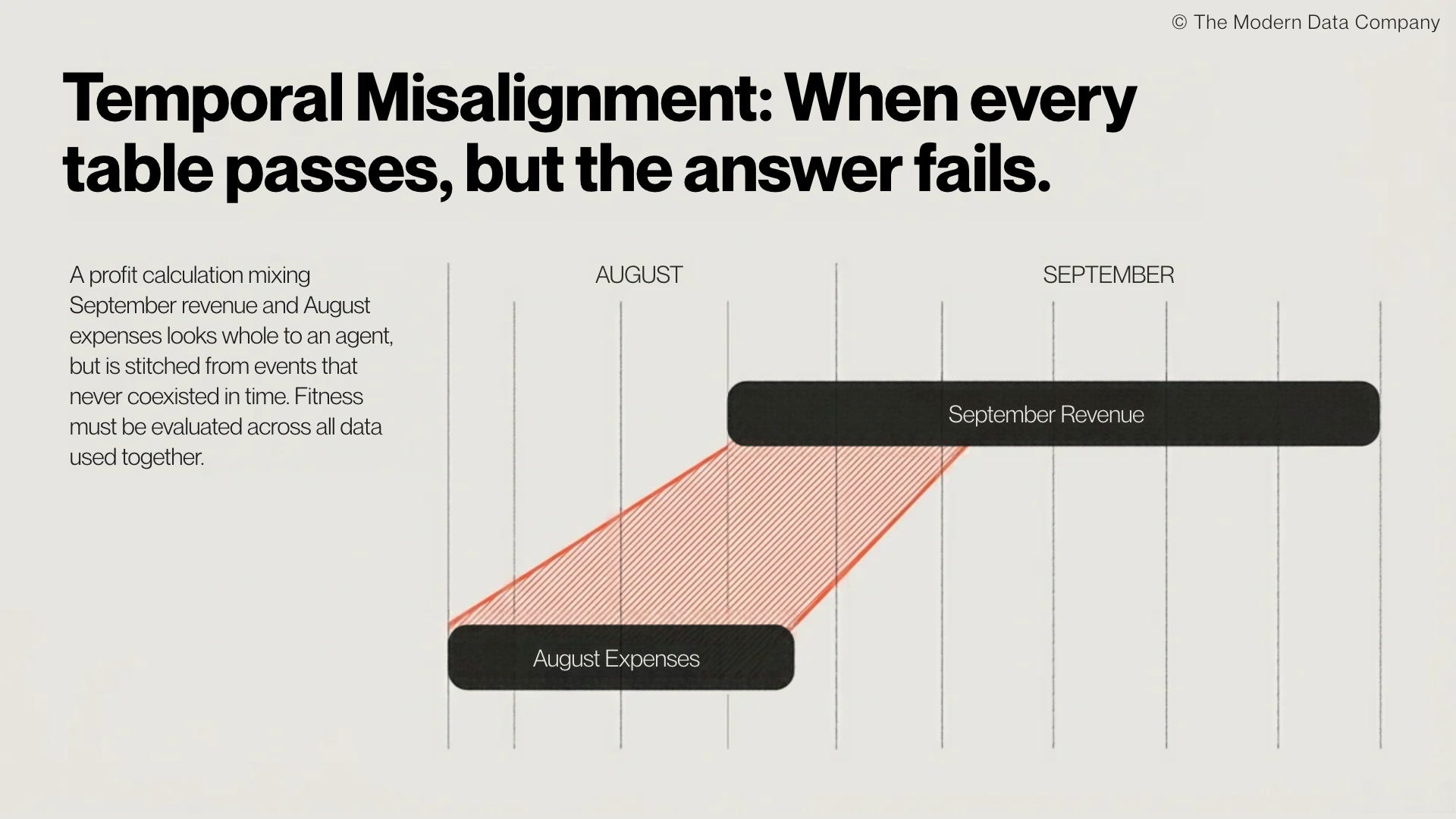
Yes. Revenue may be loaded for September while expenses have not landed, so each table passes its own checks while a profit figure mixes two different periods. Fitness has to be checked across all the data a question uses together, not table by table.
Sagar Paul, CRO at The Modern Data Company, calls this temporal misalignment: a dataset that looks whole but is stitched together from events that never coexisted in time. An example is a support chatbot answering from a knowledge base updated hours after the customer asked, and a ticket closed later still.
Why Does Business Meaning Decide Fitness
A column called revenue that matches the word in the question is not the same as matching the meaning in the asker’s head. Revenue can be gross, net, booked, or recognized, with or without refunds, in local currency or converted. Different teams use different definitions, so the right one can depend on who is asking.
When an agent finds three revenue tables with conflicting numbers, it needs the definition, the owner, and the quality status to choose, and without them it picks one silently. Gartner predicts that organizations prioritizing semantics in AI-ready data will lift agentic AI accuracy by up to 80% and cut costs by up to 60% by 2027.
What Else Decides Fitness: Quality, Grain, and Purpose
Quality is more than nulls and duplicates. It includes a row count that suddenly drops, a region missing from a load, values that do not reconcile with the finance system, and a known incident from last month. The Modern Data Report 2026 found that almost 70% of respondents say their data is not clean or trustworthy enough for AI, and 57% struggle to interpret data because the necessary context is missing.
Grain decides what can even be answered based on the granularity of detail the data needs to cover. Monthly data cannot answer a weekly question, and online-only sales cannot answer “total revenue.” Purpose then sets the bar: a rough number for an internal discussion and a number going into a board deck need different confidence, so the same data can be fit for one and unfit for the other.
What Does a Context Layer Need to Describe Fitness
Gartner found that organizations lack the practice and metadata to assess whether their data is ready for AI, and that 63% either do not have or are unsure they have the right data management practices for it.
That is the gap in the table above: a context layer that describes data but not fitness. To close it, the context layer also needs:
- the expected cadence and arrival time of each pipeline, and whether the latest period is complete;
- quality signals and known incidents, kept current;
- business definitions with owners, and which audience uses which;
- which source is authoritative for which metric;
- how datasets align with each other in time and grain;
- what the data is not meant to be used for.
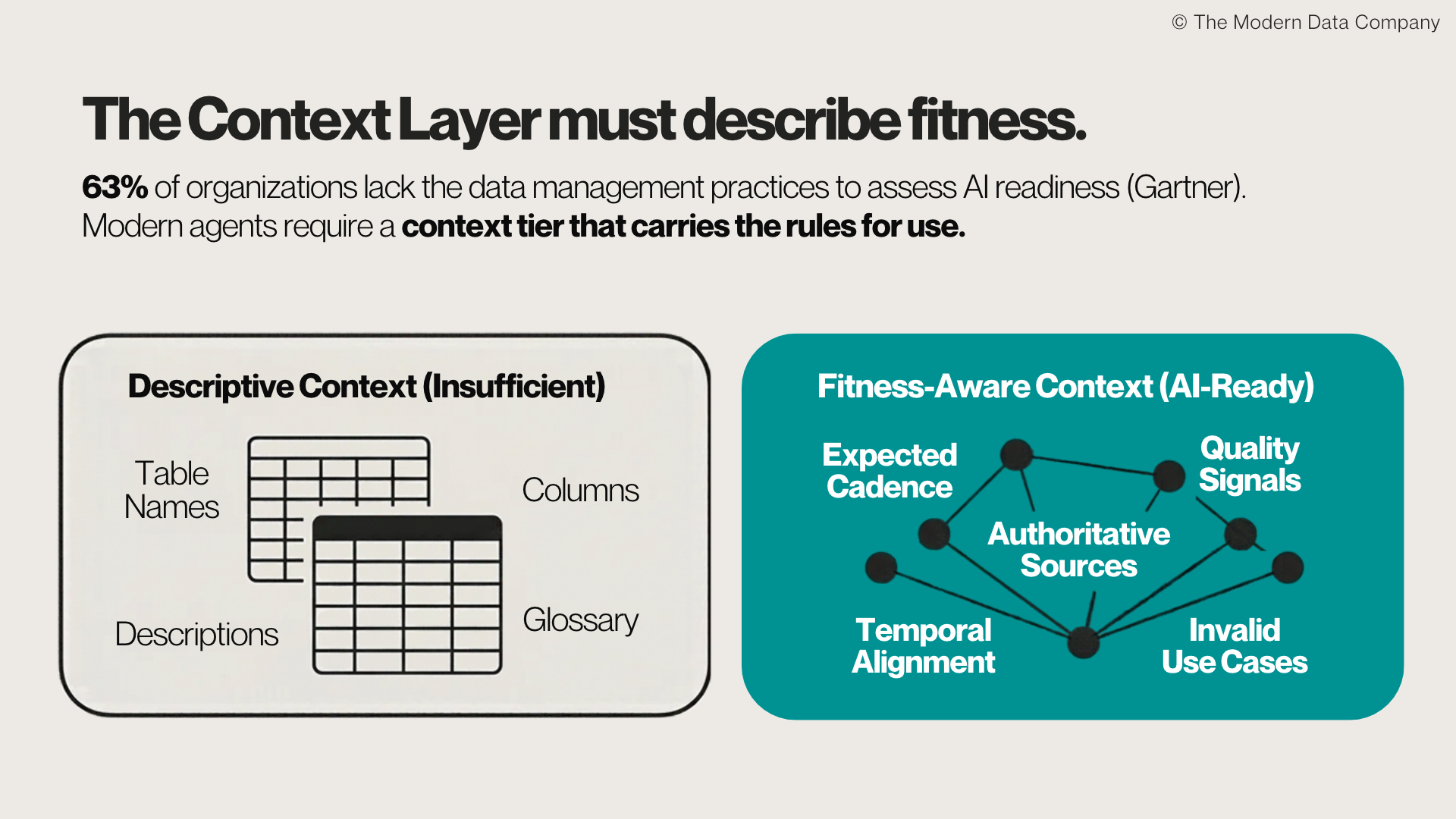
In short, the context layer has to move from describing data to describing fitness. Teams can already define SLAs for quality, freshness, and delivery and validate them continuously, which turns some of those items into checks an agent can read instead of facts an analyst remembers.
How Should an AI Agent Behave Like an Analyst?
When an analyst hears “what’s our revenue?”, they quietly work through a series of questions. Which definition, which period, and has the pipeline for it run? Which source is trusted, does the grain match, are other data such as costs or FX rates aligned, and what will the number be used for? An analyst answers most of these from experience, and an agent has to answer them explicitly, or it skips them.
Even with a rich context layer, the agent must:
- break the question into its hidden sub-questions;
- check fitness before answering, not after;
- ask back only when ambiguity would change the answer;
- state its assumptions and data limits with every answer;
- say “I can’t answer this reliably yet” when that is the truth.
In a well-built agent harness, the context service resolves these before the agent acts, returning the approved metric definition, the time zone, the authoritative data products, and their current quality status. The agent then checks fitness against evidence instead of guessing.
How DataOS Enables Data Fitness
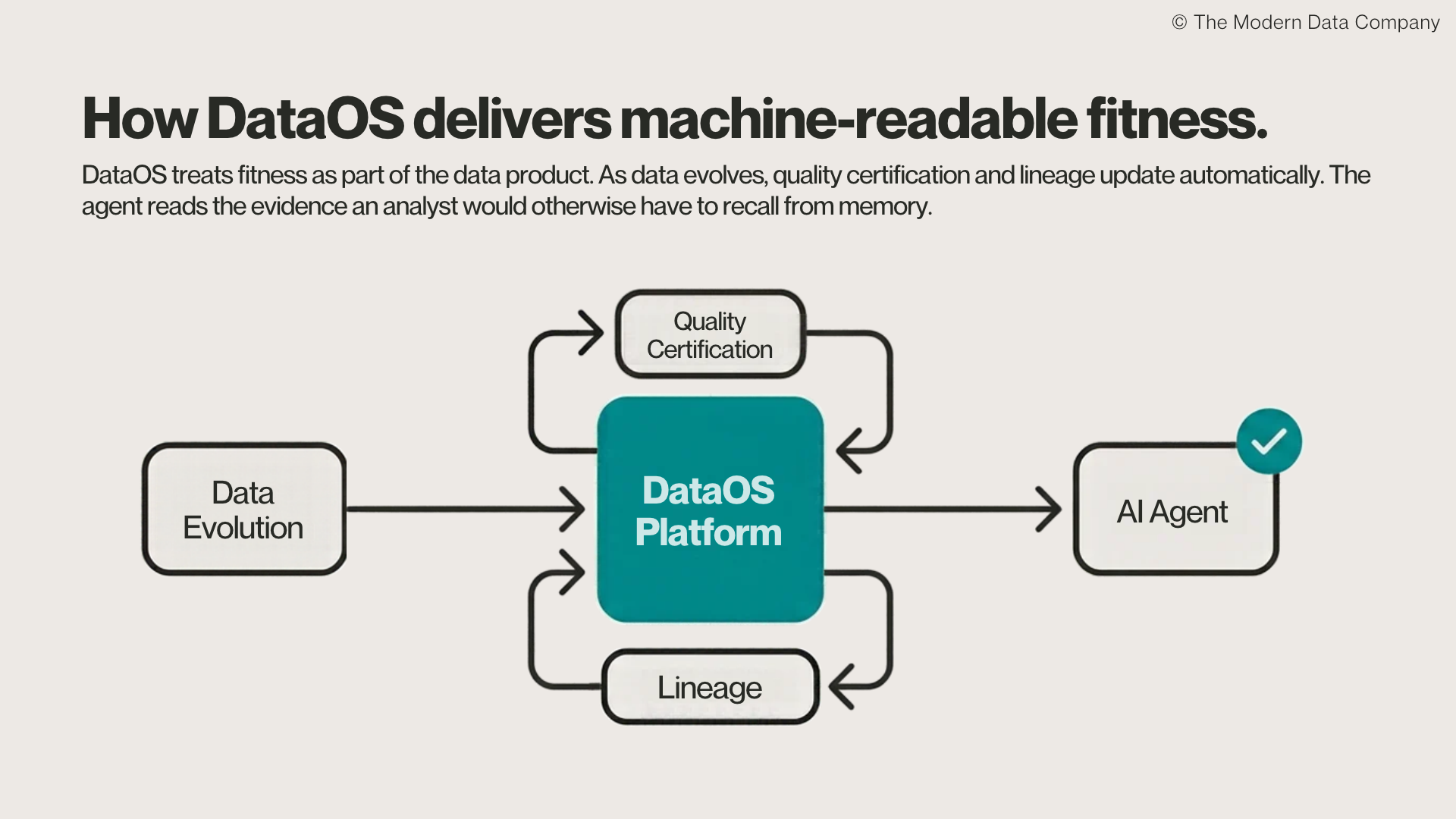
DataOS treats fitness as part of the data product rather than a note beside it. Every data product can carry its metric definition, source, ownership, lineage, freshness, and quality status alongside the data, so the agent reads the evidence an analyst would otherwise recall from memory.
The mechanism is Vulcan, the DataOS framework in which a data product is built. In Vulcan, the transform, the semantic model, the metrics, and the quality contract are authored together and deployed as one governed object.
The semantic model and metrics fix what a measure means, assertions block bad data, and data quality checks watch it over time. The result is a product that declares what a measure is, how fresh it must be, and who can see which rows.
Quality certification and lineage update automatically as a data product evolves, so an agent can tell how current and trustworthy a field is before it relies on it. That covers the freshness, quality, and meaning rows of the table above.
DataOS does not decide what a question is for or what confidence a board deck needs. Those calls stay with the people who own the metric, because purpose and confidence thresholds still require human judgment. What Vulcan and the data product can do is make the evidence of fitness readable by the agent.
How to Test Whether Your Agent Can Tell if the Data is Right
Take your three most-asked questions and write down the hidden sub-questions an analyst would ask for each. Then check which ones your context layer and agent can answer from recorded evidence today, and which depend on someone remembering.
Every one that depends on memory is a place your agent will answer confidently and wrongly.
An analyst’s judgment comes from context that was never written down, and an agent can only be as careful as the context it is given.
Fitness depends on the data, the question, and the purpose together, and until the context layer captures all three, no agent can know when its data isn’t fit for the task.


Continue reading

What Money20/20 Revealed About the Future of Credit Unions and AI

Data Ontology Explained: What It Is and Why AI Needs It
DIR Discover 2026: 3 Public Sector Data Governance Lessons