Supply Chain Turn supply chain data into decisions you can act on
DataOS connects to the systems you already have and unifies that data for BI and AI, so the answers are always current and ready to act on.

Proven impact with DataOS
Supply chain organizations deploying DataOS see measurable gains in visibility, speed, and working capital.


Why supply chain data breaks down
Supply chain teams have the data to answer their hardest questions, but it arrives too late and in too many forms to be useful.
When supply chain data stays fragmented:


How DataOS solves it
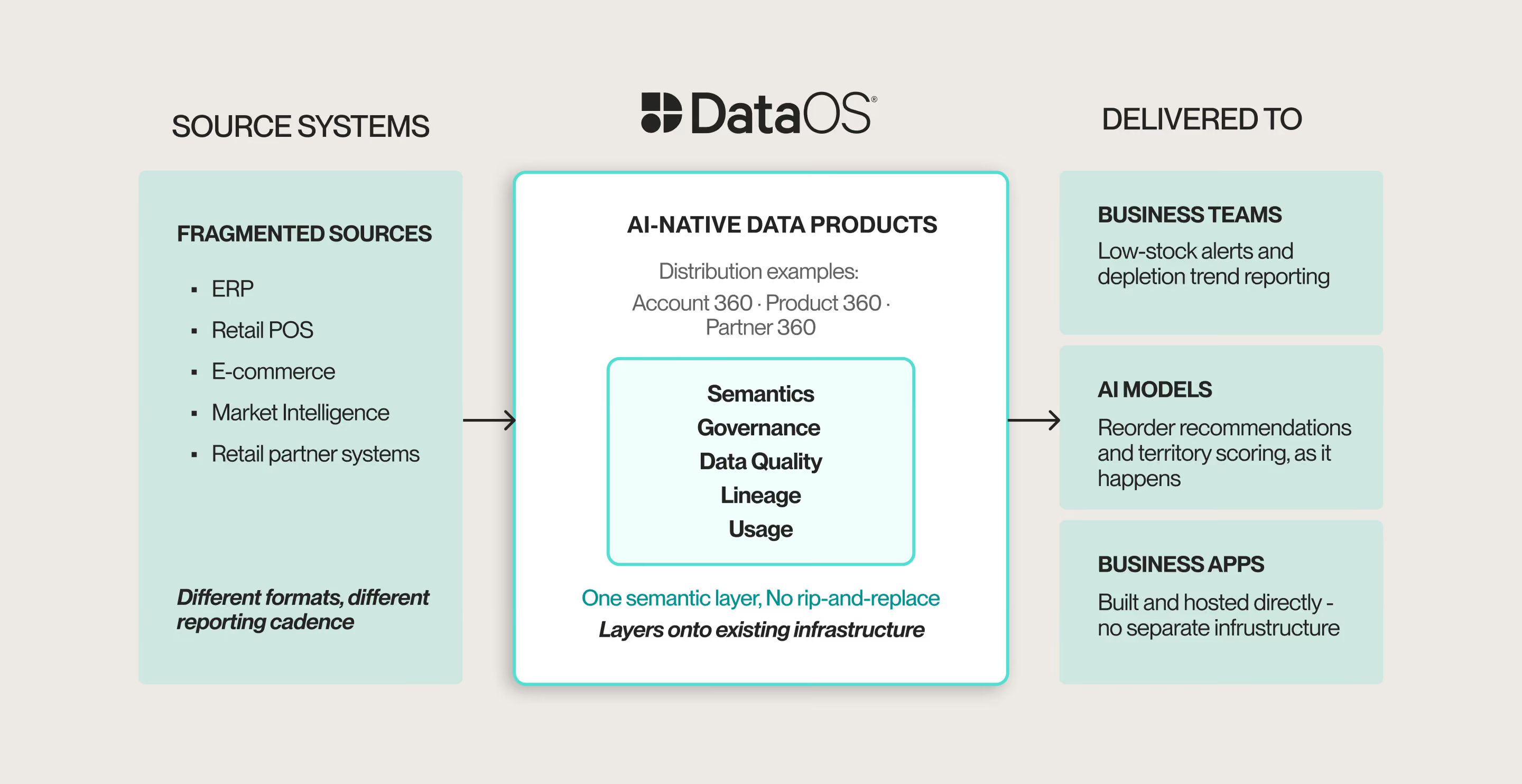
One governed data layer. Every planner, every buyer, every analyst and every agent works from the same definitions.
Who this solution is for
DataOS for Supply Chain is built for organizations whose supply chain questions cross more systems than any one team owns.
Manufacturers with complex supplier networks
Discrete, process and engineer-to-order manufacturers running long-lead, often single-source parts, where one slipped delivery slips an entire build.
Retail, CPG and distribution supply chains
Teams balancing inventory accuracy, fulfillment and replenishment across stores, distribution centres and channels that each report differently.
Healthcare and life sciences supply chains
Provider and manufacturer supply chains where procurement, clinical and financial systems have to agree, and traceability is not optional.
Logistics and fulfillment operations
Third-party logistics providers and internal networks where warehouse, transport and customer systems hold different versions of the same shipment.
Ingest ERP, planning, WMS, TMS, supplier portal and quality data into one governed model, regardless of format, system or reporting schedule.
Supplier 360, Inventory 360 and Order 360, each with quality checks, declared grain, access rules and lineage settled inside the product, and an owner.
Continuous monitoring flags orders at risk, suppliers trending late, inventory drifting from system record, and shipments that will miss commitment.
Ask in words, in your own language. Every answer carries the query that produced it, the sources it used and the definition version it ran against.
Access policies and compliance are enforced automatically at the data product level, and every agent action is logged against a named approver.
Why supply chain leaders choose DataOS


Stop waiting for multi-year platform overhauls to deliver value. Experience it in a single day.
Frequently Asked
Questions
DataOS is a data activation layer that unifies planning, supplier, inventory, order and logistics data from your existing systems into governed data products, then activates them for BI and AI so supply chain teams get answers in seconds instead of days.
No. DataOS connects to the systems you already run rather than replacing them. There is no rip-and-replace and no migration required.
DataOS ingests data regardless of source format or cadence and normalizes it into governed, consistent data products, so every team works from the same definitions no matter which system or partner the data came from. Teams can ask in their own language.
First use cases typically go live in 4 to 6 weeks. One supplier visibility application was prototyped and demonstrated within days on an existing data model, with no new infrastructure required.
The model never queries your raw tables. It reads a governed model of your supply chain, generates a query, and DataOS returns the result deterministically. Every answer carries the query, the sources and the definition version behind it, so a number that looks wrong can be traced and corrected at the definition.
Yes. The same governed context that answers a question lets an agent act on it, such as routing orders to reach a rebate tier or flagging a supplier likely to miss delivery. High-impact actions wait for a named approver, and every action and outcome is logged.
Yes. DataOS runs in production across supplier, inventory and device estates at global scale, including a governed context spanning more than 150 million devices and a supplier rebate solution covering 695 agreements across 385 suppliers and 28 ERP systems.