

The fastest way to make AI agents useful is to describe less of your business, not more.
I started my career in 1999, and people back then were saying that everything would run on websites. There was a huge website rush, and every company wanted the same thing: put everything online.
Many of those sites took months, cost a lot, and helped almost no one. The sites that worked did one job well. Book a ticket. Track a parcel. Pay a bill. The rest came later, one page at a time, because someone needed it.
I see the same rush today with context for AI agents.
Enterprises have understood that agents fail without business context. So they set out to describe the whole business first: an enterprise ontology, a complete glossary, every entity and relationship mapped before a single agent goes live. Many go further and try to fix data quality across the entire enterprise first.
The ocean has no user
A boil-the-ocean ontology project has a flaw that no amount of effort fixes. It has no user. Nobody is waiting on it to make a decision on Tuesday morning, so nobody can tell you whether it is any good.
Without a user, the shape of the ontology comes from the people building it, and from their view and priorities of how the business ought to be described.
I tell every team I work with: when you build for others, your opinion is your enemy. A catalogue of the whole business, in the order you decide, is that opinion at enterprise scale.
There is a second problem. Context does not sit still.
Definitions shift, policies change, teams reorganize, the business grows, acquisitions happen. The bigger the catalogue, the more of it is already stale the moment you are done.
Work right to left
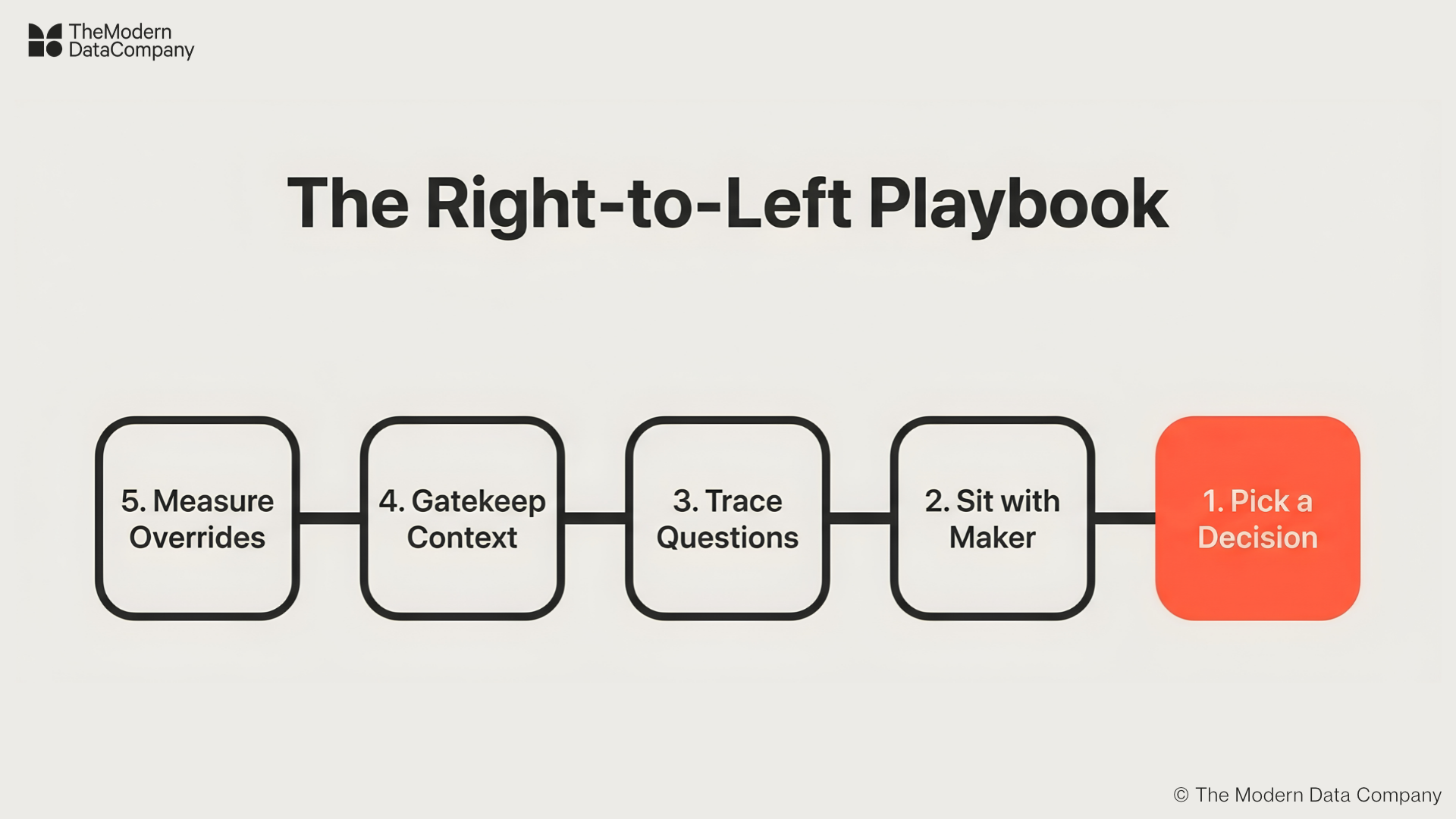
At Modern we think right to left. At Modern we think right to left. Picture a flow with the data sources on the left and the business outcome on the right. Most teams start on the left and push data forward, hoping it lands somewhere useful.
We start on the right, with the business consumer and the outcome they need, then walk back, building the context and preparing the data for exactly what that outcome requires. Applied to context, that gives one simple rule.
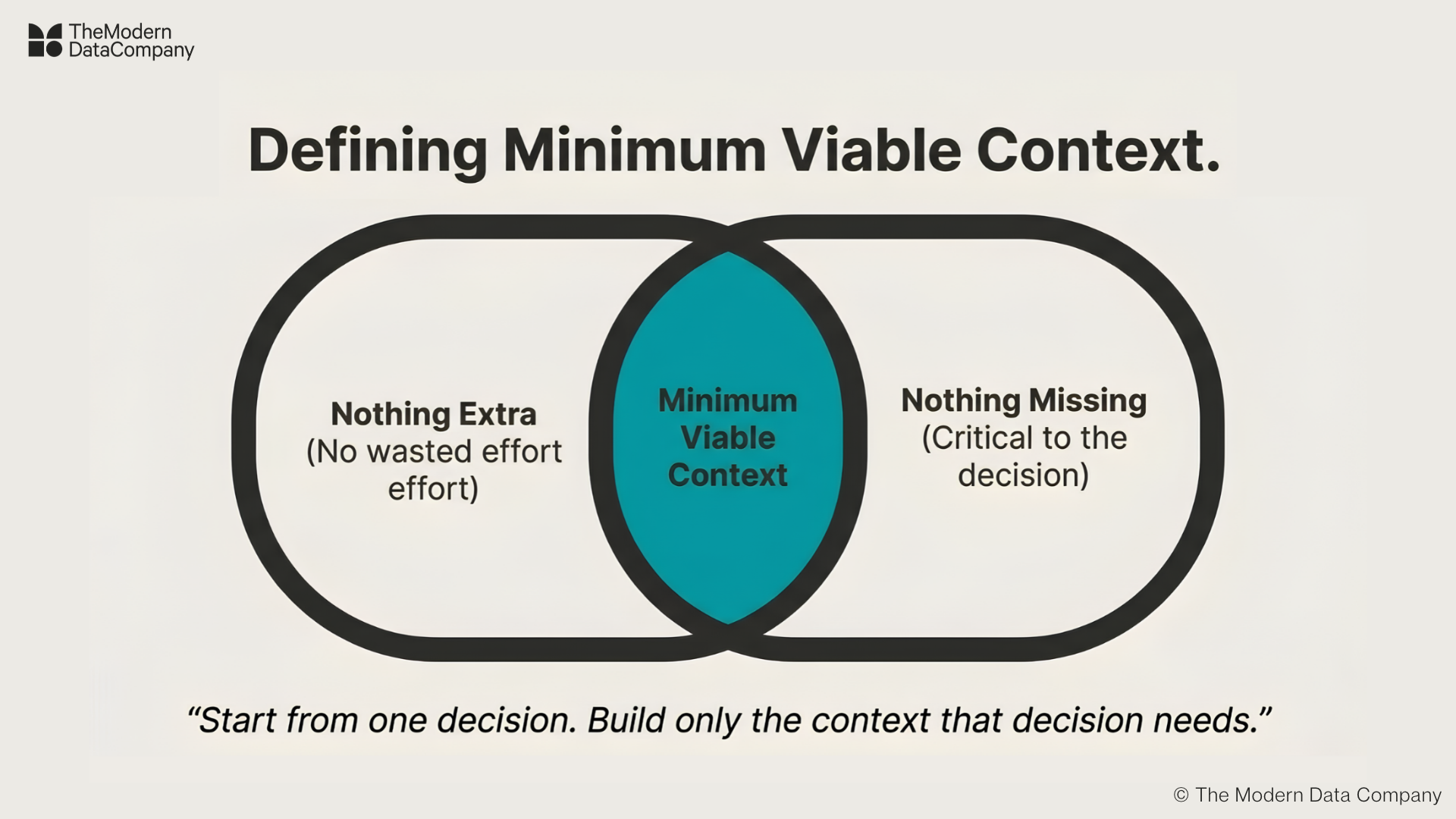
That is minimum viable context. Minimum does not imply doing less. It means nothing extra and nothing critical missing.
As part of my earlier startup, we built a messaging app for children and described its parental controls as "minimum yet critical." The same phrase fit here.
Five steps from one decision to its context
1. Pick a decision instead of a domain
"Supply chain" is a domain. "Which of my supplier’s suppliers is delayed, and can I detect it early to ask my supplier to react rather than leave it up to them?" is a decision. Choose one that recurs, has a designated owner, costs real money when it goes wrong, and is one you want an agent to support or take.
If you cannot name the person who owns the decision, you have not found it yet.
2. Sit with the person who makes the decision
Ask the VP of Supply Chain, or the planner who does it at 7 a.m., what they check before deciding. Write down their questions in their words.
- Which customer is this?
- What did we promise them?
- What does late mean in this contract?
- What did the last expedite cost us?
Those questions are the specification. The schema is not.
3. Trace only what the questions touch
Each question points to a few terms, a few rules, and a few relationships. "What did we promise" touches the contract, the service level, and the definition of a delivery date.
That last one matters more than it looks. My colleague Sagar Paul has described organizations where an agent could meet fourteen different meanings of "order delivery date." A human planner knows which one applies. The agent sees fourteen dates.
Minimum viable context does not try to settle all fourteen across the company. It pins down the one this decision uses, writes down why, and names who owns that meaning.
4. Apply the "which question?" test
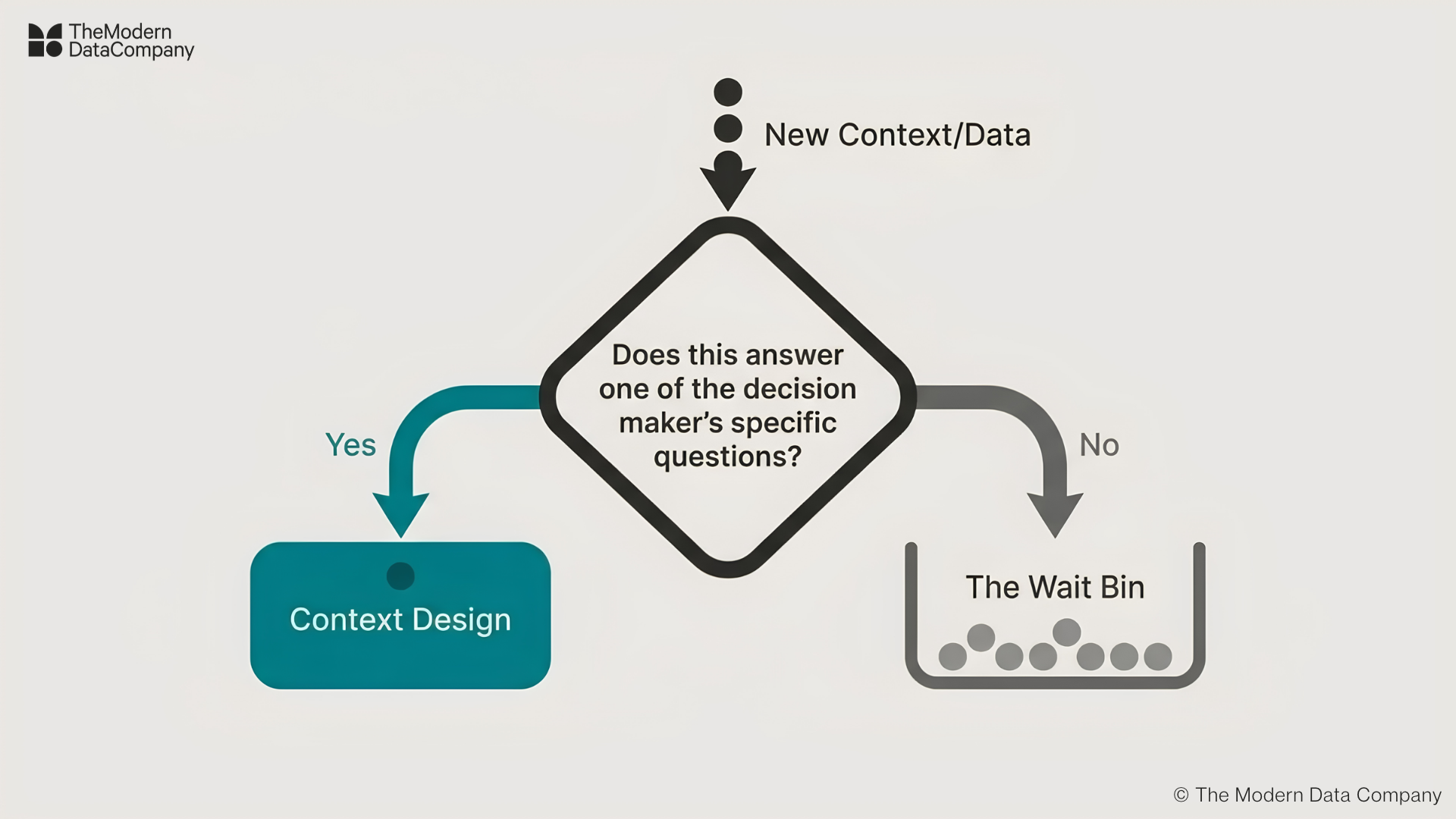
Before anything enters the context design, ask: which of the decision maker's questions does this answer? If the answer is none, it waits. It is not wrong. It is just not needed yet.
This one test keeps scope honest better than any governance committee. It is also the easiest way I know to explain to a business sponsor why something is in, or out.
5. Measure the decision in place of the catalogue
Coverage, meaning how many terms are defined or how many entities are mapped, measures effort. It says nothing about value. Measure the decision instead:
- How long does it take now, from question to action?
- How often does a human override the agent, and why?
- How often is the decision reversed later?
- What did better decisions save or earn this quarter?
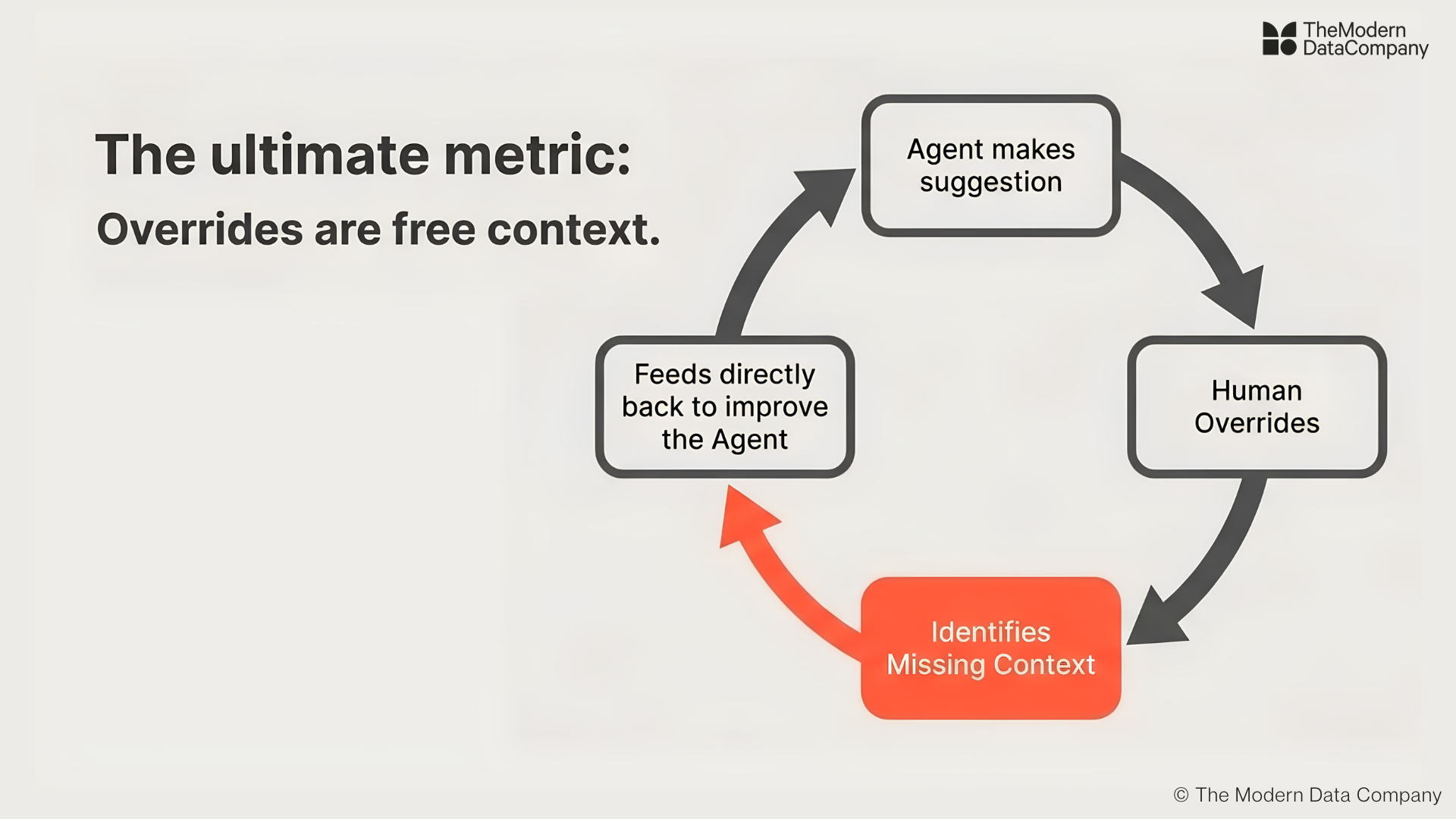
Overrides are the most useful signal. Every override is a piece of context the agent was missing, handed to you for free by the person who knows the business best. Feed it back.
How context grows from here
The fear is that this leaves you with a hundred small, disconnected islands of context. In practice, the opposite happens. Your second decision, say whether to switch suppliers for a delayed component, reuses the customer, the contract, and the delivery date definition you already built. You add only what is new.
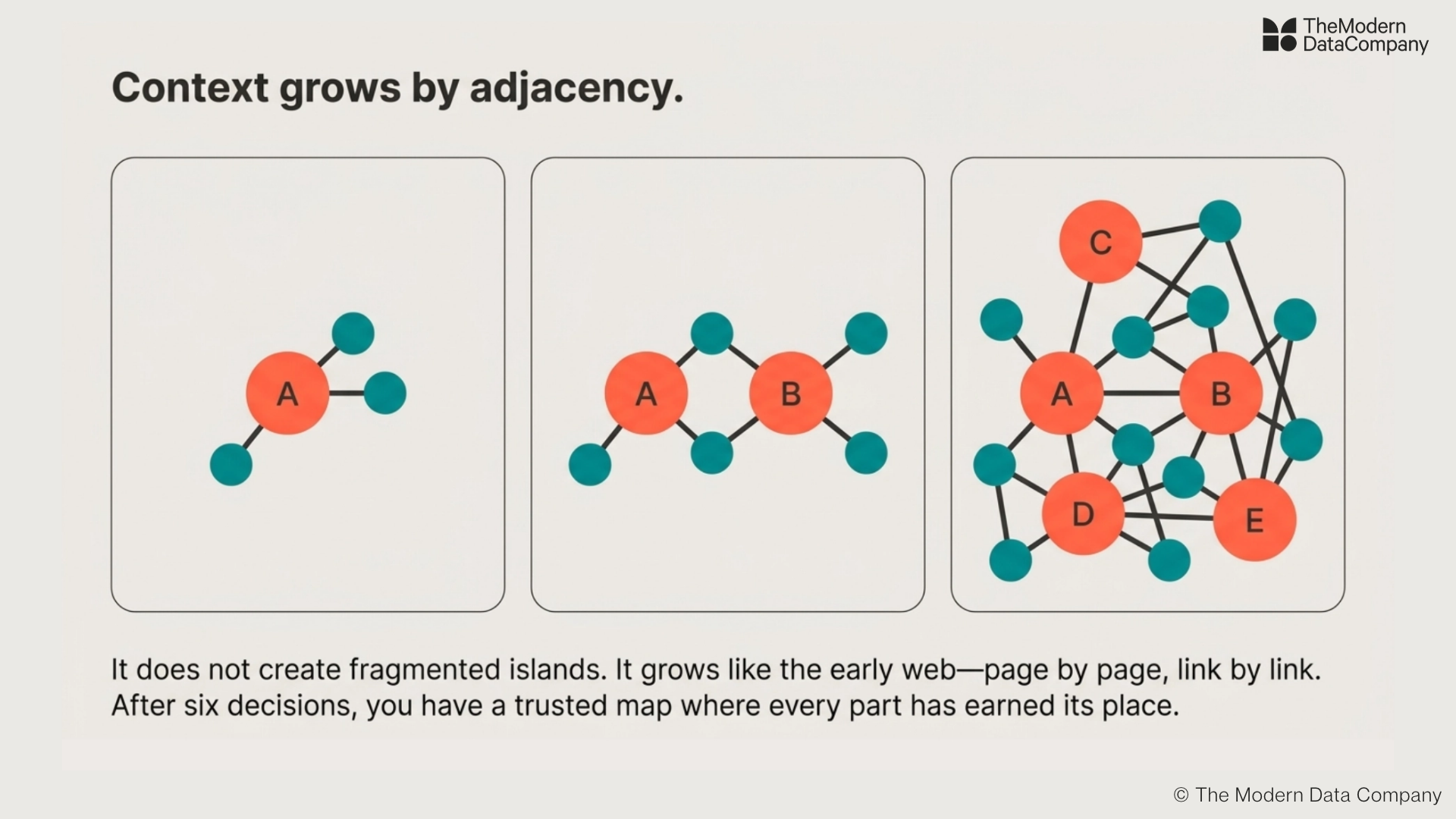
Context grows by adjacency, the way the web did: page by page, each link there because someone needed it. After five or six decisions, you have a real, used, and trusted map of the business. It will be smaller than the ontology you once planned, and every part of it will have earned its place.
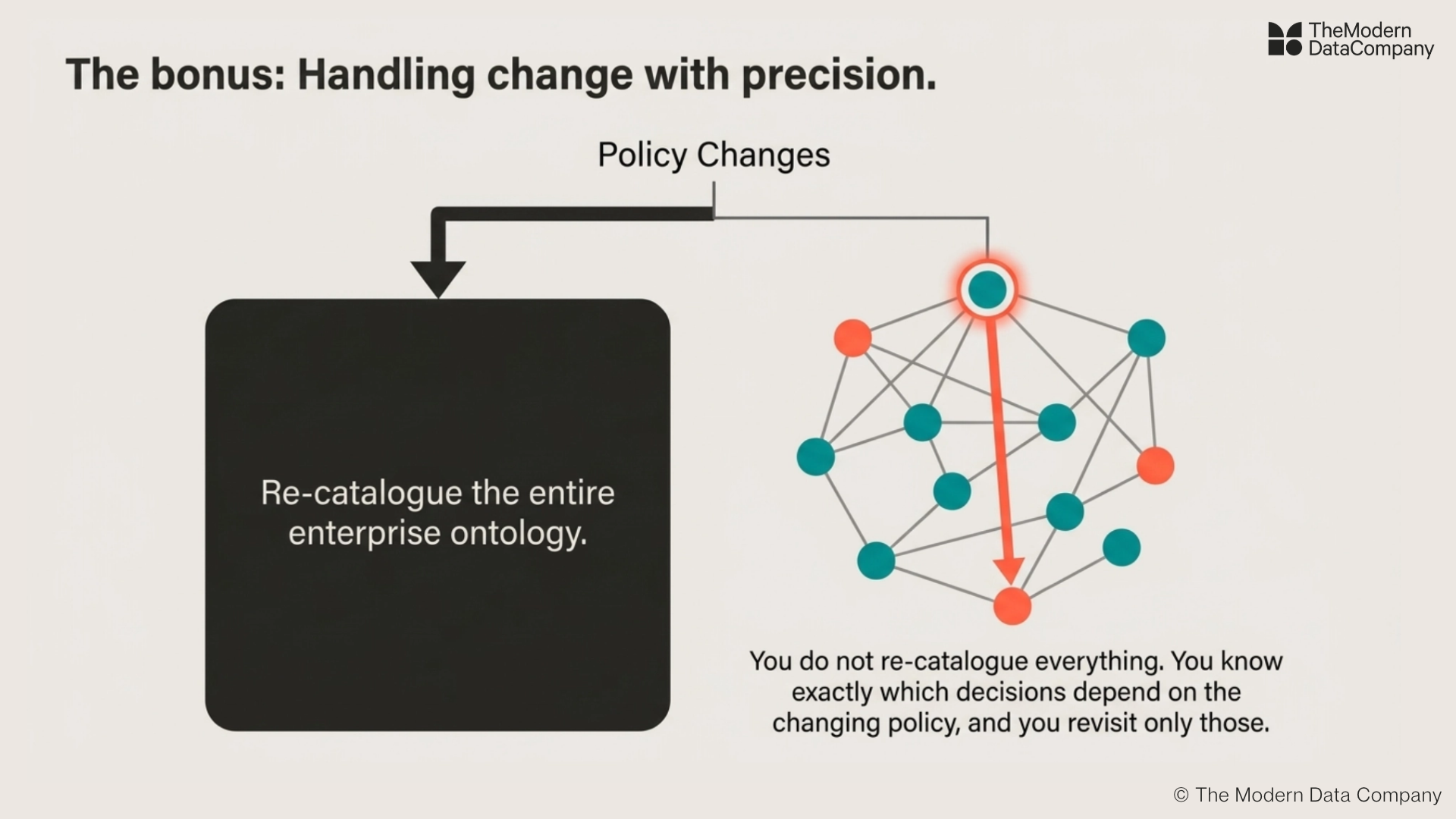
There is a bonus when things change. Because every piece of context is tied to a decision and an owner, you know exactly what to recheck when a policy moves. You do not re-catalogue everything. You revisit the decisions that depend on it.
Doing one small thing well
Zen and the Art of Motorcycle Maintenance taught me to appreciate things as they are, understand how they work, and care enough to make them a little better. Step by step. I have always read that as practical advice. Make one thing work properly. Then the next.
Agents will become ordinary. Like websites, they will move from novelty to plumbing nobody thinks about. Who did it first will stop mattering, and who did it right will take a few leaps ahead.
So here is my question for anyone starting a context program this quarter: which decision is it for?