

Introduction
Data isn’t valuable when it’s stored. It’s valuable when it’s used. Organizations are finally recognizing this and treating data as a product. Data products turn data from a technical resource into governed, reusable, and AI-ready business assets that power insights, automation, and intelligent systems. This article explores how data products reshape data strategy, governance, and activation across the enterprise.
What Is a Data Product?
A data product is a reusable, discoverable, and governed entity that combines data, context, logic, and infrastructure to make information instantly ready for activation across BI tools, applications, and AI agents. A data product is not just clean data. It's a business capability with ownership, accountability, and measurable ROI. When built as AI and business-ready, it further activates intelligence and enhances explainability across use cases.
A data product exists to make data reliably usable by people and systems beyond those that build it. Without data products, every team that needs the same data must independently locate it, interpret it, verify its quality, and figure out what the fields mean. The data product does that work once, packages the result, and makes it available for repeated consumption.
What makes something a data product vs. a data asset
A data asset is any data that exists and could theoretically be used. A raw event log is a data asset. A CSV someone exported from Salesforce last quarter is a data asset.
Neither has an owner who will fix it if it breaks, a quality check that runs automatically, or documentation that tells a new analyst what the columns mean.
A data product has all of those things: an owner, a quality check and documentation. It is built to be consumed repeatedly, by multiple teams, with confidence that what they receive is accurate, current, and exactly what was advertised.
One distinction that causes particular confusion is the difference between a data pipeline and a data product. A pipeline can produce or feed a data product, but moving and transforming data does not make the output a product. For a closer look at that distinction, read Your Data Pipeline Is Not a Data Product.
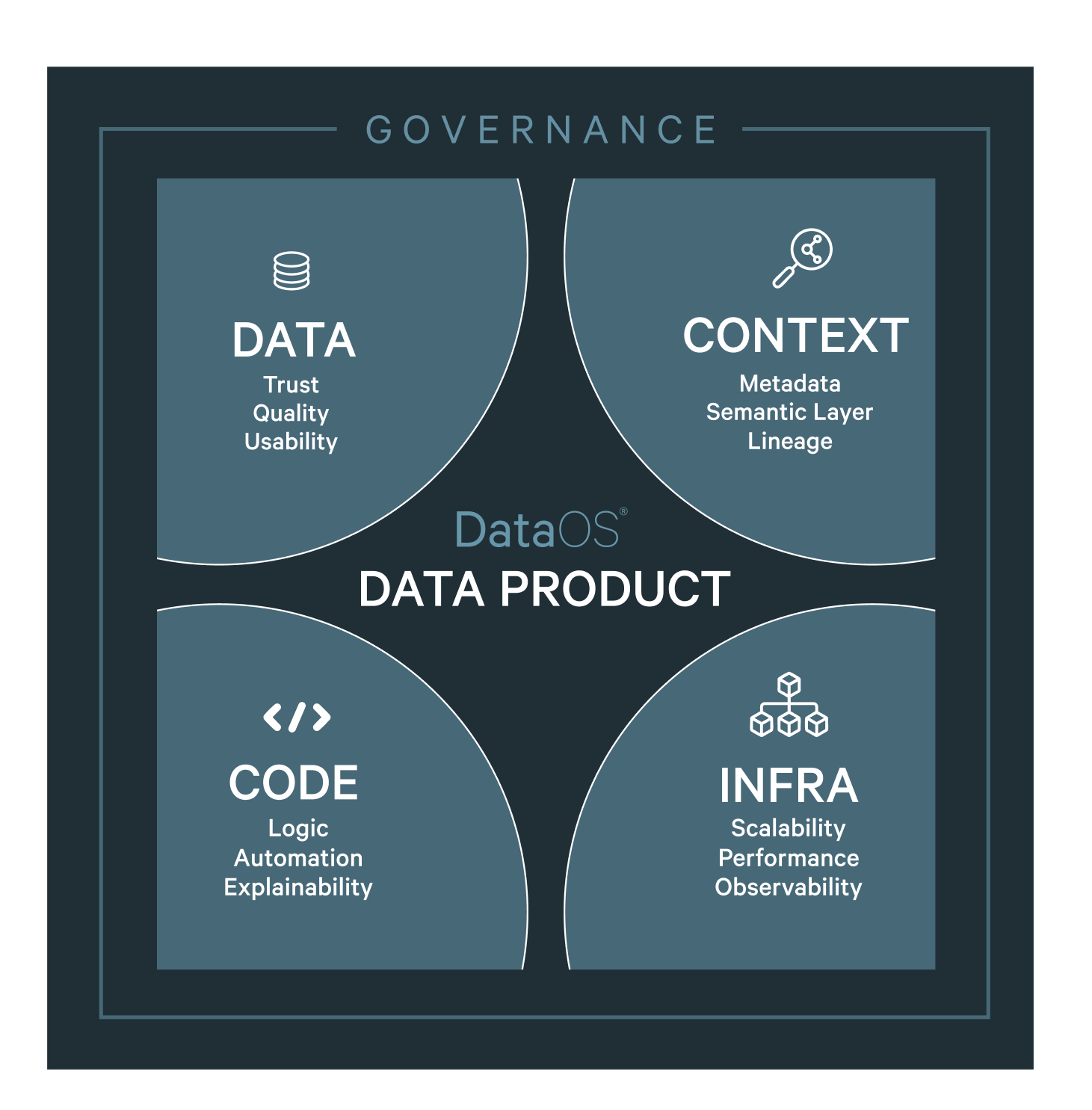
A complete data product has five foundational components:
- Data: The information itself, customer records, transactions, events, and measurements that feeds the data product. This can include raw inputs from source systems, as well as transformed datasets, all validated for accuracy and structured for consistent use. High-quality data ensures accuracy, reliability, and interoperability, driving confident decisions.
- Context: Context gives data its meaning. Without it, data is just numbers. With it, data becomes intelligence. It connects metadata, semantics, and lineage to show where the data came from and how it’s used. This shared understanding enables technical and business users to interpret data consistently, building trust and alignment across the organization.
- Code: Code is what makes the data product work. It handles the logic for collecting, processing, and delivering data. Built on software development principles like version control and testing, this approach means data products can evolve like applications, not break like pipelines, and scale as business needs change.
- Infrastructure: Infrastructure provides an operational backbone that ensures scalability, performance, and observability. It declaratively manages compute and storage, embedding enforcement to ensure data remains compliant and cost-efficient through built-in visibility into usage.
- Governance: Governance defines the policies, standards, and compliance frameworks that ensure every data product operates securely and in alignment with organizational regulatory requirements. It establishes accountability and trust, ensuring that compliance and auditability are embedded by design. In the AI era, governance isn't a checkbox. It's the foundation of trust.
Key Characteristics of Data Products
Data products are built to deliver consistent high value through a structured approach to managing and using data. They stand apart from other data entities because they are:
- Discoverable: Simple to locate and retrieve without extensive searching or manual effort.
- Accessible: Easy for authorized users to use, ensuring data is available when needed.
- Addressable: Precisely referenced and managed, improving efficiency and traceability.
- Trustworthy: Reliable and accurate, providing dependable information for confident decision-making.
- Secure: Protected by embedded controls that prevent unauthorized access and preserve data integrity.
- Interoperable: Work seamlessly across tools and systems, enabling smooth integration and reuse.
- Self-Contained: Deliver insights and utility on their own, without needing to be combined with other sources.
Together, these qualities make data products the foundation for operationalizing data, thereby creating a governed and transparent ecosystem between data producers and consumers that turns insights into action.
Types of Data Products
The three primary types differ by how close they sit to the original data source and how much transformation has been applied.
Source-aligned data products
Source-aligned data products expose operational data from a single system: an ERP, a CRM, an IoT sensor feed, a transaction database. They do minimal transformation.
The goal is to make the raw operational record available to downstream consumers with governance and documentation attached, without embedding business logic that should belong to the consumer.
A source-aligned data product from a CRM might expose account records, contact records, and opportunity records as governed, documented assets. It does not join them or calculate win rates. Those belong further downstream.
Aggregate data products
Aggregate data products join data across multiple source domains to answer cross-functional questions. A customer 360 view that combines CRM data, transaction history, support tickets, and product usage is an aggregate data product.
These carry more embedded logic and require coordination across domain teams to agree on join keys, shared definitions, and semantic alignment: the kind of cross-domain work covered in Modern's data product case studies.
Consumer-aligned data products
Consumer-aligned data products are purpose-built for a specific team or use case. A revenue dashboard data product, an ML feature store for a churn prediction model, a supplier scorecard for the procurement team: these are designed around one consumer's questions and optimized for how that consumer needs to access the data.
Consumer-aligned products often sit at the end of a chain: source-aligned products feed aggregate products, which feed consumer-aligned products. This layering lets each level serve multiple consumers downstream without duplicating transformation logic.
Decision-support data products
A fourth category is emerging specifically around AI and analytics workflows: decision-support data products that package ML features, KPI definitions, and scored outputs as governed assets. A customer churn score, a supplier risk index, or a demand forecast can each be published as a data product with its own SLA, lineage, and quality contract, making the model output as governable as the input data.
The type of data product determines how much transformation is embedded in it, and the governance requirements are the same regardless of type. For a deeper, worked-through framework on how these layers connect (including where teams typically go wrong by building source catalogs with no consumers, or consumer products that skip the source-aligned layer entirely) see How to Organize Your Data Product Ecosystem.
Is a CRM a data product?
A CRM system is not itself a data product. But data extracted from a CRM and packaged with governance, semantic documentation, quality SLAs, and a stable access interface qualifies as one.
The distinction matters: a CRM system is an operational application. A data product built from CRM data is governed infrastructure that other teams can consume without accessing the CRM directly or rebuilding the extraction themselves.
Benefits of Data Products
The shift from data-as-infrastructure to data-as-product changes everything. It changes how teams work, how decisions are made, how quickly companies move, and how much value data generates.
Data products deliver both strategic and operational value by making data behave like a business asset with measurable returns:
- Explainable Decisions Faster: Integrate business logic and context to deliver reliable, actionable insights that inspire confident, data-driven choices. Not just answers but answers you can explain.
- Increase Efficiency: Standardize, streamline, and automate data processes to minimize manual work and accelerate productivity. Teams stop wasting time hunting for data and start using it.
- Scale and Reuse Easily: Adapt across teams and evolving business needs without the need for rebuilding or re-engineering. Build once, use everywhere.
- Ensure Data Quality: Maintain accuracy, completeness, and trust through built-in validation and quality checks.
- Empower Users: Enable self-service access so business teams can explore and analyze data without dependency on specialists.
- Align with Business Goals: Design every data product around clear objectives and measurable outcomes.
- Integrate Seamlessly: Connect effortlessly with tools and systems across your ecosystem for consistent, trusted use.
Persona-Based Benefits
Data products create tangible value across roles, empowering every team to move faster and make better decisions.
- CIOs and Data Leaders: Gain visibility into ROI and governance while accelerating innovation through standardized, trusted data foundations.
- Line of Business Leaders: Get instant access to accurate, trustworthy data that powers faster decisions, reduces dependence on IT, and unlocks new revenue opportunities.
- Data Scientists and Analysts: Access consistent, AI-ready, and business-ready data that minimizes preparation time, enables faster experimentation, and model deployment.
- Data Engineers and Developers: Build once and deploy everywhere with reusable APIs, schemas, and governed components that speed up delivery and reduce maintenance overhead.
How to Measure Data Product ROI
Common measures include adoption (the number of consumers and repeat queries against the product), trust signals (support tickets and reconciliation time avoided), time saved versus each team rebuilding the same pipeline independently, and the business outcomes tied to the decisions the product supports, such as faster reporting cycles or fewer conflicting numbers in board reporting.
The Data Product Mindset: Designing for Trust, Context and Activation
Treating data as a product isn't just a technical shift. It's a fundamental rethinking of what data is and who it serves and represents, both cultural and technical evolution.
For decades, organizations treated data as technical infrastructure owned by IT, managed in silos, and delivered on demand. Data products flip that model. They treat data like software: with owners, users, SLAs, and lifecycle management. They treat data like a business asset, with a focus on ROI, governance, and accountability.
The data product mindset draws on product management and software engineering principles, emphasizing purpose, usability, and accountability over just delivery. Projects typically optimize deadlines, but products optimize ongoing outcomes, which are measured by adoption, quality, and business impact.
It starts with understanding why the data exists and who it serves, then defines quality, usability, and success metrics upfront. Teams iterate and monitor over time, treating data products as living entities with owners, service level objectives (SLOs), and feedback loops. This mindset introduces ownership, governance, and continuous improvement, ensuring that data becomes a durable, evolving business entity rather than a one-time deliverable.
In short, this shift enables organizations to transition from short-term execution to continuous value creation, aligning technical efforts with business goals and user needs to drive faster and more effective decision-making.
Choosing the Right Candidates for Data Products
Data products play a central role in modern architectures, such as data mesh and data fabric, helping organizations manage complexity at scale.
In a data mesh, data products serve as foundational units owned, governed, and maintained by decentralized teams. Each team builds products tailored to its domain, ensuring relevance, quality, and autonomy while promoting scalability and agility across the enterprise.
In a data fabric, data products unify data across sources and platforms. They create a cohesive, governed layer that simplifies integration, access, and reuse—enabling seamless information flow across the organization. Together, these architectures make data more flexible, discoverable, and actionable.
Building a data product should be an intentional decision informed by business needs, data maturity, and long-term value.
When Data Products Makes Business Sense
- Recurring Analytical Needs: When teams repeatedly perform similar analyses or generate recurring reports, a data product can automate and standardize the process. For example, a marketing performance dashboard can continuously aggregate and visualize campaign metrics, saving time and ensuring consistency.
- Cross-Departmental Integration: When multiple teams need a shared, unified view of data. A Customer 360 data product, for instance, can combine sales, support, and marketing information to provide a holistic view of customer interactions and behaviors.
- Strategic Decision-Making: When data supports long-term business strategy. A predictive sales forecasting product can inform budgeting, inventory planning, and resource allocation across departments.
- Complex Data Needs: When the same complex transformations or enrichments are required repeatedly. For example, a data product that processes and enriches financial transactions for compliance reporting or fraud detection can save time and ensure consistency.
When Data Products Aren’t the Right Fit
- Ad-Hoc Requests: When data requests are one-time or ad-hoc, such as a one-off report for a specific meeting. In these cases, a quick analysis or temporary solution might be more appropriate than investing in a data product.
- Low-Quality Data: If the underlying data is incomplete or unreliable, building a product on top of it can create misleading insights. The focus should first be on improving data quality.
- Short-Term Projects: If the data will only be used briefly or for a single event, the overhead of creating a data product may not be justified.
- Lack of Business Alignment: When the effort doesn’t directly support business alignment or strategic goals or has unclear ownership, it risks becoming shelfware. Every data product should be tied to measurable business outcomes.
By assessing these factors, teams can focus on creating data products that deliver sustained business value while avoiding unnecessary overhead.
Data Products as the Activation Layer for AI
In the AI era, data isn't just powering dashboards and reports. It's training models, feeding agents, and making autonomous decisions. The stakes are higher. The speed is faster. And the gap between "having data" and "having trusted, contextualized, governed data" becomes the gap between AI that works and AI that fails.
Context and governance form the intelligence layer of the data stack, and their role becomes critical in an agentic world.
Context provides the understanding that allows agentic systems to interpret entities, relationships, and constraints. It enables semantic enrichment, explainability, and traceable decision paths, helping agents reason over meaning rather than just data points. Context elevates static information into rich, interconnected intelligence that fuels automation and AI.
Governance ensures that the right data is used securely, ethically, and compliantly. It is embedded before data reaches models or systems, building trust at the source. Governed data products come with access controls, masking, audit trails, and policies by default. In the AI era, this guarantees that models are trained and evaluated only on high-quality, compliant data, thereby closing the gap between governance and activation.
Why agents need more than a table
Traditional data architecture was built for analytics. AI agents, on the other hand, are intent-driven systems that act on behalf of the business. When an analyst queries data, they bring institutional context with them; they know what a cryptic column name means because they were in the room when it was defined. Agents have no such memory. For an agent to act with confidence, that context such as business meaning, quality guarantees, lineage, and governance has to travel with the data itself. That shift, and what it means for how agentic systems should be architected, is explored in Why Agentic AI Needs Data Products.
Why more context isn't automatically better context
The instinctive fix for an AI agent producing wrong answers has been to hand it more context such as tables, more schema, more documentation via retrieval-augmented generation or few-shot prompting. That scales badly on both accuracy and cost because every additional hop to reconstruct meaning at inference time adds tokens, latency, and a new surface for error. In fact, research shows model accuracy drops when relevant information sits buried in the middle of a long context window. The fix is bounded context: a curated, governed, semantically consistent scope of data and domain understanding built only for a specific business problem. For a deeper walkthrough of why unfiltered context makes models more confidently wrong, and what a properly bounded context looks like in practice, read Why AI Gets It Wrong and How Data Products Fix That.
Being context-native by design
A data lakehouse stores tables and serves queries, but it doesn't know what a table means. That knowledge typically lives in documentation, tribal memory, and the heads of analysts who've been around long enough to know why "net revenue" means something different in billing than it does in sales. A context-native data product closes that gap by carrying its meaning, quality signals, lineage, and access rules as intrinsic properties of the product itself. For the full breakdown of what a context-native data product carries that a plain table doesn't, see Context Native: The Data Product Foundation AI Agents Need.
Together, context and governance define the foundation of agentic data ecosystems. They turn raw data into trusted, actionable knowledge, enabling organizations to evolve from simple data management to intelligent, AI-driven decision-making. In this agentic era, data products act as the connective tissue between systems, people, and AI—activating data safely, transparently, and at scale.
This is where platforms like DataOS make a difference. While the principles of data products are universal, operationalizing them at an enterprise scale requires purpose-built infrastructure. DataOS brings this vision to life by making data product creation systematic, not heroic. It enables teams to create discoverable and reusable data products, each embedded with governance and semantics. Access controls, SLAs, quality validation, and usage monitoring are automatically enforced—not bolted on, but built in—ensuring trust, compliance, and metrics consistency without added effort. The result: data products that don't just exist in theory but activate intelligence in production.
Conclusion
Data products are redefining how organizations operationalize data and activate intelligence across the enterprise. They represent the evolution from data-as-infrastructure to data-as-a-business asset—from a cost center to a value driver.
The question isn't whether to adopt data products, it's how fast you can make the shift. Organizations that embrace this transformation will not only strengthen their data foundations but also position themselves to lead in the AI-driven future. Those that don't will find themselves managing pipelines while competitors activate intelligence.
The future of enterprise data isn't more storage or faster queries. It's data that works like a product—governed, trusted, and ready to drive the next generation of business and AI.