Categories


Introduction
Ontology has been part of computer science and knowledge management for decades, but it has spent most of that time on the sidelines of everyday data work. As enterprises put LLMs and AI agents in front of their data, they are finding that access alone is not enough. AI also needs to understand what the data means and how the pieces of the business connect.
In this post, we explain what a data ontology is and how it differs from the way data is usually stored. We walk through the building blocks of an ontology using a retail banking example, look at how ontology makes data easier to use, and explain why it has become a priority for data leaders in 2026. Finally, we show how DataOS turns ontology into something teams can build, connect to governed data, and put to work, starting from the data products they already have.
What is Data Ontology?
An ontology is a structured way of describing a domain: what concepts exist, what characteristics they have, and how they relate to one another. In computer science, an ontology formally defines concepts, properties, and relationships so that the meaning of data is explicit and can be understood not only by people, but also by software, analytics systems, and AI.
A useful way to think about ontology is as a model of how the business understands the world, rather than how data happens to be stored in a particular database. A table might hold a column called cust_id and another called acct_no. An ontology converts these column definitions into the business relationship they represent: A client owning an account. This is business meaning that is not derivable from the raw table and column names.
A data ontology starts as a conceptual model and becomes far more useful once it is connected to real enterprise data. At that point it works as a semantic map between business meaning and the systems where the data lives.
Ontology in the Artificial Intelligence Context
AI systems need more than access to data. An LLM may be able to read a table, but it still needs context to answer questions such as:
- What does "Charge" mean here? Is it a transaction fee, a merchant charge, or a legal charge?
- How is a customer related to this transaction? Did the customer initiate it? Was it authorized using a card they own? Was it later associated with a fraud investigation?
These are not simply data-access questions. They are questions about meaning and relationships.
Ontology represents that context explicitly:
Client → owns → Credit Card → authorizes → Transaction → paid to → Merchant
With that map in place, an AI system no longer has to reconstruct meaning from tables, column names, and joins every time someone asks a question. It can follow defined relationships, resolve ambiguous terms from their surrounding context, and trace a path from a business question to the data that answers it.
This matters most for questions nobody planned for. Traditional applications and dashboards usually run against questions known in advance, so engineers could design the joins, metrics, and business logic ahead of time. With LLMs and agents, users ask questions that were never anticipated when the data model was designed. The system needs to know what business concepts exist, what they mean, how they relate, which paths connect them, and how they connect to enterprise data. Ontology provides that map.
The Building Blocks of an Ontology
Consider a retail banking domain. Its ontology may contain concepts such as Client, Account, Financial Product, Transaction, and Risk Profile. More specialized concepts can be represented as subclasses. For example, Checking Account and Savings Account can be types of Account. Properties such as Client First Name, Client Last Name, Account Type and Account Number describe these concepts, while relationships such as Client owns Account and Client initiates Transaction explain how they interact.
In simple terms:
- Classes identify the concepts that exist in the domain.
- Subclasses represent more specialized types of those concepts.
- Properties describe their characteristics.
- Relationships explain how one concept is connected to another.
Relationships are particularly important because business knowledge is rarely hierarchical and relationship information cannot be inferred from database schemas. A Client may own a Credit Card, initiate a Transaction, and have a Risk Profile. A Transaction may be paid to a Merchant, occur at a Location, incur a Charge, and be associated with a Fraud Case. The result is a connected graph of business knowledge, where each node represents a concept and each edge carries a specific meaning.
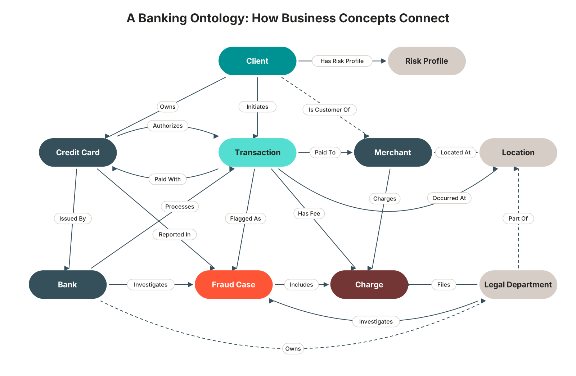
This is why ontology is naturally represented as a graph. The same concepts can participate in many different relationships, there can be multiple paths between concepts, and the graph can contain cycles. The relationship itself carries meaning: owns, authorizes, initiates, and paid to are not interchangeable links.
The banking example also shows why context and disambiguation matter. The concept Charge can mean different things depending on how it is connected: a transaction may have a fee charge, a merchant may charge an amount, or a legal department may file a charge. The surrounding relationships provide the context needed to interpret the term correctly.
How does ontology make data easier?
Ontology lets people and systems work with data in business terms instead of database terms. Rather than knowing which tables to join and which columns hold which values, a user can ask about Clients, Transactions, and Merchants and rely on the ontology to resolve what those concepts mean and where they live.
From ontology to actual data
An ontology can begin as a conceptual model: Client, Transaction, Merchant, Location, Risk Profile, and the relationships between them. At this stage, it describes how the business thinks about the domain.
Once data binding is introduced, those concepts are connected to their real representations in enterprise data. A conceptual Client may be bound to customer records, a Transaction to transaction records, and a Merchant to merchant data. The ontology becomes more than a diagram. It becomes a semantic map between business meaning and actual data.
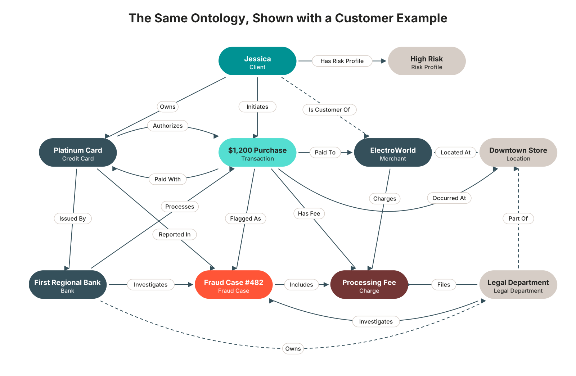
This is the same banking ontology shown earlier, now bound to data. Every concept points to a real example: Jessica is the Client, her Platinum Card is the Credit Card, and her $1,200 Purchase at ElectroWorld is the Transaction. The relationships stay the same, so a question about Jessica's purchase can follow them straight to the records that answer it.
What that unlocks
- Business terminology for queries. Users can query underlying data using the language they already use every day.
- One meaning across many sources. When the same concept appears under different names in different systems, the ontology ties them back to a single definition.
- Better AI answers. The ontology informs AI so it answers questions more accurately, including questions that span concepts from multiple domains.
- Fewer one-off models. Teams no longer need to rebuild joins and logic every time a new question comes up.
Why is ontology important for data leaders now?
Ontology is not a new idea. For decades, enterprises have understood the value of describing the business as a connected set of concepts and relationships. The challenge was that this way of representing knowledge did not fit naturally with how enterprise data systems evolved.
Why ontology stayed on the sidelines
Most enterprise data ended up in relational databases. These systems are excellent at storing and processing structured data, but they tend to represent relationships through tables, foreign keys, and joins. When a rich business graph is translated into a relational model, the data remains connected, but much of the meaning of those connections becomes less explicit.
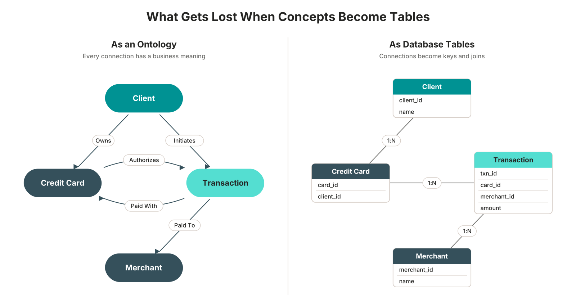
On the left, a credit card both authorizes a transaction and pays for it, and the client initiates it. On the right, both of the card's relationships collapse into a single card_id column, and the link between the client and the transaction disappears entirely. The data can still be joined, but the meaning is gone.
In the banking ontology, a Client owns a Credit Card, a Credit Card authorizes a Transaction, a Transaction is paid to a Merchant, the transaction occurs at a Location, and it may be flagged as part of a Fraud Case. Each edge has a distinct business meaning, and the same concepts can be connected through several different paths. In the equivalent relational model, those relationships are largely reduced to keys, joins, and 1:1, 1:N, or N:1 cardinalities. The system can still join the records, but the richer business semantics are no longer first-class elements of the model.
Historically, this made ontology difficult to operationalize. Even if the business could describe its domain as a rich network of concepts and relationships, enterprise technology was largely optimized around schemas, tables, and applications. Ontology often remained closer to an architectural or academic discipline than something embedded in day-to-day data consumption.
What has changed
What has changed is the technology around ontology. RDF, OWL, and SPARQL have existed for years. Mature graph standards, cloud-scale graph databases, better semantic tooling, embeddings, and LLMs make ontology much easier to build, maintain, and, most importantly, put to work.
AI creates the immediate use case
This is the biggest reason ontology matters to data leaders right now. As teams roll out LLMs and agents, users are asking open-ended questions across the business, and the data model has to support questions no one designed it for. Ontology gives AI the business context to answer them reliably.
The shift is not that ontology has suddenly become a good idea. It has always been a powerful way of representing business knowledge. What has changed is our ability, and increasingly our need, to operationalize it. Ontology is moving from an academic concept to an operational business context layer because AI now has both the ability and the immediate need to use it.
Why DataOS Is a Strong Fit for Ontology
DataOS brings ontology closer to day-to-day data work. Instead of treating ontology as a separate modeling exercise, it builds on the semantic and governed data foundation organizations already create through data products.
- Start with governed data products. DataOS already enables teams to build semantic models as data products around specific business use cases. These products bring together the right data, metrics, dimensions, relationships, quality rules, and access controls in a focused, governed way.
- Infer first, then let the business enrich. Once data products exist, organizations do not have to start ontology design from a blank canvas. A significant amount of business context is already encoded in the semantic model, even if it reflects only the scope of a particular use case. DataOS uses that foundation to infer an initial ontology, which business teams can then review, extend, and enrich.
- Or build from scratch when needed. For organizations without suitable data products or an existing ontology, DataOS provides a path to build the ontology directly, adding concepts, relationships, properties, and business rules incrementally.
- Accelerate data binding. Creating an ontology is only part of the challenge. Connecting it back to real enterprise data is often the harder step. Whether the ontology is inferred or created directly, DataOS provides a faster path to bind business concepts to governed data products, semantic models, and underlying data.
- Put the ontology to work immediately. Once the ontology is connected to governed data, it becomes a practical discovery layer for the business. Through Dex, or another LLM-based interface, users can explore relationships, ask broader questions, and uncover connections that were not anticipated when an individual data product was designed.
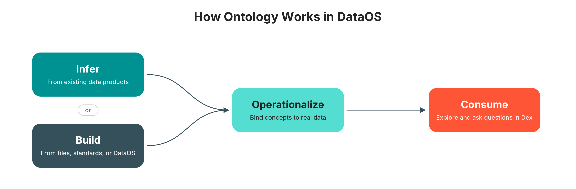
The advantage of DataOS is not only that it helps build an ontology. It connects ontology creation, data binding, governance, and AI-driven consumption into one continuous path, from business context to business value.
Building a new ontology in DataOS
Creating a new ontology in DataOS is practical, incremental, and business-friendly. Rather than forcing a large, one-time implementation, DataOS lets teams start from what they already have, import reusable standards or templates, and progressively enrich the ontology with concepts, relationships, properties, rules, data binding, and data quality definitions.
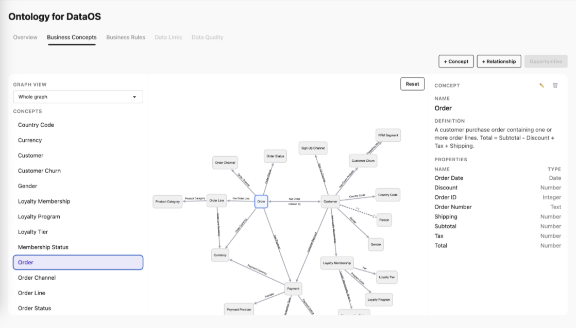
Teams can start an ontology in four ways:
- Import from a file. DataOS supports Turtle (.ttl) and JSON-LD files containing OWL classes, properties, relationships, and business rules, so organizations that maintain ontology assets elsewhere can bring them in and extend them.
- Begin from a template. Pre-built templates for an industry, domain, or business pattern give teams a working ontology quickly that they can refine over time.
- Import published standards. Vocabularies such as SKOS, DCMI Metadata Terms, Schema.org, FOAF, and PROV-O cover common needs like concept schemes, metadata terms, people and organizations, and provenance. DataOS can combine them with enterprise-specific concepts, so the ontology is both standards-aware and business-specific.
- Build from DataOS assets. Teams can browse catalogs, schemas, tables, and data products, grounding the ontology in real enterprise data rather than treating it as a disconnected documentation exercise.
Once the foundation exists, teams work with it through four areas:
- Business Concepts is the central design space. A concept such as Order carries a definition (a customer purchase order containing one or more order lines, with total calculated from subtotal, discount, tax, and shipping) and typed properties such as Order Date, Order ID, Subtotal, Tax, and Total. A graph view shows how Order connects to Customer, Order Line, Payment, Order Status, Currency, and more, and teams can add concepts and relationships manually where domain expertise goes beyond what the data shows.
- Business Rules capture how totals are calculated, what qualifies as a valid customer, when an order is complete, how loyalty status is determined, or what conditions create a churn risk.
- Data Links connect concepts back to the data products, tables, attributes, or semantic elements that represent them. This is where the ontology becomes operational.
- Data Quality ties concepts to expectations, so teams can reason about whether the data behind a concept is complete, valid, fresh, accurate, and fit for use.
DataOS also manages ontology evolution. Imported definitions add to the existing ontology rather than replacing it, and the platform flags conflicts when new definitions overlap with existing concepts or relationships. For large enterprises, where different teams own different concepts and different systems use different terminology, this gives everyone one place to review, reconcile, and mature a shared business ontology.
Data binding in DataOS
Data binding turns an ontology from a descriptive asset into an operational one. It lets the descriptive power of the ontology inform query operations, and DataOS provides the data infrastructure to do the binding. Users can then query underlying data using familiar business terminology, and AI can answer more accurately, including across concepts from multiple domains.
Inferring Ontology from Data Products
Business data products already contain a significant amount of business context. They define entities, measures, dimensions, metrics, relationships, glossary mappings, quality rules, access policies, and lineage. That context is useful, but it is not always expressed as a formal ontology that represents the business as a connected model of concepts and relationships.
Data products in DataOS
A data product in DataOS brings together data from multiple inputs and organizes it into a harmonized data model. Inputs may come from JSON files, APIs, BigQuery, MySQL, Snowflake, Lakehouse tables, or existing data products from other platforms. Consumers do not need to know where each input came from or how the source systems differ. DataOS abstracts that complexity and presents a trusted, unified, business-ready layer.
For example, a data product such as Device Insights 360 can combine device telemetry, memory information, failure prediction data, issue logs, and other operational signals to support device performance analysis. Instead of exposing raw telemetry tables to every user or tool, DataOS organizes the data around the business objective: understanding device performance, diagnosing issues, and optimizing outcomes. The same governed foundation serves dashboards, data science notebooks, AI/ML models, LLM-powered queries, and applications.
Each data product carries the context that an ontology can build on:
- Semantic model. Measures, dimensions, metrics, descriptions, relationships, and business meaning are defined once and packaged inside the product, so every dashboard, notebook, and application uses the same metric definition.
- Embedded data quality. Technical and business checks include missing value, range, regex, schema, uniqueness, and validity checks, plus dynamic business validations. DataOS can detect schema drift and alert owners through channels such as Teams before downstream systems are affected, and business checks can validate incoming values against ranges maintained in changing reference tables.
- Lineage. As data moves from inputs through transformations into logical tables, semantic models, metrics, and outputs, DataOS captures where it came from and how it was transformed, improving trust, auditability, and operational control.
- Business glossary. One source may call a field device_id, another d_id. DataOS maps these attributes to glossary terms so users and AI systems understand they refer to the same concept, which lets business users ask questions in natural language.
- Tags and policies. Data can be tagged as PII, confidential, internal, or other classifications. Based on role, location, identity, or organization, one user may see PII in clear text while another sees it masked, and the policy applies consistently across BI, applications, LLMs, notebooks, SQL, and APIs.
- Broad consumption. A data product can be accessed through BI synchronization, AI/ML workflows, notebooks, Postgres SQL, GraphQL, and APIs, serving analysts, data scientists, developers, AI agents, and business users without each group rebuilding its own version.
- Software engineering practices. Sources, transformations, metrics, quality checks, and metadata are configured in YAML, enabling version control, automated testing, CI/CD, and environment promotion. Incremental changes ship without redeploying the whole product.
- Federated consistency. A metric may sit on different physical sources in different regions, but its business definition and formula stay governed consistently, which supports local data sovereignty requirements alongside global consistency in business meaning.
Together, these make enterprise data ready for business, analytics, and AI consumption, turning a collection of disconnected technical assets into a portfolio of governed, reusable, AI-ready products.
Building upon data products
DataOS can examine the structure, semantics, relationships, and metadata already in a data product and use that information to generate an initial ontology: a graph of the business concepts behind the product, the relationships between them, and the language used to reason over them.
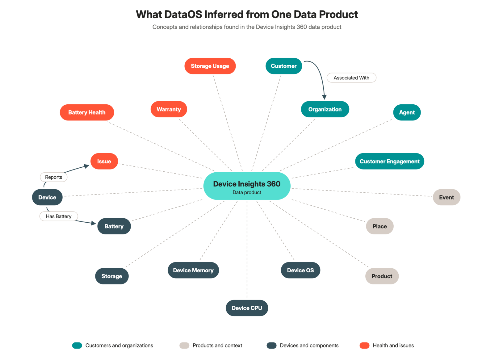
Inference accelerates ontology creation; it does not replace business modeling. Because a data product already contains business-aligned definitions, semantic models, tags, glossary terms, and relationships, teams start from a real foundation instead of a blank canvas.
In the Device Insights 360 data product, DataOS can infer concepts such as device, battery, product, issue, memory, storage, organization, customer, event, warranty, and agent, along with how they relate. A device may have a battery, a device may report issues, memory usage may be associated with a device, a customer may be associated with an organization, and warranty or failure signals may connect to device health.
Teams can review the inferred ontology in two ways. A graph view shows concepts as nodes and relationships as edges, so architects, product owners, and business stakeholders can see how the data product reflects the real business domain. A schema view offers a more structured way to review concepts and relationships and validate them against business understanding. The inferred ontology becomes both a discovery artifact and a design artifact.
The inferred ontology can be exported in linked data formats, which supports interoperability with external ontology tools, taxonomy systems, graph databases, and knowledge management platforms, and reduces vendor lock-in:
- JSON-LD for web applications and APIs
- RDF/Turtle for semantic web applications and ontology tools
- N-Triples for line-based RDF processing, streaming, and large datasets
The ontology also evolves with its data product. When new sources, metrics, relationships, glossary terms, or quality rules are added, the ontology can be refreshed and extended, so it becomes part of the ongoing data product lifecycle rather than a one-time documentation exercise.
Architects and modelers can also use built-in LLM integration to ask questions of the ontology, inspect relationships, and understand how concepts connect. This speeds up design and review and gives business and technical teams a shared way to confirm the model reflects the domain. Once inferred, the ontology can be exported as natural language triples: plain statements of how concepts relate that can be used to fine-tune models, power RAG systems, or load into a graph database.
The Power of Data Products and Ontology
Every data product has a deliberate boundary because it is built to solve a specific use case. That focus is what gives it trust, governance, quality, metrics, and policies. It also means no single data product can anticipate every future question.
The ontology sits across data products and connects the concepts they share:
Customer → purchases → Product → fulfilled through → Shipment → supplied by → Supplier
That connection lets AI move from one governed data product to another when a question crosses their individual boundaries. A question about which suppliers are behind late deliveries to a key customer segment no longer depends on someone having built that exact view in advance.
Data products establish trust. Ontology establishes connections. Together, they let AI answer questions that no individual data product was designed to answer, while every answer still rests on governed, trusted data.