The Architecture of Business Intent with Data Products
Lorem ipsum dolor sit amet, consectetur adipiscing elit. Suspendisse varius enim in eros elementum tristique. Duis cursus, mi quis viverra ornare, eros dolor interdum nulla, ut commodo diam libero vitae erat. Aenean faucibus nibh et justo cursus id rutrum lorem imperdiet. Nunc ut sem vitae risus tristique posuere.

The whisper Ray Kinsella hears in the cornfield in Field of Dreams is "if you build it, he will come." Singular. One ghost, coming home so that Ray can make peace with his father. But that is not the version most people remember.
What the culture retells is "build it and they will come": a vague collective, a philosophy of optimistic construction with no particular person in mind. One word changed and the whole meaning shifted.
Nobody corrects it. The misquote is so deeply embedded that questioning it feels unnecessary.
Why Business Requirements Get Lost in Translation
The dynamic maps to data products with uncomfortable precision. The business says: build this, and he will come. A specific outcome for a specific goal.
By the time that instruction passes through a project brief, a requirements document, a sprint backlog, and a stand-up, what the engineering team hears is: build this, and they will come.
The original "he" has been telephone-gamed into something nobody owns.
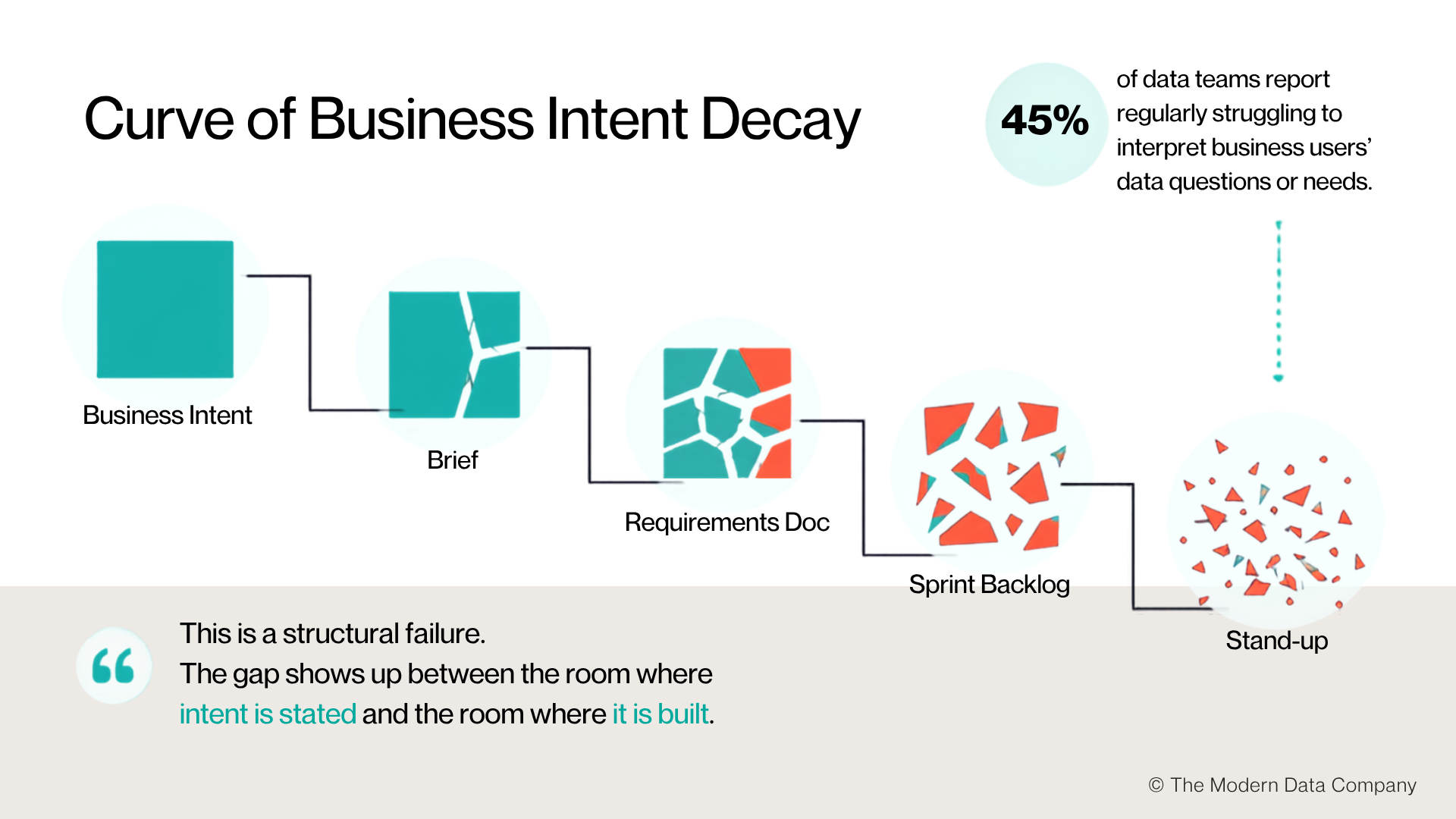
This is more of a structural failure rather than a communication problem. Forty-five percent of data teams report regularly struggling to interpret business users' data questions or needs. The gap is not about effort or intelligence. It is about what happens between the room where intent is stated and the room where it is built.
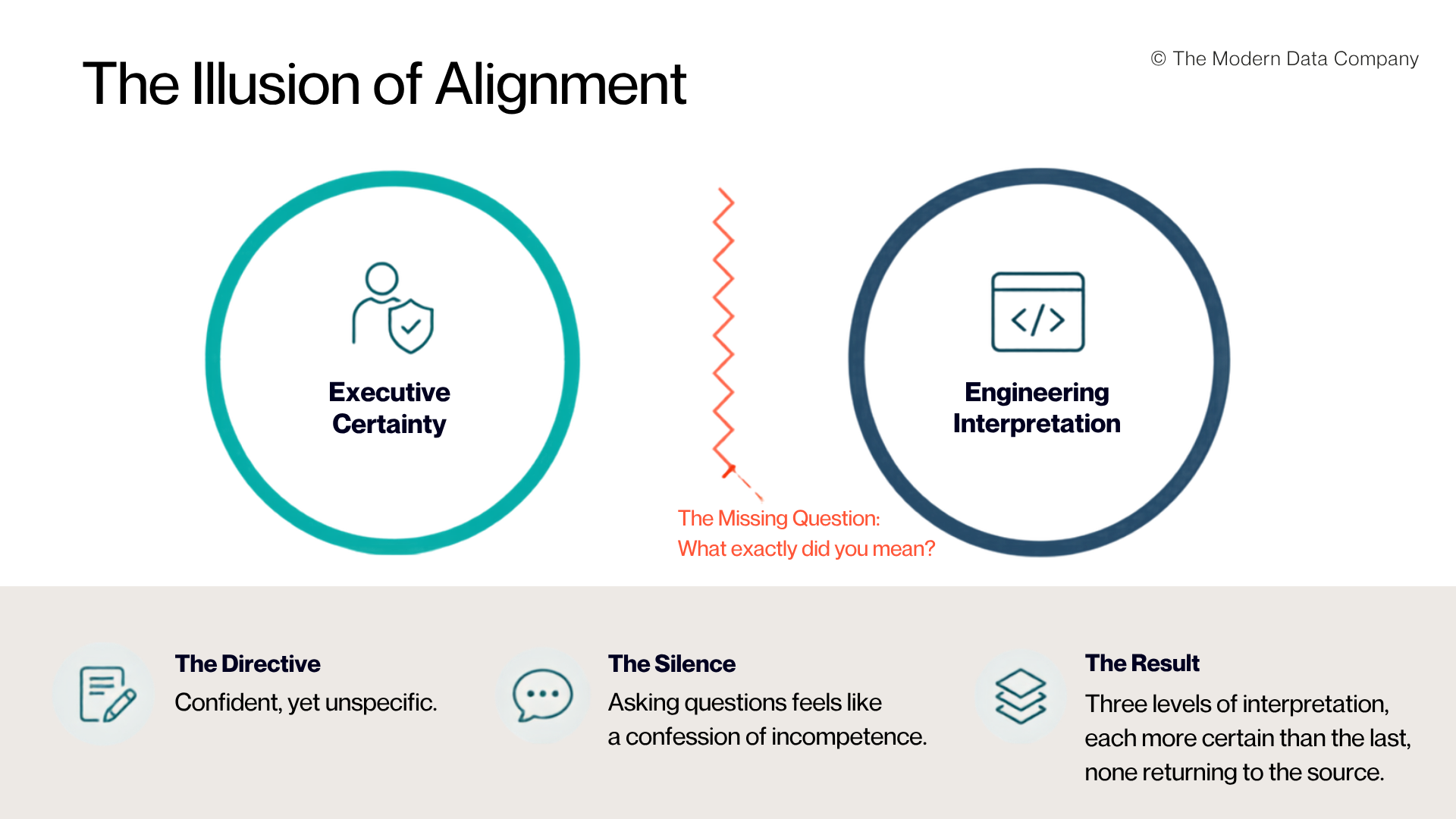
The most dangerous version of this starts with a forceful mandate. The senior executive delivers a directive that is confident without being specific. The clarifying questions do not get asked because asking them feels like a confession of incompetence.
By the time the requirement reaches the engineer, it has passed through three levels of interpretation, each more certain than the last, none of them going back to the source. Weeks pass and sometimes months. Everyone is equally motivated to appear to have understood perfectly. Nobody asks the simple question: what exactly did you mean?
They build it for “they”, when the business meant “he”.
The business-IT translation problem in data is a structural problem with no natural checkpoint between original intent and final implementation.
Why Data Teams Keep Building What Nobody Asked For
There is a second dynamic that compounds the first, and it runs in the opposite direction. Think of a fish tank. The business is the pump, pushing budget into the system continuously, without asking where the bubbles go. The engineering team keeps swimming, keeps building, because the budget keeps coming.
Nobody in the tank is incentivized to stop and ask what they were originally building toward, because the answer might stop the bubbles.
This is self-preservation. Organizations often fail to distinguish between data management, which is technical execution, and data governance, which is business oversight. An engineering function that has learned to stay funded without staying accountable to outcomes is operating rationally within the incentive structure it lives in.
The telephone game completes itself. The "he" becomes "they." The data product gets delivered to nobody in particular and the business stops filing tickets and starts building spreadsheets: the spreadsheet does what the product was supposed to do.
That spreadsheet itself is the verdict that the data developed did not do its job in becoming directly useful.
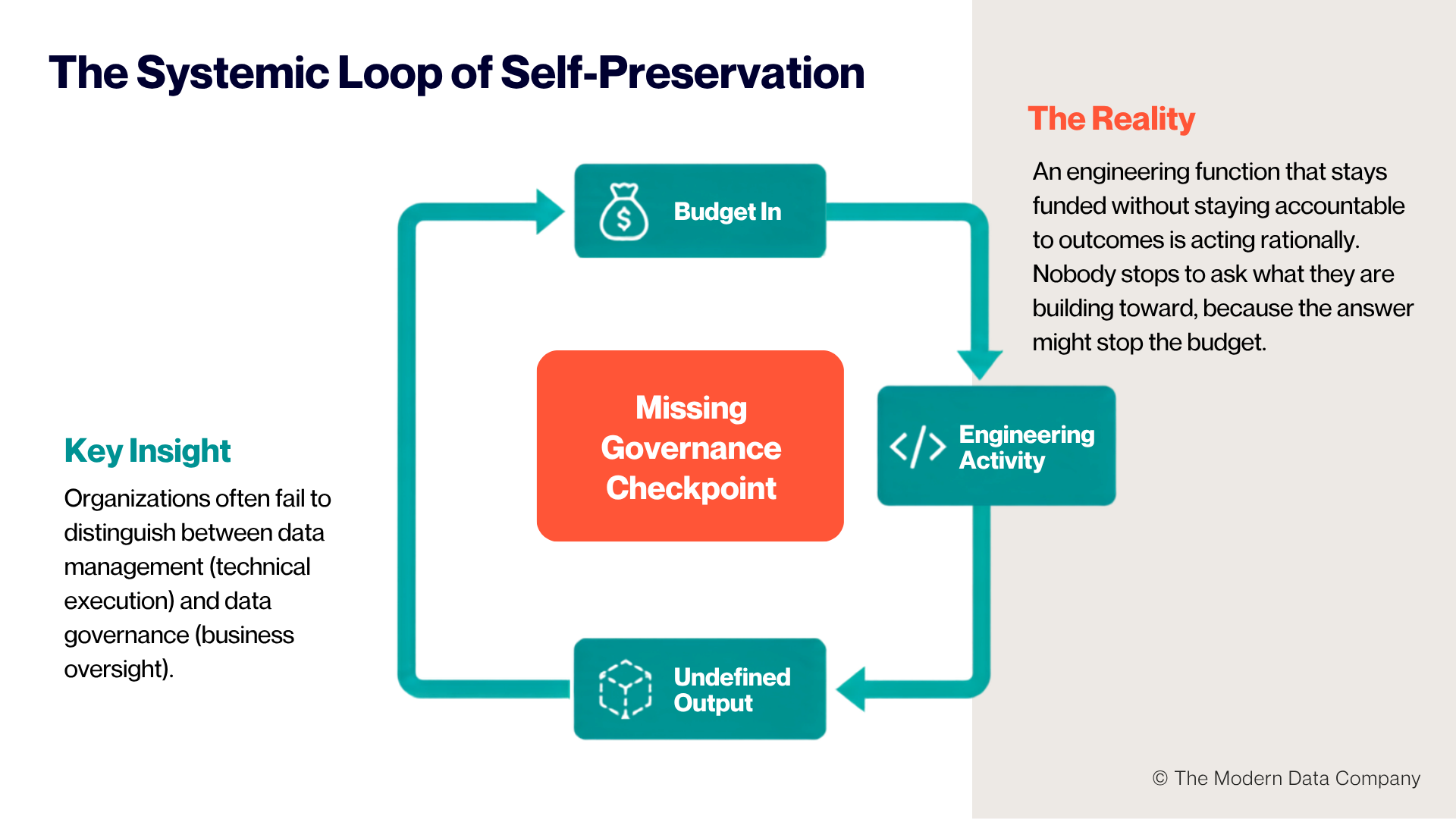
When engineering teams are not held accountable to the original business outcome, they build what is technically correct and strategically irrelevant.
What Is Embedded Governance in a Data Product
The structural fix is an organizational historian embedded in the data product itself: a dynamic record of the original intent, readable by everyone who touches the product across its lifecycle.
This is not a data dictionary, which documents fields and types. It is not a lineage diagram, which maps where data came from.
It is a record of what success was supposed to mean, written at the moment of intent and updated at each stage of interpretation.
The obvious objection: the executive will never engage with a historian. Probably true. But the historian is not for the executive. It is for everyone the executive's instruction passes through.
Its job is to capture the best current interpretation of intent at each stage, so that when the product lands and the executive says "that was not what I meant," there is a record of what was understood, when, and by whom.
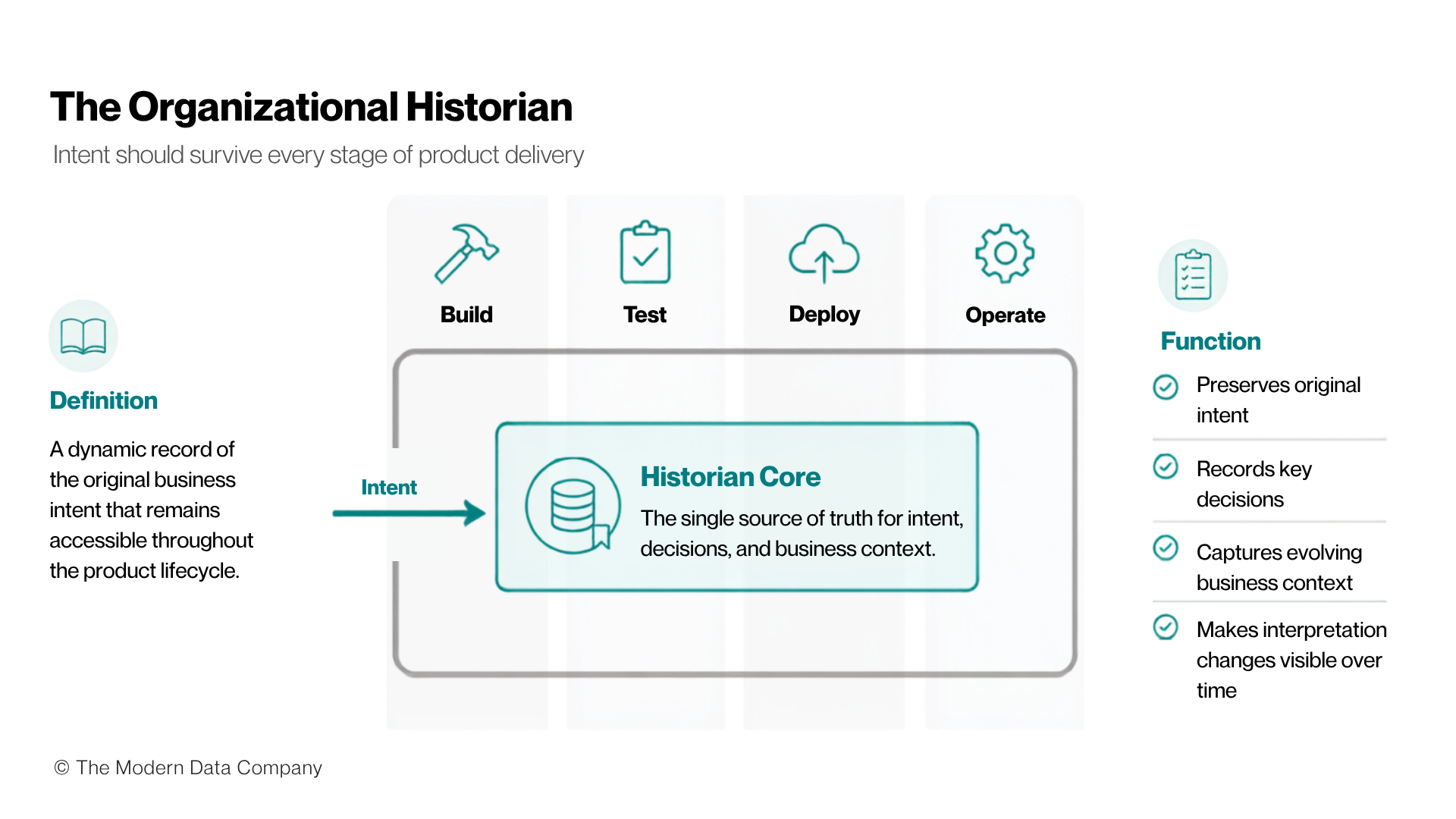
This does not prevent misalignment, but makes misalignment visible instead of invisible. Visible misalignment is an honest starting point for fixing it. Invisible misalignment is how organizations spend months building the wrong thing with complete confidence.
The key word is embedded. Governance fails as a mandate and succeeds as a behavior change. Governance that is laid down in a separate document gets ignored. Governance that exists in the product gets consulted, the way a data product manifest (a version-controlled record of a data product's purpose, output contract, owner, and business outcome that travels with the product throughout its lifecycle) lives in the codebase.
When the manifest is empty where the business outcome should be, that emptiness is information. You can ignore a document. You cannot ship the product without opening the manifest.
Embedded governance turns intent from a memory into a record, without adding process steps that engineers work around.
How DataOS Embeds Governance in Data Products
The organizational historian concept is not hypothetical infrastructure. DataOS operationalizes it through the DataOS Data Product Hub, which treats business intent as a first-class property of every data product, not an afterthought to be documented somewhere else.
In DataOS, every data product carries its purpose definition, its output contract, its owner, and its stated business outcome as built-in metadata that cannot be separated from the product itself. When a downstream team opens the product, they open the context of why it exists. When an engineer modifies a pipeline, the manifest surfaces what that pipeline was built to deliver.
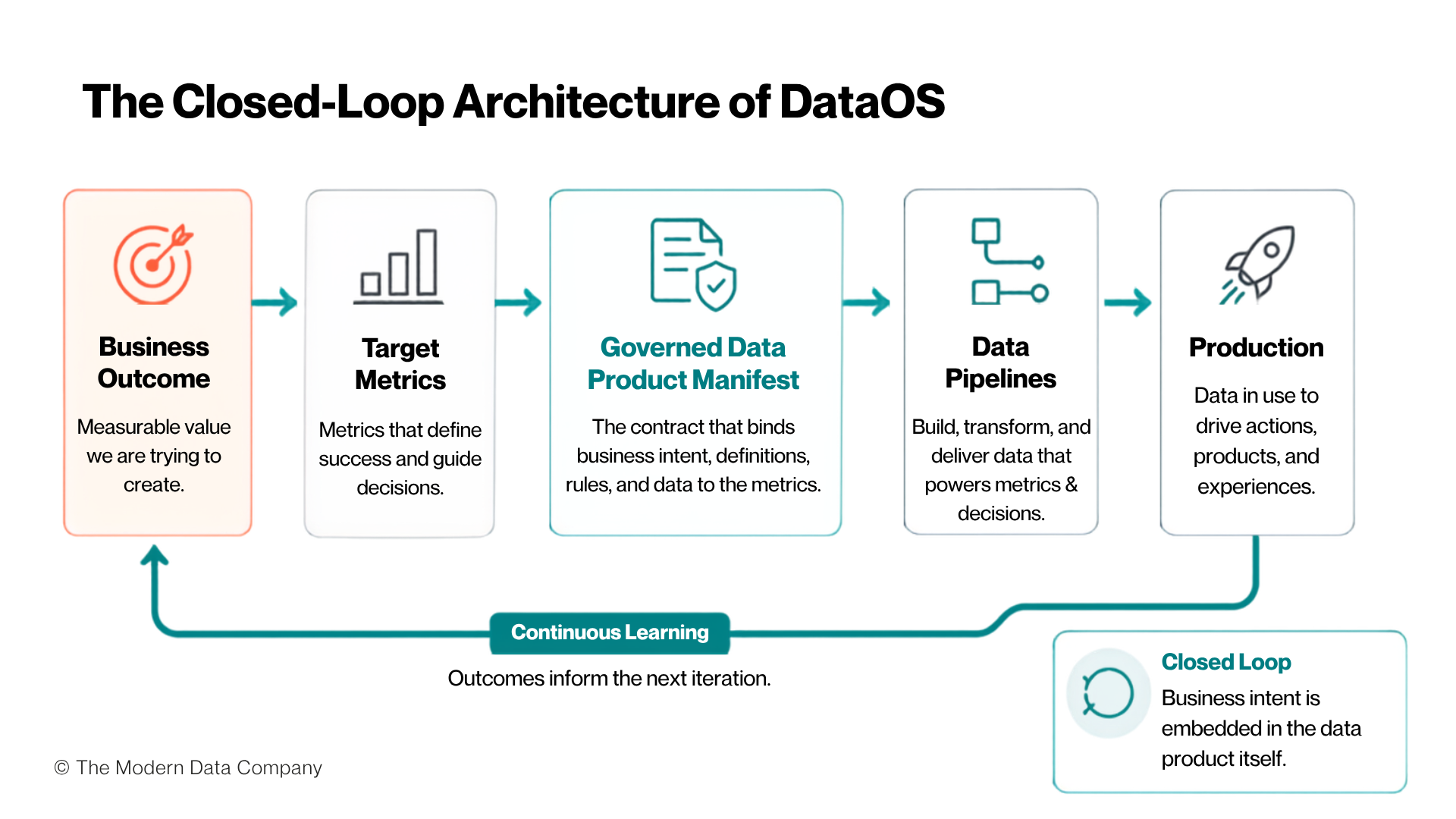
The record of original intent does not exist in a meeting summary or a Confluence page last edited in 2022. It is part of the data product.
Right-to-left thinking (the discipline of starting with the business outcome and working backward to determine what data infrastructure is required to produce it, rather than building data infrastructure and hoping it aligns with something useful) is how DataOS approaches product design. The business outcome defines the product. The product defines the pipeline. The pipeline does not define the outcome.
This is what closes the loop the organizational historian is supposed to close. By making business intent structurally inseparable from the thing being built.

DataOS makes the original business intent a load-bearing property of the data product, not an artifact that erodes between the room where it was stated and the room where it was built.
How to Prevent Requirements Drift in Data Products
Three practices separate data products that stay connected to their original purpose from those that drift.
1. Write the outcome before writing the requirement.
The outcome written should be concrete, such as "the procurement lead can identify within ten minutes which suppliers are driving Cost of Poor Quality this quarter."
The requirement flows from the outcome. When the requirement arrives without the outcome behind it, the engineer fills in the gap with assumptions, and those assumptions compound at every handoff.
2. Make the grain explicit.
Data engineering teams frequently work in isolation, creating datasets without sufficient input from business users about their actual needs.
Specifying what a single row of the product represents, what time period it covers, and what business event it reflects forces a conversation that would otherwise happen after delivery, when it is too late and too expensive.
3. Version the intent alongside the schema.
Schema changes are versioned. Intent should be too. When the business outcome shifts, that shift should be recorded in the product manifest with the same discipline as a schema migration.
Intent drift is the upstream version of schema drift, and it is far more costly because it is invisible until the product lands in the wrong hands.
The fix for requirements drift is not a better requirements process. It is embedding the original outcome into the product so that every person who touches it knows what it was hired to do.
Final Note: It Was Always About Specific Intent
The line was never "build it and they will come." It was always he: one specific person, one specific outcome, one specific reason to build the thing at all.
The question worth asking is not "what did we build?" The question is "who was it for, and can we prove we still know the answer?"
For more on building data products that stay connected to business outcomes, see Data Products: What They Are, Why They Matter, How to Build Them and Bounded Context: The Data Foundation AI Agents Actually Need.



.webp)
.webp)
%202.webp)