Categories


What is context, and who owns it today?
Context tells AI agents and people what the business means: definitions, relationships, freshness and rules on who may use what. Context is not a layer sitting on top of the stack. It is an enterprise capability built into the data itself. It is built from the ground up, exists inside every system that produces data, moves with that data and governs how it is used. That is why, in most enterprises, nobody owns it as a whole.
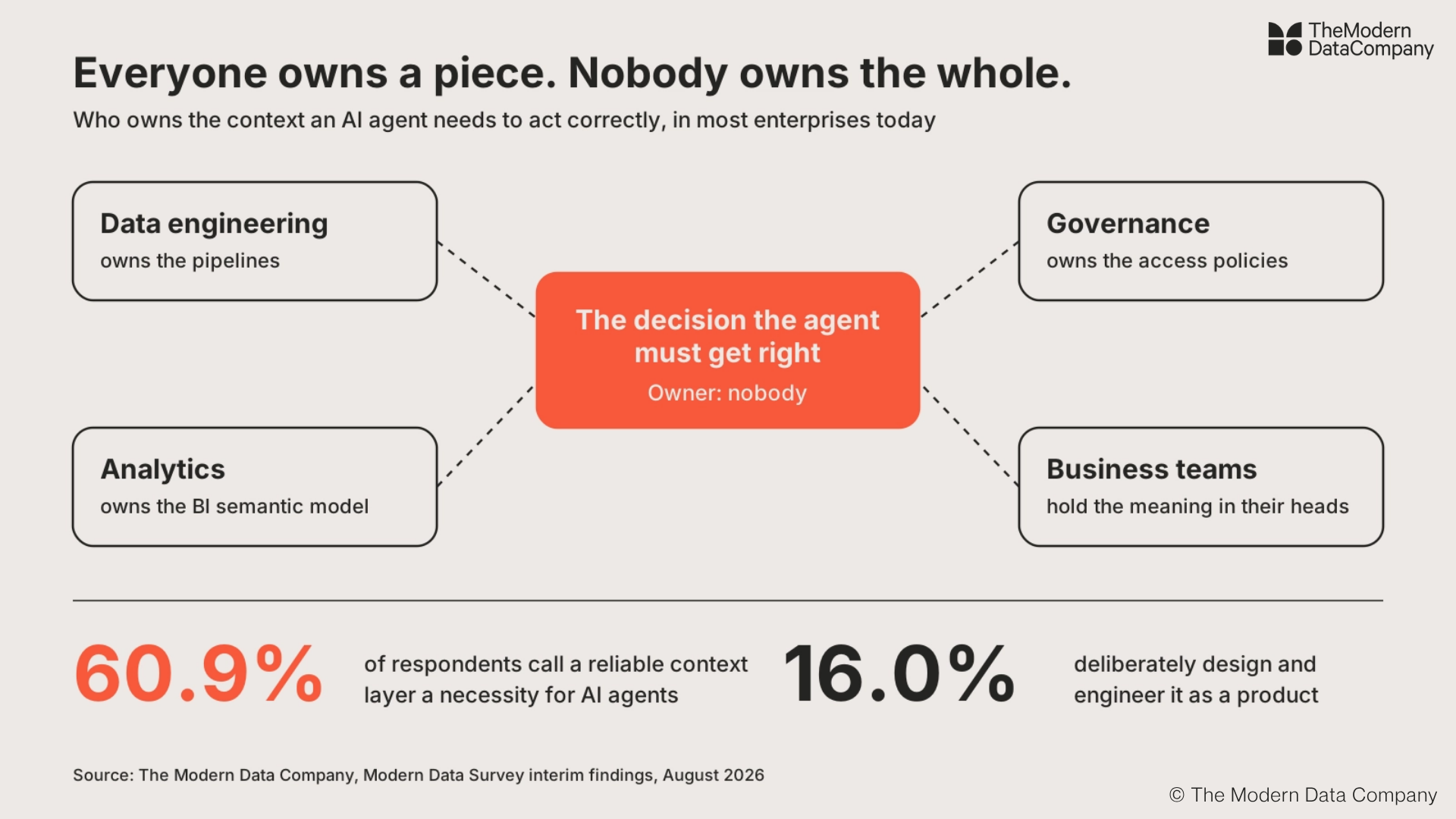
Data engineering owns pipelines, analysts own the dashboard semantic model, governance owns policies, and business teams hold the meaning in their heads. Nobody owns the question that matters: does the agent have what it needs to make this decision correctly?
In the latest Modern Data Survey findings, 60.9% of respondents called reliable context a necessity for AI agents, yet only 16.0% design it as a product. The Modern Data Report 2026 found 93% of respondents meet conflicting metrics. People patch that with meetings, gut feel and manual checks. An agent cannot.
Why does context need a product manager?
Because context has users, and those users have jobs to finish. That makes it a product, and a product without a manager drifts toward what its builders find interesting.
I tell every team I work with: when you build for others, your opinion is your enemy. Context built by engineers reflects how engineers see the business. While context built by business reflects how business sees business.
Clayton Christensen's jobs-to-be-done theory says people hire a product to make progress on a job. Three users hire context:
- The AI agent needs the right definition, freshness and permission at the moment it acts.
- The decision owner, such as a VP of Supply Chain, needs answers that match how the business really works and on whose behalf the Agent may work.
- The steward needs to know what is used and whether it is still true.
Balancing them is product work. McKinsey found that scaling data products takes empowered data product owners who can state value in business terms. With agents acting on context, the stakes are higher.
What does a product manager do?
A product manager tasked with building context picks which decisions the context serves next, ships what each decision needs in small releases and measures whether those decisions improve. The product manager takes responsibility for the knowledge boundaries and, thus, the outcomes.
Take a renewals agent asked to flag accounts at risk of churn. It reads active users from the product analytics table and sees healthy usage. What it cannot see is that finance counts an account as active by paid seats, not logins, that the usage table stopped refreshing nine days ago and that the account’s largest division moved to a separate contract last quarter.
Each of those facts existed somewhere in the enterprise. None of them reached the agent, so it marks the account safe and the renewal is lost.
A product manager would treat churn flagging as the decision to serve, ship the shared definition, the freshness signal and the contract lineage it depends on, then track whether flagged accounts match actual churn. The role owns outcomes.
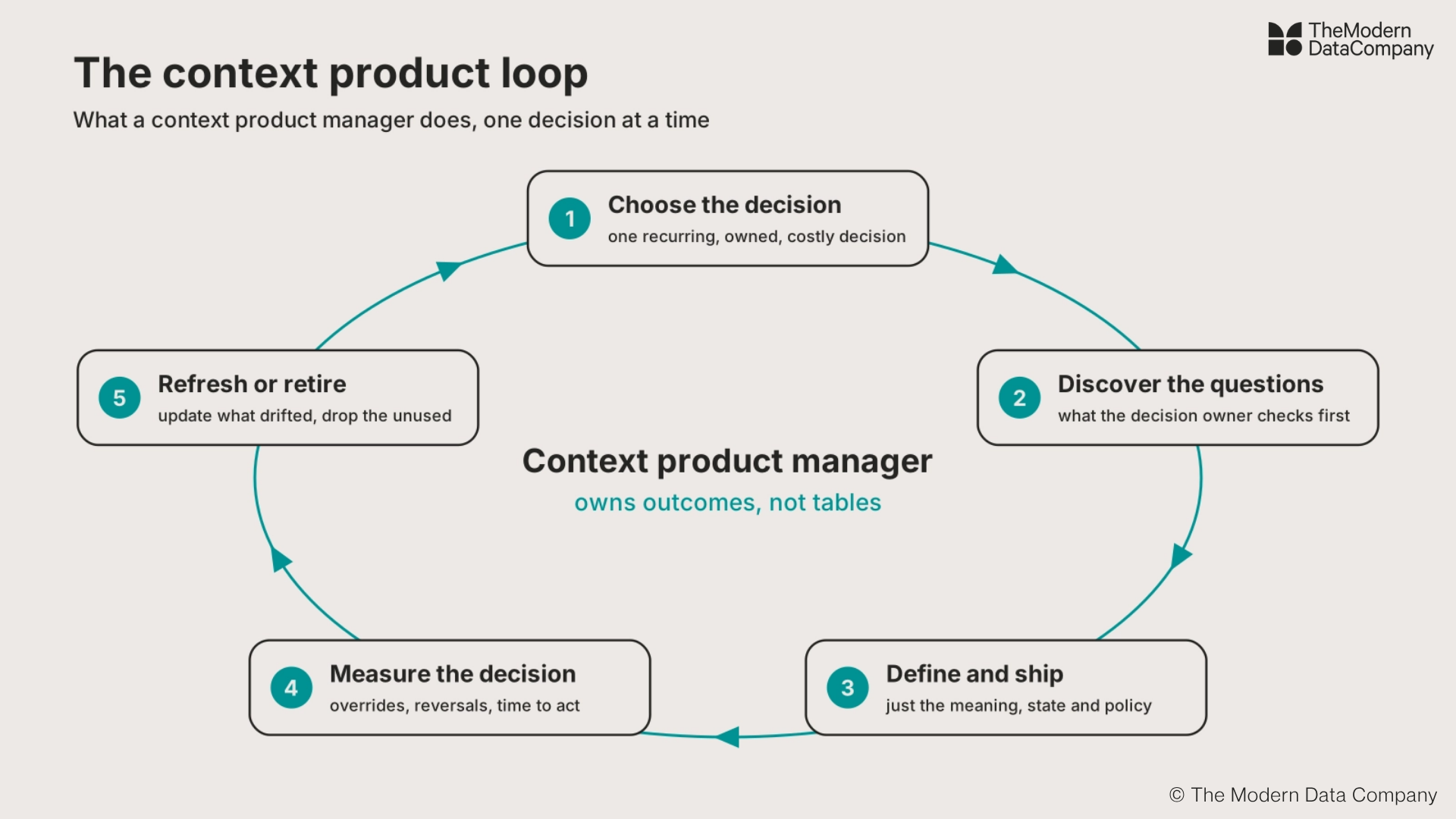
It runs as a loop:
- Choose the decision. One that recurs, has an owner and costs money when wrong. This is minimum viable contextin practice.
- Discover the questions. Write down what the decision owner checks before acting.
- Define and ship. Pin only the definitions, relationships and rules those questions touch, each with a named owner.
- Measure the decision. Track overrides, reversals and time to act.
- Refresh or retire. Update what drifted. Remove what no decision uses.
Researchers now treat context engineering as a discipline of its own. Engineering answers how. The product manager answers for whom, and what comes first.
How do you know if your context is working?
Your context is working when the decisions that depend on it get faster, are overridden less and are reversed less. Counting terms defined or entities mapped measures effort, not value.
We talk a lot about the cost of data and too little about its value. A glossary can grow for years without anyone asking what it changed. Track these instead:
- Override rate: how often a person corrects the agent. Each override is missing context, handed to you free.
- Time to decision: from question to action.
- Reversal rate: decisions undone later.
- Reuse: how many decisions share a piece of context.
My colleagues Priyanshi Durbha and Khushi Bedar show how semantic metric trees tie data products to business results. Context deserves the same discipline.
How does DataOS support product-managed context?
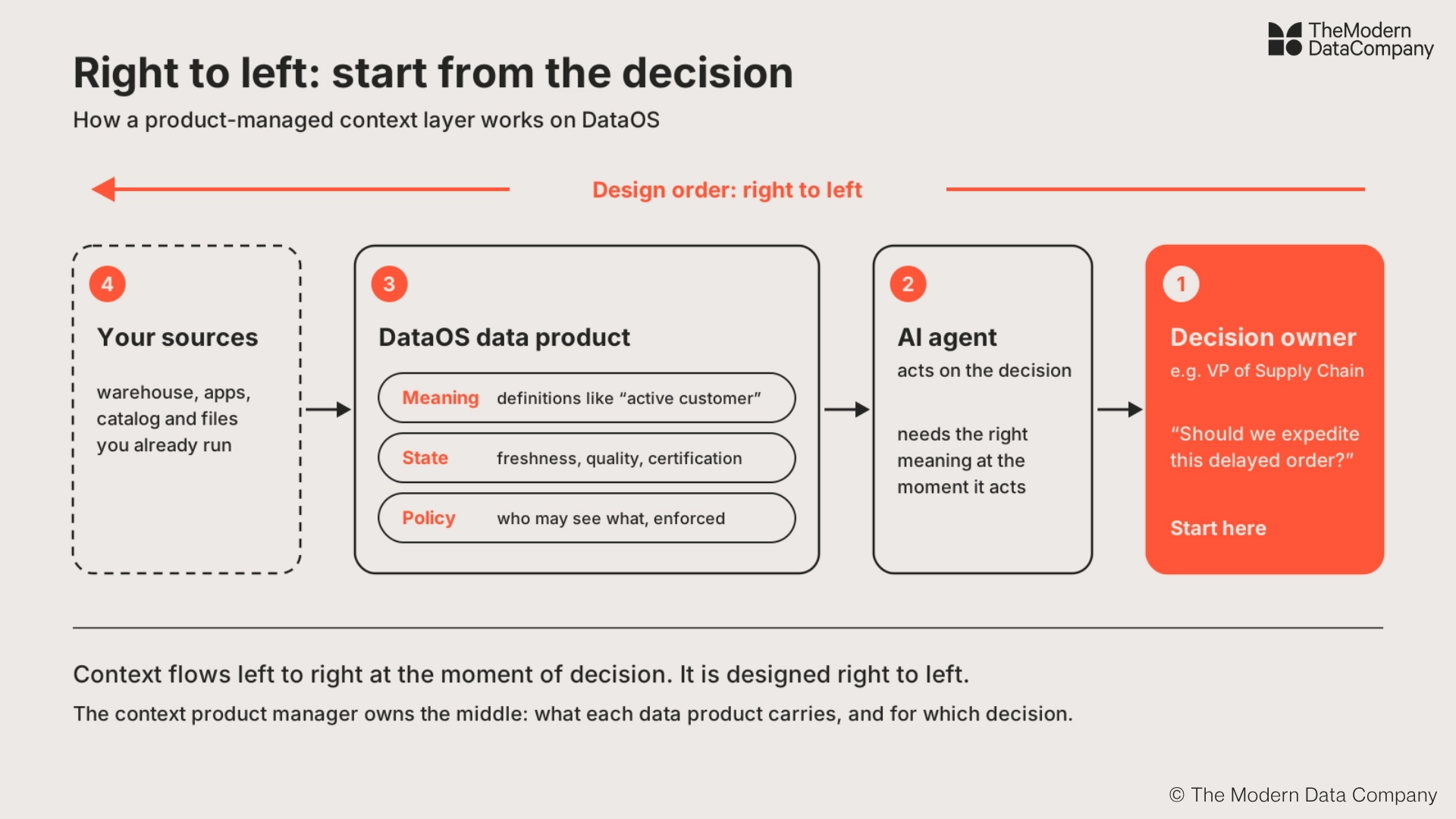
DataOS packages context inside data products, so each one carries its meaning, state and policy wherever it is used. That gives a context product manager a real unit to own, ship and measure.
DataOS is business-first and works right to left, from the decision back to the data. As Build your context explains, each data product passes three things to an agent:
- Meaning: definitions such as "active customer" travel inside the product, so the agent never guesses from column names.
- State: freshness, quality and certification, so the agent can tell stale from wrong.
- Policy: access rules enforced at the product, not passed to the model as a prompt it might ignore.
A shared semantic model keeps meaning consistent for people and agents, with APIs and MCP-native access built in.
So, who should own your context?
One designated person, accountable for the decisions it serves. Context will evolve into something that you don’t need to actively think about. It will evolve the fastest where it is treated as a product with users instead of a project with an end date.
Give context one accountable product manager, and judge them on improved decisions.
Frequently asked questions
What is the difference between a context layer and a semantic layer?
A semantic layer defines business metrics and their logic, mostly for BI. A context layer includes it and adds what agents need to act: relationships, freshness, lineage and access policy, delivered at the moment of decision.
Who should own context: the data team or the AI team?
Neither alone. Data teams own the pieces, and AI teams own the agents. A context product manager should own the outcome: which decisions it serves and whether they improve.
Is a context product manager the same as a data product manager?
Close cousins. A data product manager owns one data product. A context product manager owns the shared meaning many data products and agents depend on. In small teams, one person often does both.