Token Economics: Why Value Per Token Matters More Than Token Cost
Lorem ipsum dolor sit amet, consectetur adipiscing elit. Suspendisse varius enim in eros elementum tristique. Duis cursus, mi quis viverra ornare, eros dolor interdum nulla, ut commodo diam libero vitae erat. Aenean faucibus nibh et justo cursus id rutrum lorem imperdiet. Nunc ut sem vitae risus tristique posuere.

For the last couple of years, most enterprise AI conversations have focused on capability.
What can large language models do? Can they summarize documents? Can they write code? Can they answer business questions? Can they act as agents? Can they reason across data, documents, and tools?
Increasingly, the answer is yes.
People have already experienced this in their personal lives. They ask a question, share some information, and get a useful response almost instantly. The answer may not always be perfect, but it is often useful enough to help them move forward. In many cases, they are now able to complete tasks they could not have imagined a tool doing for them earlier.
That expectation is now entering the workplace.
Business users are beginning to ask a simple but powerful question: why can’t work feel like this?
Why should a sales leader wait three days for a report? Why should a finance manager raise a ticket for every small analysis? Why should an operations leader depend on another team every time they want to understand what is going on? Why should business users first find the right dashboard, then navigate its filters and tabs, when they can simply ask a question?
This growing expectation is driving rapid adoption of LLMs and AI agents inside enterprises. But with adoption comes a new reality: more usage means more tokens, and more tokens mean more cost.
Unlike traditional software licensing, token cost is variable, usage-driven, and often visible only after the task is complete. This introduces a new discipline that enterprises need to understand and manage: token economics.
Tokens Are the Actual Unit of AI Consumption
Tokens are the basic unit of consumption for LLMs. In simple terms, they are the pieces of text that a model reads and writes. Every prompt, document, retrieved context, system instruction, tool response, intermediate step, and generated answer consumes tokens.
When usage is small, this cost may appear insignificant. A few prompts here and there do not attract much financial scrutiny. But the economics change when enterprises move from experimentation to production-scale workflows.
With AI agents, this gets amplified even more.
An AI agent does not simply answer one question. It may break the question into multiple steps, retrieve documents, inspect data, call APIs, generate SQL, validate the SQL, handle errors, retry, summarize results, and then format the final answer for the user. Each step consumes tokens.
This means the cost is not only in the final response. The cost is in the entire path the agent takes to reach that response.
That distinction matters. A user may think, “I only asked one question.” But behind that question, the system may have performed a long chain of actions. In agentic systems, the journey can be more expensive than the answer.
Why Enterprise Usage Is Growing So Fast
The growth in enterprise AI usage is not driven by a belief that AI is perfect. Business users know that answers may not be 100 percent accurate. They know that data quality can be poor. They know hallucination is a risk.
Yet demand continues to rise because the business value is not perfection. The value is speed of judgment.
Most business decisions are already made under uncertainty. A sales leader reviews pipeline and makes a call on the probability of a deal closing. A supply chain leader looks at delays and makes a call on the probability of goods arriving on time. A risk officer studies patterns and decides on mitigation. A product manager looks at feedback, metrics, and market signals and decides how the product should evolve next.
Business users do not live in a world of perfect information. They live in a world where decisions need to be made with incomplete, changing, and often messy information.
So when an LLM provides a reasonably useful answer instantly, the question is not always, “Is this perfect?” The better question is, “Does this help me make a better judgment call faster?”
That is why adoption is expanding. AI is not only replacing existing work. It is changing the effort required to ask questions, explore possibilities, and reach decisions. When the effort cost of asking questions goes down, the demand for answers goes up.
This is powerful, but it also creates a cost challenge. As more users discover more use cases, token consumption can grow quickly and unpredictably.
Where Tokens Actually Get Consumed
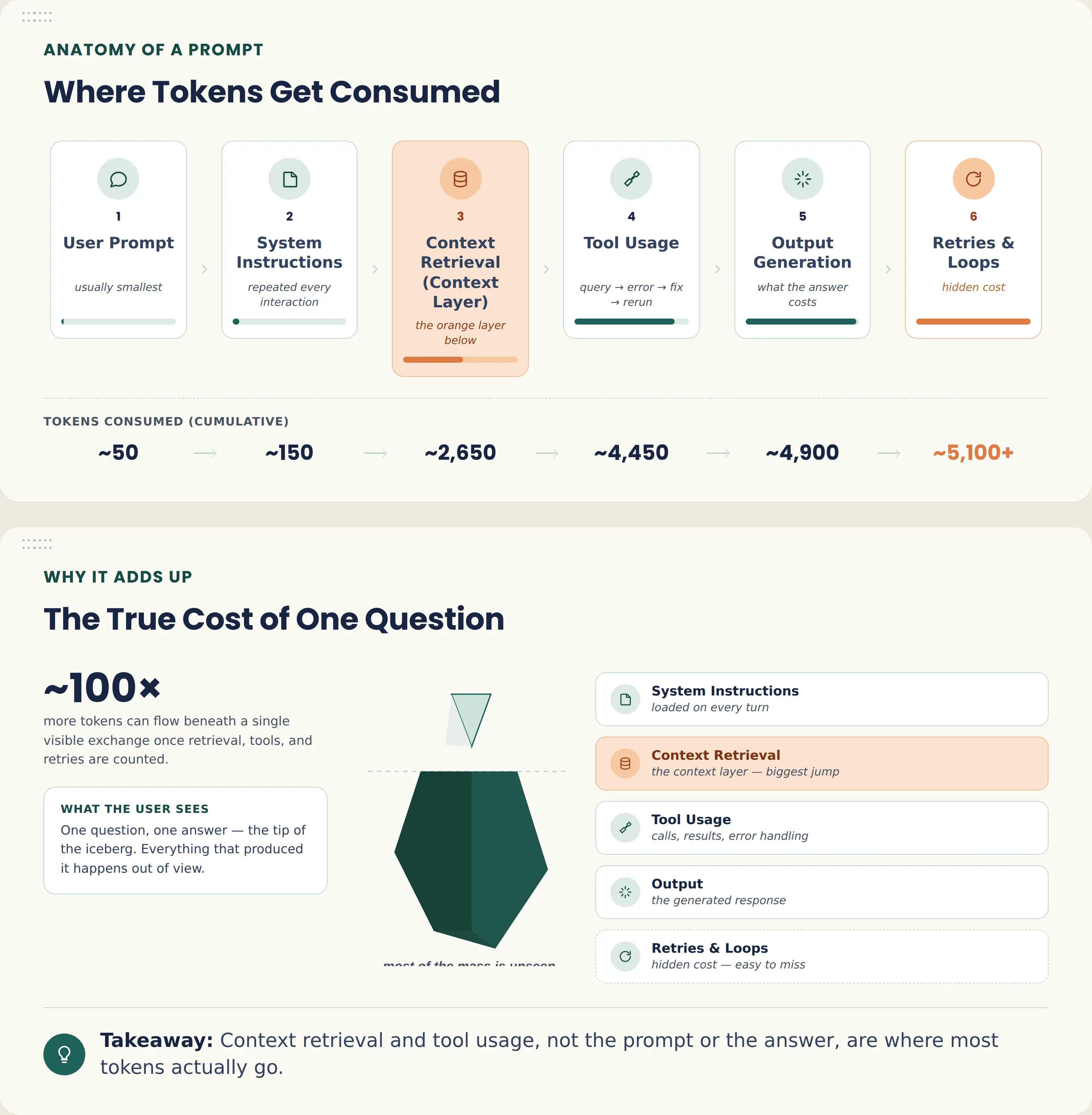
From the outside, an AI interaction may look simple. A user types a question and receives an answer. But technically, tokens are consumed across several layers.
The first layer is the user prompt. This is usually the smallest part.
The second layer is system instruction. Enterprise agents typically carry instructions about their role, boundaries, policies, tools, response format, and governance requirements. These instructions may be included repeatedly across interactions.
The third layer is context. This is where token usage can increase significantly. If an agent needs to read documents, retrieve knowledge, inspect previous conversations, understand data definitions, review schemas, or use semantic context, all of that becomes part of the token flow.
This is also where many enterprise AI initiatives struggle. Between raw enterprise data and the business user, there is often a missing layer of meaning. The data exists, but the business context around that data is scattered across schemas, dashboards, wikis, tribal knowledge, metric definitions, glossary tools, and governance documents.
This missing middle is the Context Layer.
The Context Layer sits between enterprise data and the business user. It gives business meaning to technical data. It helps AI systems understand which data product to use, what a metric means, how dimensions relate to measures, which fields are governed, which definitions are trusted, and which policies apply.
In DataOS, this Context Layer is built through governed Data Products and their Semantic Models. A Data Product packages data with business definitions, measures, dimensions, metrics, relationships, glossary terms, descriptions, tags, quality checks, lineage, and access policies. The Semantic Model gives AI systems and business users a consistent way to understand and query that data.
The fourth layer of token consumption is tool usage. If the agent generates a query, calls a database, receives an error, fixes the query, runs it again, interprets the output, and explains the result, each step consumes tokens.
The fifth layer is the output. Long reports, detailed summaries, generated code, test cases, documentation, and explanations can consume a meaningful number of tokens.
The final and often hidden layer is retries and loops. Poorly designed agents may keep retrieving, rewriting, retrying, and rechecking. That creates both accuracy risk and cost risk.
In traditional software, a bad flow may create a poor user experience. In agentic software, a bad flow can create a poor user experience and a high bill.
Value per Token Matters More Than Token Reduction Alone
Technology teams often focus on reducing token usage. That is important, but it is not enough. Enterprises also need to understand value per token.
There are three ways to think about value.
The first is substitution. Is the AI workflow replacing or reducing human effort? For example, is it reducing time spent preparing meeting briefs, summarizing tickets, reviewing documents, or writing test cases?
The second is augmentation. Is the AI improving the quality or speed of human judgment? For example, is it helping leaders make better decisions faster by bringing together signals that were previously scattered?
The third is expansion. Is the AI enabling new work that was not practical before? For example, can a business user now ask questions that previously required a dedicated analyst, engineer, or data scientist?
Each of these has a different ROI model. Substitution is measured in effort saved. Augmentation is measured in better or faster decisions. Expansion is measured in new capabilities, new workflows, and new business value.
This is why token economics cannot be treated only as a technical cost optimization exercise. It is a business design problem.
How Technology Can Reduce Token Cost
There are several ways technology teams can reduce token cost without reducing usefulness.
The first is better retrieval. Enterprises should avoid sending everything to the model. Large documents, full histories, entire schemas, and excessive context are expensive and often reduce answer quality. Good retrieval sends only the most relevant context.
The LLM should also not do everything. In many cases, it should call the right database, API, workflow, metric layer, or deterministic system. A model should not calculate what a query can calculate more reliably.
This is where DataOS makes a difference.
In DataOS, the Semantic Model of a Data Product can be shared with the AI system as part of the Context Layer. The model does not need to guess which table, column, metric, or business definition to use. It can use the DataOS context to identify the right Data Product, select the right measures and dimensions, apply the right metric definitions, and use descriptions, tags, glossary mappings, and relationships to choose the right data elements.
This reduces hallucination because the LLM is not trying to hold and manipulate enterprise data inside its own context window. Instead, the LLM interprets the user’s question and relies on DataOS to execute the query against governed data products. The response is grounded in deterministic data access, governed metrics, and reusable semantic definitions.
The second technique is model routing. Not every task needs the largest or most powerful model. Smaller models may be sufficient for classification, extraction, formatting, simple summarization, and routing. Larger models should be reserved for tasks that genuinely require complex reasoning.
Dex by DataOS supports this direction by integrating with multiple models, giving users and teams the option to choose the right model for the task, recording token and cost usage, and creating the foundation for intelligent model routing. This allows enterprises to move from “one model for everything” to a more economical and fit-for-purpose AI architecture.
The third technique is caching and pre-computation. If the same document summary, answer, intermediate result, or explanation is used repeatedly, it should not be regenerated every time. Similarly, if users repeatedly ask for the same analysis, it may be better to create a metric, data product, summary, index, reusable workflow, or application component rather than asking the LLM to recreate the answer every time.
DataOS supports this thinking through reusable Data Products, governed metrics, and semantic definitions. Instead of every agent repeatedly rediscovering the same business logic, that logic can be packaged once and reused across BI, AI, applications, APIs, notebooks, and agents.
Dex by DataOS can also support preloaded context. Common business questions, trusted queries, or recurring analytical patterns can be made available as reusable context so that the AI system does not need to regenerate the same reasoning path every time.
The fourth technique is better prompt design. Shorter, clearer, and more structured prompts reduce unnecessary token usage and can also reduce retries.
This is another area where the Context Layer matters. When the Semantic Model, glossary, tags, relationships, and metric definitions are already available through DataOS, users do not need to write long prompts explaining what every term means. The AI system can rely on the DataOS context to understand business meaning and translate the user’s natural language request into a governed query.
The fifth technique is guardrails on loops. Agents need limits. How many retries are allowed? How many tool calls can be made? What is the stopping condition? When should the agent ask for clarification? When should it escalate to a human?
This last point is especially important. Sometimes the best way to reduce token cost is not better prompting. It is better product and data architecture.
If data is well modeled, well described, governed, and accessible through reliable interfaces, the agent does not need to guess as much. It needs less context, fewer retries, and fewer explanations to understand what it is working with.
This is where DataOS’s approach to Data Products becomes important. A Data Product is not just a dataset. It is a governed, reusable, consumption-ready product that packages data with context, quality, lineage, policy, and semantic meaning. That makes it easier for AI systems to retrieve the right information, use the right metric, respect the right policy, and produce answers that are grounded in business meaning.
Bad data architecture increases token cost. Good data architecture reduces token cost.
How Product Managers Can Improve AI ROI
Cost reduction has limits. The bigger opportunity is improving ROI.
Product managers have an important role because they sit at the intersection of user value, business outcomes, and build choices. They need to decide where AI should be used, where it should not be used, and what kind of experience creates the best return.
The first responsibility is choosing the right use cases. Not every use case deserves an LLM. Not every LLM use case deserves an agent. Some use cases are impressive but low value. Others are boring but extremely valuable.
A product manager needs to ask: What decision does this improve? What time does this save? What risk does this reduce? What revenue does this influence? What dependency does this remove?
The second responsibility is defining the value metric.
For a support copilot, the value metric may be average handle time, first contact resolution, customer satisfaction, or agent training time. For a sales intelligence agent, it may be account research time, meeting preparation quality, opportunity conversion, or seller productivity. For a data engineering assistant, it may be cycle time, defect reduction, test coverage, or documentation completeness.
Without a value metric, token cost looks like just another cost. With a value metric, token cost can be evaluated as an investment.
The third responsibility is designing the interaction carefully. A vague, open-ended chatbot can become expensive because users ask broad questions and the agent tries to do too much. A well-designed workflow can guide the user, constrain the task, retrieve better context, and produce more useful output.
The fourth responsibility is segmenting users and use cases. An executive asking a strategic question, an analyst exploring data, a support agent handling a customer, and an engineer debugging code do not need the same experience, model, context, or cost profile.
The fifth responsibility is defining acceptable accuracy and risk. For some tasks, an 80 percent useful answer may be enough. For others, 99 percent accuracy with human review may be required. For regulated decisions, AI may assist but not decide.
ROI depends on this clarity.
What Enterprises Should Do Now
Enterprises need to manage token economics deliberately before costs become difficult to explain.
The first step is visibility. Organizations should track token usage by application, workflow, model, team, and use case.
The second step is connecting usage to business outcomes. It is not enough to know how many tokens were consumed. Leaders need to know what business result those tokens supported.
The third step is classifying use cases. Some use cases are experimental. Some are productivity-focused. Some are customer-facing. Some support business decisions. Some are mission-critical. They should not all have the same cost, governance, and architecture model.
The fourth step is setting design principles. Use the right model for the right task. Retrieve only the context required. Limit retries. Cache repeated work. Use deterministic systems where possible. Keep humans in the loop where needed.
The fifth step is investing in the Context Layer. Enterprises need more than raw data and more than powerful models. They need a layer that connects business meaning to governed data access. Data Products, Semantic Models, glossary mappings, metrics, lineage, quality rules, and policies are not just data management artifacts anymore. They are part of the AI operating model.
This is where DataOS becomes relevant. It helps create and operate that Context Layer by packaging data into governed Data Products, enriching them with semantic models, and exposing them through interfaces that AI systems, BI tools, applications, notebooks, and business users can consume consistently.
The sixth step is making token economics cross-functional. This cannot sit only with engineering. It cannot sit only with finance. It cannot sit only with product. It requires product, technology, data, finance, security, and governance teams to work together.
Technology can optimize consumption, but the business must define value.
The Real Maturity Test for Enterprise AI
Enterprise AI is moving from experimentation to economics.
The first wave was about what LLMs can do. The next wave will be about what they are worth.
Token cost will rise because usage will rise. That is not automatically bad. In fact, rising usage may be a sign that people are finding real value. But unmanaged usage will become a problem.
Enterprises will need to understand where tokens create value, where they create waste, and how to design systems that balance accuracy, speed, context, governance, and cost.
From the technology side, token optimization can no longer be an afterthought. Model selection, retrieval, caching, context design, tool calling, agent limits, and observability are now cost decisions as much as technical decisions.
From the product side, AI can no longer be measured only by novelty. It must be measured by outcomes. Does it save time? Does it reduce effort? Does it improve decisions? Does it reduce risk? Does it increase revenue? Does it improve customer experience?
And from the data side, enterprises need to recognize that raw data is not enough. AI needs context. Business users need trusted meaning. Agents need governed access. The Context Layer is what connects all three.
Token economics is not about using fewer tokens everywhere.
It is about spending tokens where they create meaningful business value.
That is where enterprise AI will mature.
For more on Token Economics:
Check out this episode of Data Untangled, hosted by the authors, Dinker Charak & Sachin Dharmapurikar
https://www.youtube.com/watch?v=7tYoXh8DJ5w