Categories


Microsoft's decision creates a transition window for existing customers. It also gives organizations an opportunity to rethink how they govern, manage, and put enterprise data to work.
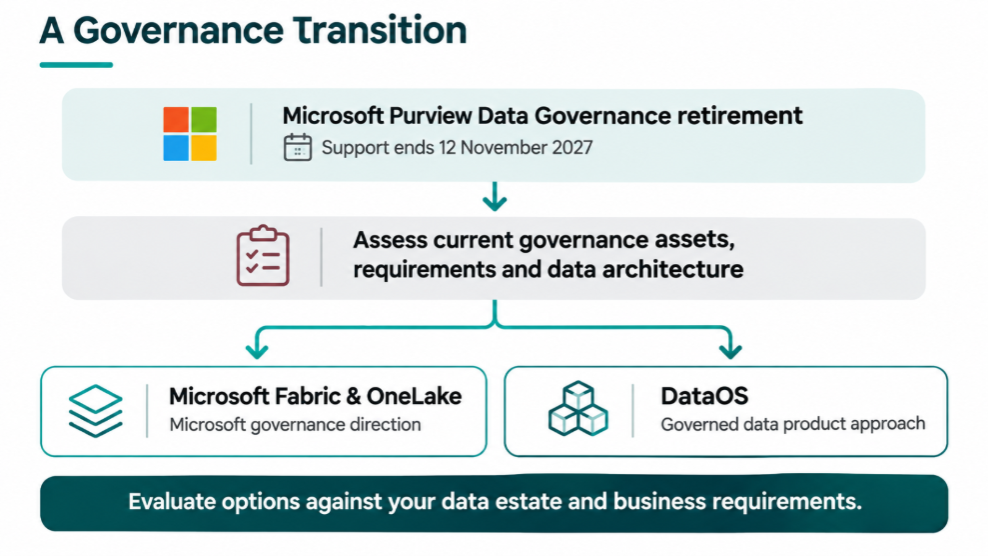
On November 12, 2026, Microsoft announced the retirement of Microsoft Purview Data Governance, with support ending on November 12, 2027. The announcement affects Unified Catalog, Data Map, Workflows, and the classic Azure Purview data governance solutions. Microsoft is directing customers towards Microsoft Fabric and the OneLake catalog as its future data governance approach.
If your organization operates across multiple data platforms, cloud environments, and business applications, this is an important moment to reassess how your data governance strategy supports the wider enterprise. You may have already invested in data cataloguing, business glossaries, lineage and quality controls. The next question is whether these investments are helping your teams consistently prepare, govern, and deliver trusted data for business use.
For organizations with complex data architectures and a need to support multiple business domains, moving entirely towards Fabric and OneLake may not address every requirement. You may need an approach that works across your existing technology landscape, connects governance with data engineering and consumption, and makes trusted data reusable across analytics and AI initiatives.
This is also a good time to examine a broader question: how effectively does the current approach connect data governance with the actual work of preparing, managing and consuming enterprise data?
What changes for Microsoft Purview users?
Microsoft's announcement affects its data governance offering, including Unified Catalog, Data Map, Workflows and the classic Azure Purview data governance solutions. Existing customers have until November 12, 2027, before support ends. During this period, organisations will need to review the governance assets and processes they have built, including data inventories, business glossaries, lineage, classifications and workflows, and understand how these will be carried forward. Microsoft is directing customers towards Microsoft Fabric and the OneLake catalog as its future data governance platform.
It is important to distinguish this change from Microsoft's broader Purview portfolio. Its Data Security and Compliance capabilities remain unchanged. For organisations that rely on Purview primarily for data governance, the immediate task is to assess the impact on their existing environment, understand the transition options and determine whether the Fabric and OneLake approach meets their requirements. This assessment should also consider the wider data landscape, particularly where data is spread across multiple platforms and cloud environments.
What Enterprises should look for when switching from Microsoft Purview Data Governance
Enterprise data governance has evolved beyond maintaining data inventories, documenting ownership and tracking lineage. Organizations now expect governance to improve data quality, establish accountability, provide business context, and make trusted information accessible to the people and systems that need it. Platforms such as Microsoft Purview have helped establish these foundations, and organizations should consider how they will preserve and extend these capabilities as they plan their transition.
A common challenge, however, is that governance activities often remain disconnected from the work of preparing and delivering data for business use. Data engineering, quality management, stewardship, and analytics teams may work with different definitions, processes and interpretations of the same information. This can lead to inconsistent data, duplicated effort, and longer delivery cycles. As organizations evaluate their next governance platform, they should look beyond immediate migration and consider how their governance approach can better connect data management, quality, and business consumption.

A Data Product Approach to Enterprise Governance
At The Modern Data Company, we believe that data governance becomes more effective when it is closely connected to how data is built, managed, and consumed.
This is a central idea behind DataOS.
DataOS provides a platform for creating and managing governed data products across an enterprise data landscape. A data product brings together the data itself, its transformation logic, metadata, business semantics, quality information, lineage, governance and consumption interfaces.
This provides a managed unit of data that teams can understand, trust, and reuse.
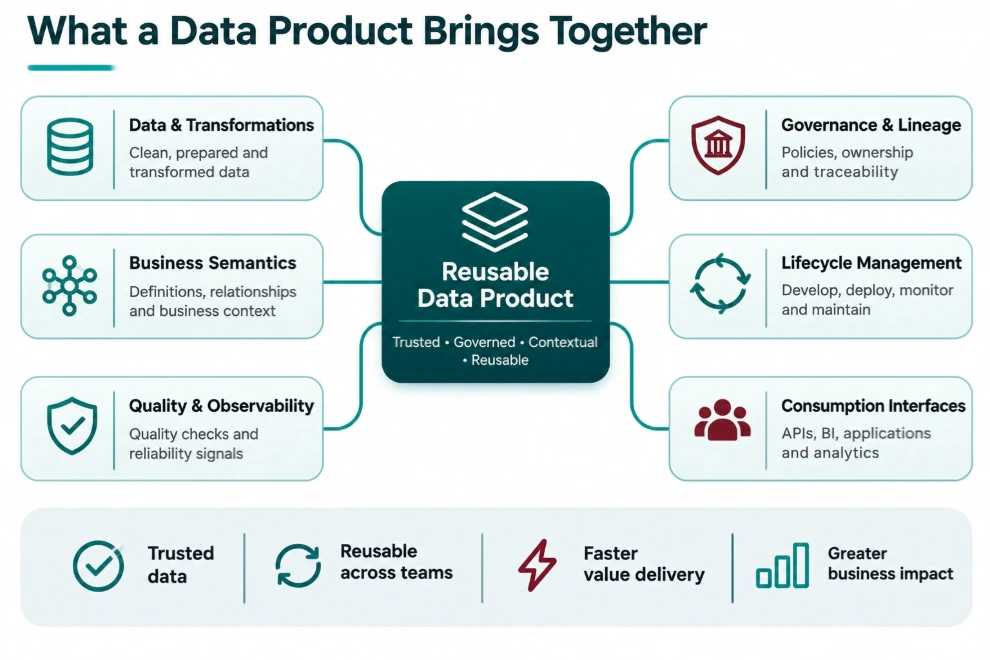
Consider a customer data product. It may combine information from multiple operational systems and data sources, apply agreed business definitions and transformations, incorporate quality checks, and expose a consistent customer view to approved consumers.
The product carries the context needed to understand its contents, its ownership, its dependencies, and the conditions under which it can be used.
The same approach can be applied to other business domains, including products, suppliers, inventory, finance, manufacturing, and supply chain operations.
DataOS brings several important capabilities together in this model:
Business Context & Semantics
Business definitions, relationships, metadata, and ownership help establish a consistent understanding of enterprise data. A shared semantic foundation also makes it easier for different teams to work with the same business concepts.
Data Quality and Trust
Quality checks and observability help teams assess the reliability of data products. Issues can be identified against agreed expectations, with quality information available alongside the data being consumed.
Governance & Control
Governance policies, access controls, and ownership can be associated with data products and their consumption. This helps make governance part of the way data is managed and shared.
Managed Data Product Lifecycle
Data products can be developed, deployed, versioned, monitored, and maintained through a structured lifecycle. Teams can manage changes and dependencies as business requirements evolve.
Consumption & Activation
Data products can be exposed to downstream applications, BI platforms, APIs, and analytical workloads. Teams can build on trusted data without repeatedly recreating the same preparation and business logic.
Together, these capabilities help organizations establish a more consistent operating model for enterprise data.
What this looks like in a Business Scenario
Take customer data as an example.
A large organization may hold customer information across its digital channels, CRM, operational applications, and enterprise data warehouses. The same customer can appear in multiple records, with differences in names, contact information, and other attributes.
A data quality programme can identify missing fields, inconsistent values, and potential duplicates. Governance processes can establish ownership, definitions, and access policies.
The business, however, needs a reliable customer view that can be used across reporting, segmentation, engagement, and other customer facing activities.
Using DataOS, the organization can build a governed customer data product from the relevant source datasets. Agreed transformation and standardization logic can be applied, quality checks can be incorporated, and source lineage and business definitions can be made available alongside the resulting customer view.
Downstream teams can then consume this product through approved interfaces and use a consistent set of customer attributes and definitions.
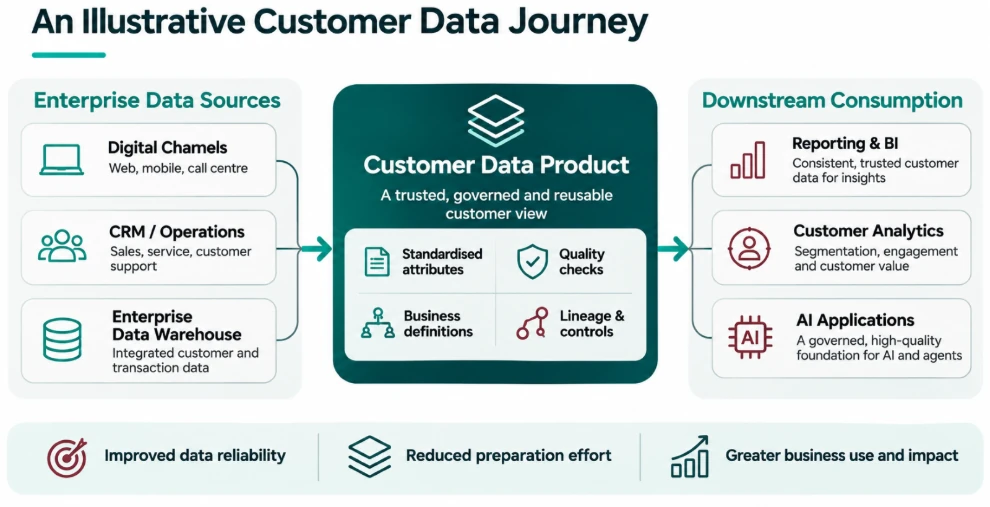
The benefits extend beyond the initial customer data requirement. The same foundation can support customer analytics, product penetration analysis, profitability insights, and future AI initiatives.
The important measure is whether the organization can demonstrate improvements in data reliability, reduce repeated preparation efforts, and make the resulting data useful across more business activities.
Here is a Microsoft Purview Migration Guide to DataOS
Organizations can take a structured approach to moving from Microsoft Purview to DataOS, building on their existing governance investments while aligning them with future data requirements. The first step is to understand which governance capabilities they currently use, what needs to be carried forward, and how these can be established within the DataOS environment. The following steps provide a practical way to approach the transition.
1. Assess your existing Purview environment
Take stock of your current data catalog, business glossary, classifications, lineage, ownership structures, quality rules, workflows and access policies. Identify which capabilities are actively used, which are business critical, and which need to be redesigned.
2. Map existing governance requirements
Review how your current governance policies, business definitions, metadata and data quality expectations should be represented in the new environment. Identify gaps and dependencies, particularly where existing processes involve integrations with other enterprise systems.
3. Connect your existing data landscape
DataOS works with existing data infrastructure, allowing organizations to retain their underlying data platforms while building a governed data product layer. Identify the relevant data sources and establish the connections required for the first set of data products.
4. Establish governed data products
Organize priority business data around reusable data products. Bring together the data, transformation logic, business definitions, quality information, lineage, ownership and governance policies needed by downstream consumers.
5. Validate and roll out in phases
Start with a priority business domain or use case. Validate data quality, governance controls, lineage, access and consumption requirements before extending the approach to other domains. This allows teams to address gaps early and build on an approach that has been tested in their environment.
The transition can be an opportunity to establish a more connected approach to enterprise data governance. With DataOS, organizations can build on their existing data infrastructure and progressively move towards governed, reusable data products that support business intelligence, applications and AI initiatives.
Choosing the Next Step
Organizations currently using Purview should begin by understanding the impact of Microsoft's announcement on their existing governance investments. They will need to identify the capabilities they depend on, review their current data architecture, assess the migration options, and plan how existing governance assets will be preserved.
Microsoft Fabric and OneLake will be a relevant option for many customers, particularly those with a strong Microsoft centric data strategy. Organizations with broader requirements should also evaluate how their future governance approach will support existing platforms, business domains, and downstream consumers.
DataOS offers an alternative approach for organizations looking to connect data governance with the creation, management, and consumption of trusted data products. By bringing together business context, semantics, data quality, lineage and governance, DataOS helps organizations make enterprise data more consistent, accessible and reusable across business intelligence, applications and AI initiatives. The Modern Data Company helps enterprises build on their existing data infrastructure to put trusted data to work across the organization.