Categories


When a supplier moves a part's delivery date, a satellite manufacturer has to answer one question fast: which spacecraft, which work, and which customer promises does this change touch? The late part is a physical problem. Working out what the lateness affects is a data problem, and that is the problem this article examines.
What we know and what we don't. Public filings show supplier delays can push back satellite deliveries and trigger compensation claims. Reports that the needed records sit apart and are joined by hand come mostly from vendors. How often the assessment is needed, what it costs, and how much existing software covers it remain open.
How Do Supplier Delays Reach a Satellite Customer?
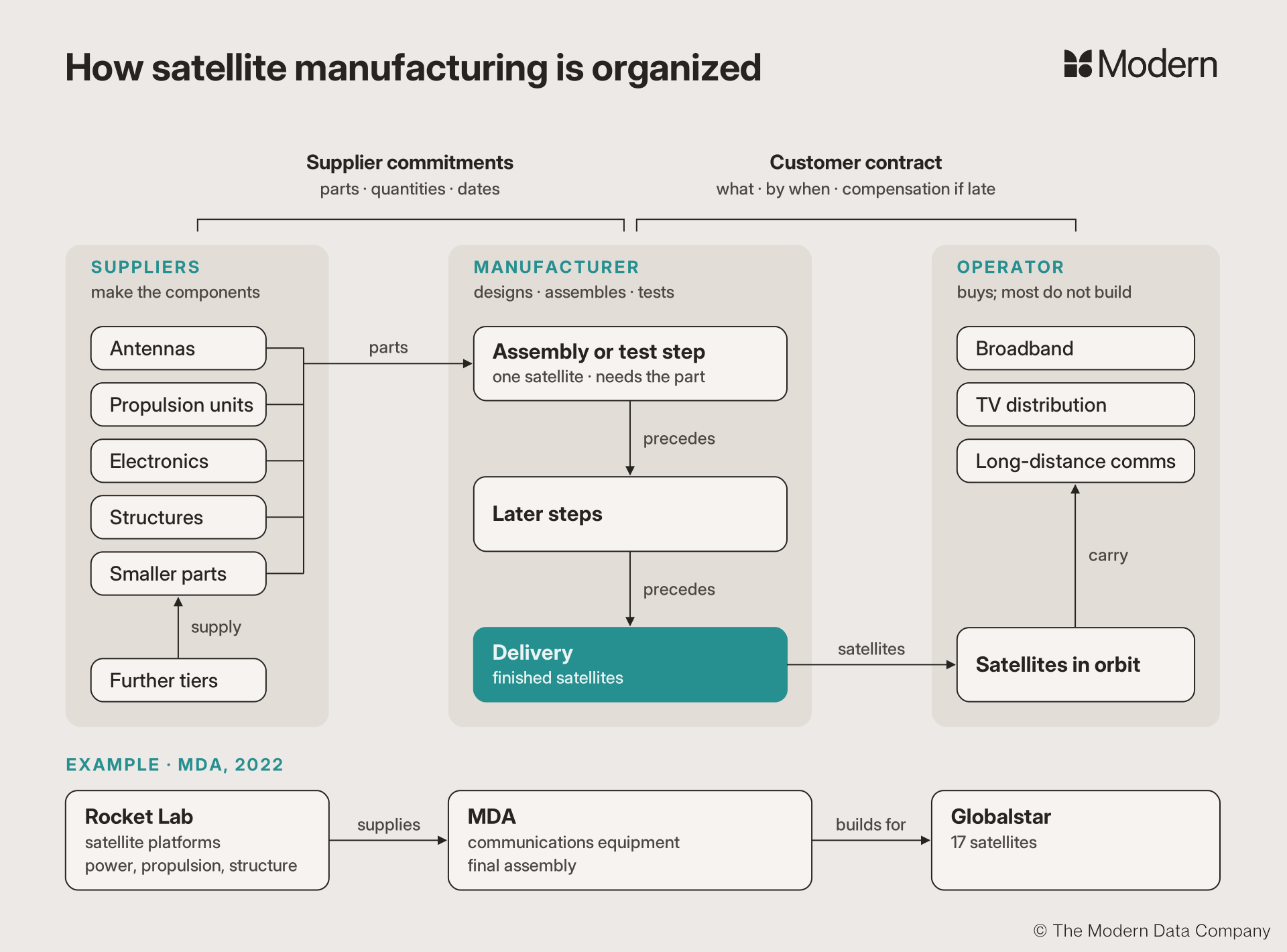
A satellite manufacturer sits between two sets of promises: what its suppliers owe it, and what it owes its customer. Operators rarely build their own satellites. They buy them under contracts that fix what is delivered, by when, and what is owed if delivery is late.
The manufacturer designs, assembles, and tests the spacecraft, but buys many parts, sometimes across several supplier tiers. On Globalstar's 17-satellite order, MDA led the payload and final assembly and test, while Rocket Lab designed and built the spacecraft buses that carry power, propulsion and structure.
The two sets of promises meet in the assembly and test schedule. Each part feeds a specific step on a specific satellite, and each step gates the ones after it. A slipped part date is the first link in a chain that can end at a customer's delivery date.
Why Is Supplier Delay Impact So Hard to Assess?
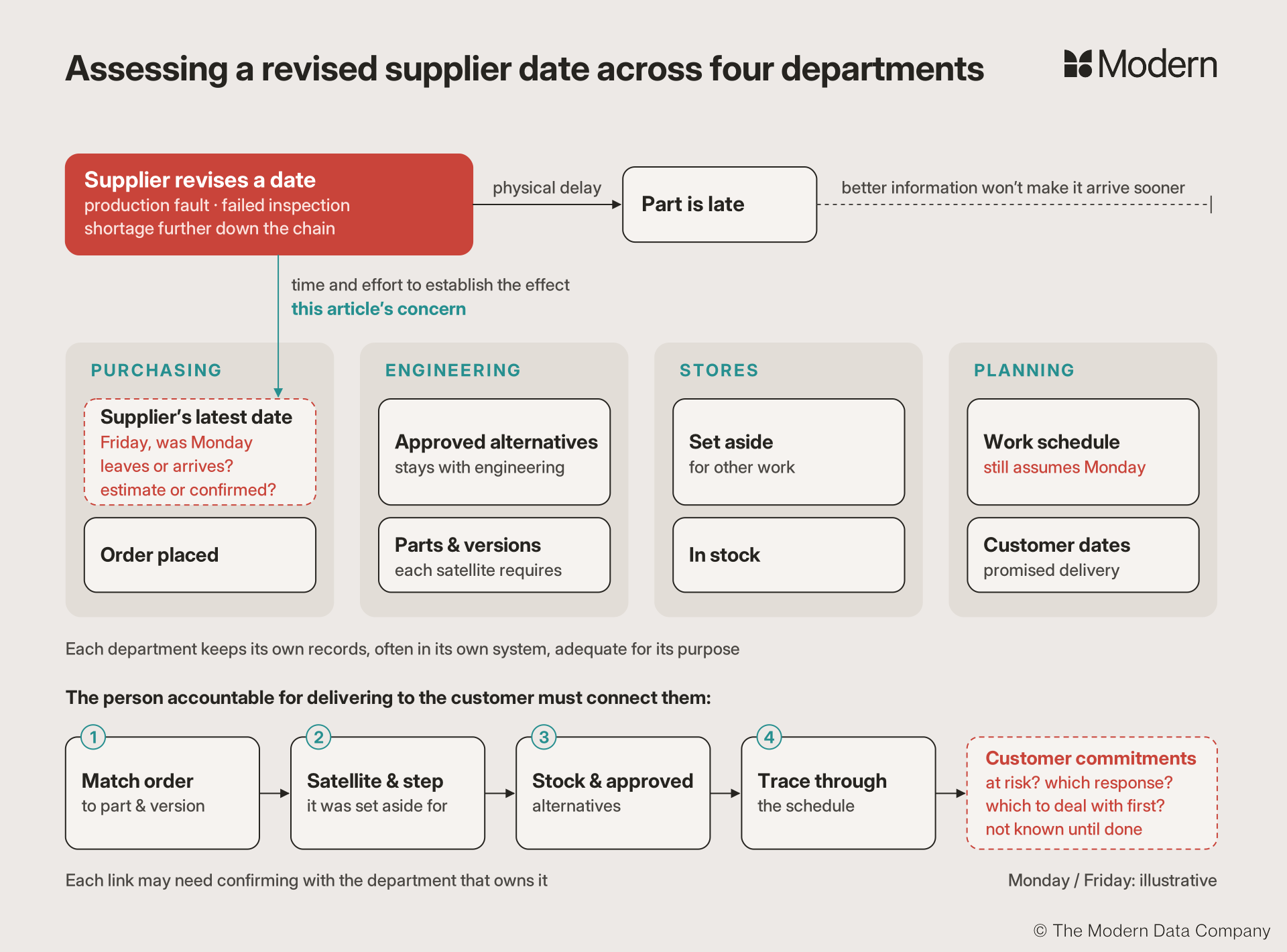
The answer needs four sets of records, kept separately by four departments.
Each set fits its own purpose. Trouble starts when a supplier tells purchasing that Monday's part will arrive Friday, while the schedule still assumes Monday.
Someone then joins the records by hand: matching the order to the part and version, finding the satellite and step it was reserved for, checking stock and alternatives, and tracing the effect to the customer date. Each join may need confirming with its owner.
The dates need reading carefully too. A supplier date may mean departure rather than arrival, and an estimate is not a confirmation. Until the joins are done, nobody can say whether the customer date is at risk, which is the gap decision-ready supply chain data is meant to close.
Is This a Real Problem in the Space Industry?
Audits and practitioner accounts describe the same split, though the evidence is uneven.
- Space Development Agency. In January 2026, the GAO recommended that the agency build and maintain an architecture-level networked schedule reflecting both government and contractor work.
- NASA Artemis. NASA's Office of Inspector General reported in October 2023 that the agency lacked visibility into its critical suppliers, with many projects not tracking their prime contractors' supply chain impacts.
- Builders and manufacturers. Vendor-published accounts describe RAL Space and Reflect Orbital joining parts, orders and stock through separate systems, email and spreadsheets. An anonymous Cofactr case describes buying against suppliers' original dates rather than revised ones.
Not every manufacturer starts from zero; GomSpace adopted project-based manufacturing software in 2017, according to its vendor IFS. The real question is whether the link from supplier change to customer commitment is maintained, or rebuilt by hand each time.
What Does a Late Supplier Cost a Satellite Manufacturer?
A late supplier can become a contractual liability. In its Q3 2025 report, MDA said the Globalstar satellites would arrive later than contracted, partly because of delays at certain key suppliers. It noted Globalstar could claim liquidated damages, and MDA could in turn claim against contributing suppliers.
Globalstar's 10-Q for the quarter ended 30 September 2026 puts dates on it. The first set reached final delivery in July 2026 and launched in August. The second set is due in December, and damages are still under discussion.
Neither filing blames information management, but both show the stakes.
Options also narrow over time. Caught early, a slip can be absorbed by resequencing work, using an approved alternative, borrowing stock or agreeing a revised plan with the customer. While the assessment drags on, other teams keep planning against the old date.
From Manual Reconstruction to Commitment Lineage
The shift we propose is to treat every promise in a satellite program as data with lineage. Data teams already trace how a report number depends on upstream tables. A supplier date deserves the same treatment: a commitment with known dependents, not a field in a purchasing system.
Commitment lineage is a maintained path from each supplier promise, through parts and work steps, to each customer promise. It turns "who can rebuild this answer by Friday?" into "what does the lineage already show?" It rests on five conditions.
- Maintained links. Each supplier order stays connected to its part and version, the quantity reserved for each satellite and step, and the dependent customer commitment.
- Precise meanings. Estimates are distinguished from confirmed dates, departure from arrival, approved alternatives from pending ones. This takes lineage with semantics, not lineage alone.
- Source and time on every fact. Users see where each fact came from and how current it is.
- Visible gaps. Missing links and conflicting records are flagged, never papered over.
- Decisions stay with people. The output is a review list. Approving alternatives, revising schedules, and changing customer promises remain human calls.
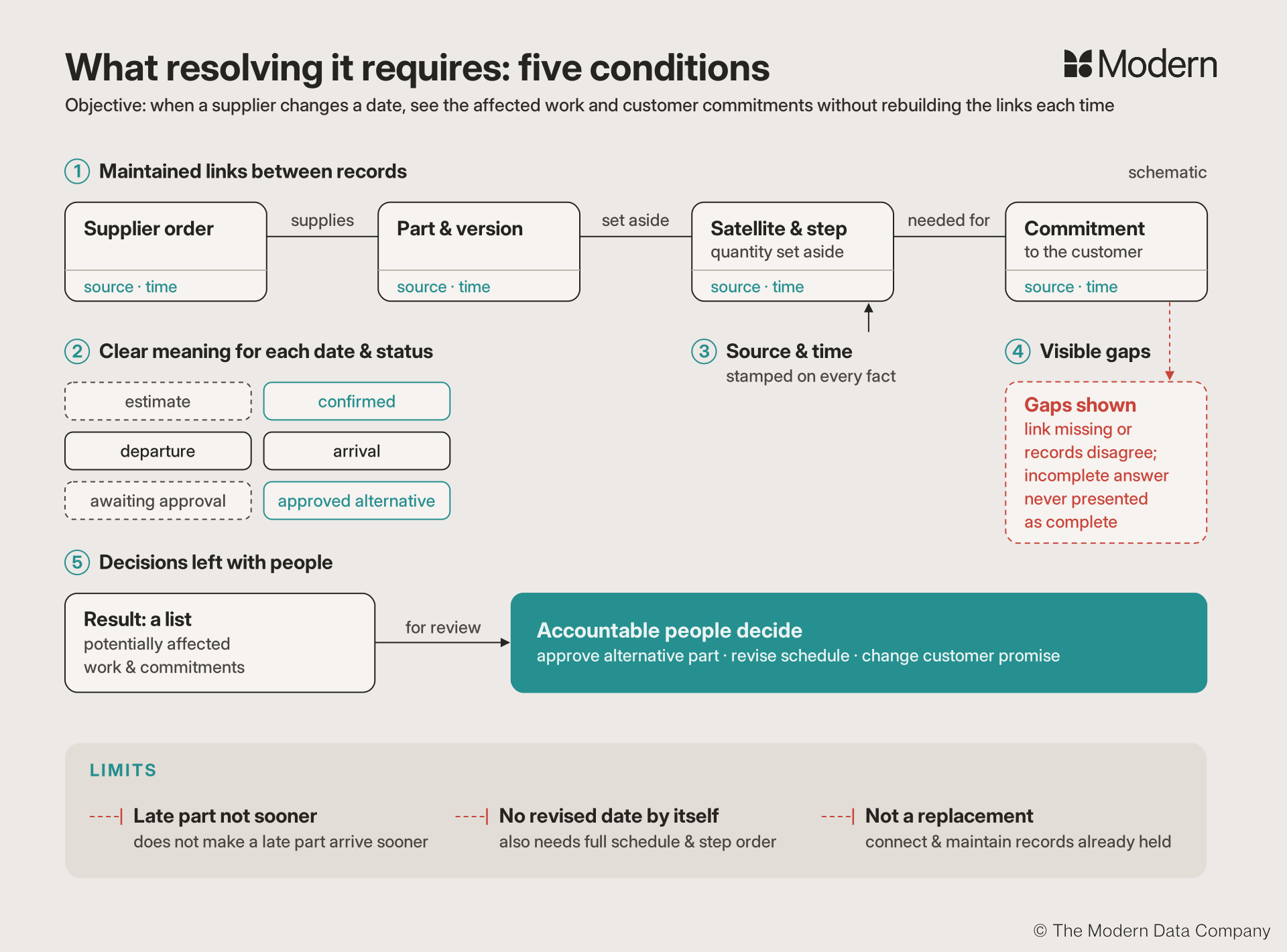
Lineage does not make a part arrive sooner, and a revised delivery date still needs the full schedule. Most manufacturers already hold the records, so the work is connecting them, not replacing systems.
It is also the precondition for AI in the program office. An assistant asked, "What does this slip break?" can only answer from links someone maintains, which is why the context layer has to come before the agent.
Can a Data Platform Show What a Supplier Delay Puts at Risk?
DataOS can connect purchasing, engineering, stock, and planning records so a revised supplier date is read alongside the work and customer commitments it touches.
An implementation would link those records, surface approved alternatives, and flag missing or conflicting information, with a source and update time on each fact. Delivery managers could review it through a report, an application or an AI assistant.
If your team assembles this assessment by hand today, we would like to hear which records are involved and which checks take the most work.