

Early in my career, I wrote software for high-energy physics. One concept from the world of physics has stayed with me: half-life. You cannot say when a single atom will decay. You can say, with great confidence, how long it takes for half of a sample to go. And every radioactive isotope keeps its own clock. Some last seconds. Some outlast civilizations.
Context is not a layer. It is a capability that ages.
We often talk about context as a layer, something you add on top of the data. I think that framing hides the real problem. Context is an enterprise capability built into the data itself: what things mean, what rules apply, and what is true right now. And like anything living, it ages.
It does not age evenly. In the enterprises I work with, I see three broad clocks:
- Facts or events decay fastest. A customer's status, an order's delivery date, today's stock level, the price on a contract. A new order, a payment or a shipment changes them every day, often without anyone telling the data.
- Policies decay at a middle pace. Discount limits, credit thresholds, approval rules, who may see what. They change with regulation, targets, and incidents, usually as discrete events.
- Definitions decay slowest. What a customer is, how revenue is recognized, what counts as active. They can hold for years. But when one changes, the blast radius is the largest, because everything downstream leans on it.
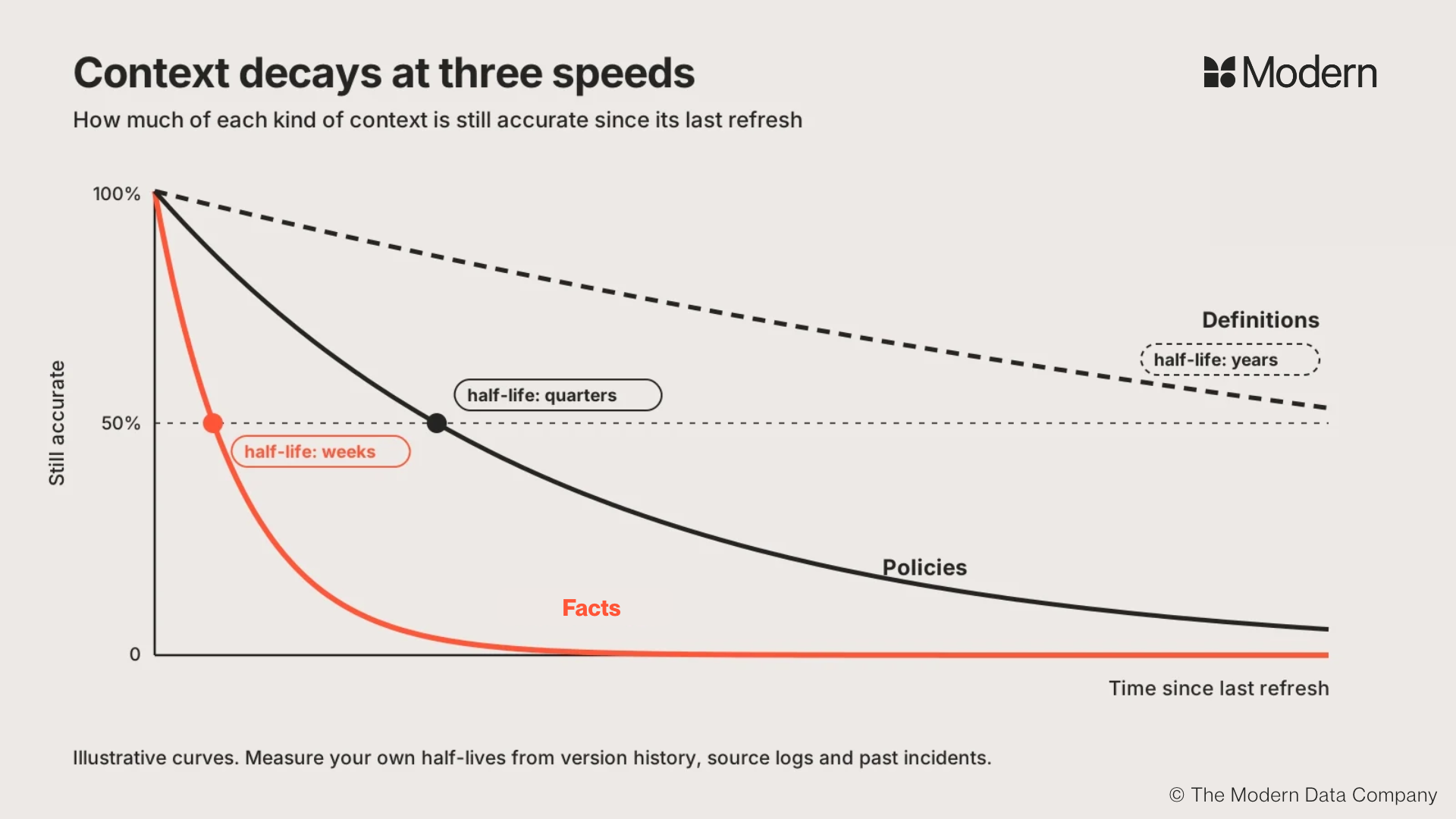
Stale context is worse than missing context. A missing definition potentially makes an AI agent stop and ask. A stale one makes it act, confidently and wrongly.
Why blanket re-cataloging fails
The usual fix is the annual review. Everyone re-checks the glossary, the catalog, and the policy register on the same calendar. It feels responsible, but it is the wrong shape.
Facts go stale within weeks, so for most of the year the agent works from an out-of-date map. Definitions barely move, so teams spend weeks re-approving what has not changed. Equal effort for unequal decay means you are always too late on the fast things and too early on the slow ones.
There is a more subtle problem too. A refresh plan built by the catalog team reflects how the catalog team sees the catalog. It is organized around tables and owners, not around the decisions that break when context goes stale. Nobody is being careless. The plan simply starts from the wrong end.
Refresh by half-life: four moves
Here is the alternative I suggest to teams. Refresh each piece of context at the speed it decays, and weight it by what breaks when it does.
1. Measure the “half-life” from your change history. You don't need to guess. Take one kind of context, say customer status. Version history and source system logs show how long each item stayed unchanged before it changed. The half-life is the point at which half of them had changed. If half your customer statuses changed within six weeks, their half-life is six weeks. If half your core definitions are still unchanged after three years, theirs is at least three years. Past incidents then tell you which of those changes actually hurt.
2. Refresh on events instead of on dates. Fast-decaying facts and events should refresh when the source moves: a status change in the CRM, a payment in billing, a shipment in the warehouse system. Policies should refresh on the event that changes them, such as a new regulation or a revised approval limit. Slow definitions need a deliberate review and a new version, so a change is a decision rather than an accident.
3. Listen for the clicks. A Geiger counter tells you something is decaying without opening the box. In an enterprise, the clicks are agent overrides, growing reconciliation work, and people asking which number is right. When the clicks speed up around a piece of context, its half-life is shorter than you thought.
4. Retire what nothing uses. Context that no decision depends on still costs effort to keep fresh. If nothing reads it, let it go.
Put decay speed and impact together and you get a simple map of where the effort belongs.
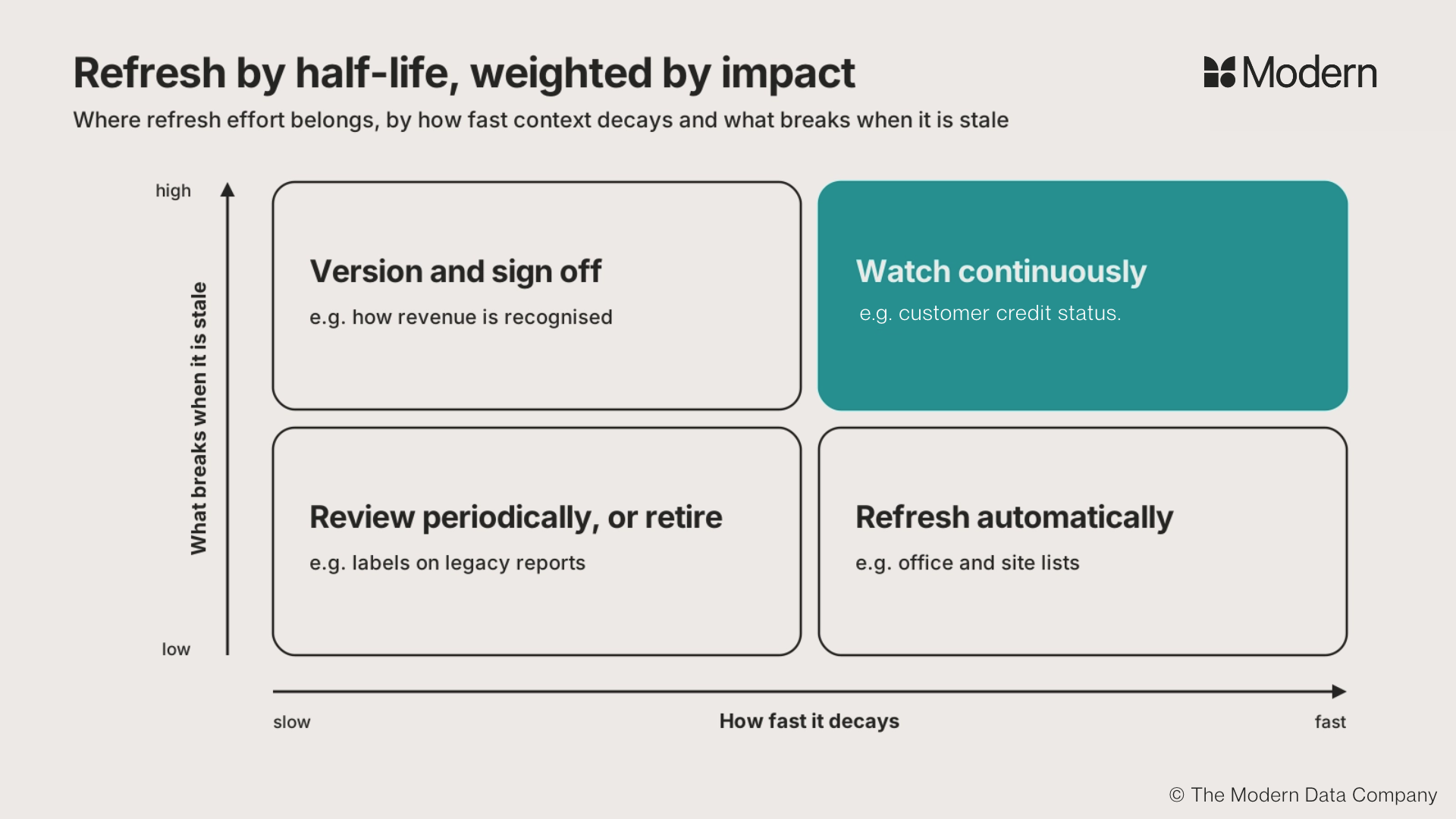
Fast, high-impact context deserves continuous watching. Fast, low-impact context should refresh automatically. Slow, high-impact context needs versioning and sign-off. Slow, low-impact context can wait for a periodic review, or for retirement.
How DataOS keeps context fresh
Refreshing by half-life is hard when context exists somewhere else: a wiki, a spreadsheet, a glossary someone updates by hand. The data moves on. The description of it does not.
DataOS takes the other route. Context is built into each data product, alongside the data it describes, so it refreshes through the same machinery:
- Facts arrive with the data. Data products are built from the systems where facts and events are recorded, so a new order or a status change shows up with the data instead of waiting for a review.
- Policies are enforced at the product. Change an access rule or a threshold once, and every consumer, people and agents alike, gets the new rule.
- Definitions change as new versions. A slow, high-impact change gets an owner and a version, not a quiet edit in place.
- Freshness travels with the product. Lineage shows what a change touches, and freshness and quality signals tell an agent how old its context is before it acts.
That last point matters most to me. An agent that can see its context is old can slow down, ask, or hand the decision to a person. An agent that cannot see it simply acts.
Keep the fastest clocks fresh
Every technology cycle I have seen since 1999 has had a version of this problem. Early websites went stale because pages were written by hand; we learned to publish from live systems instead.
Context will go the same way. The organizations that get it right will be the ones that know which context is decaying fastest and keep that part fresh. That’s a far cry from cataloging everything.
So here is my question: which piece of your context has the shortest half-life, and when did anyone last check it?