The Unique Challenges of Public Sector AI
Lorem ipsum dolor sit amet, consectetur adipiscing elit. Suspendisse varius enim in eros elementum tristique. Duis cursus, mi quis viverra ornare, eros dolor interdum nulla, ut commodo diam libero vitae erat. Aenean faucibus nibh et justo cursus id rutrum lorem imperdiet. Nunc ut sem vitae risus tristique posuere.
A state agency pilots an AI tool to flag likely improper payments in a benefits program. In the demo, on a clean sample dataset, it works. In production, it reads from the same case management system caseworkers use every day. It flags the wrong cases, misses obvious ones, and nobody can explain why.
The model didn’t change between the demo and production. The data it had to reason over did.
That pattern shows up across government. In NASCIO’s 2026 State CIO Survey, 82% of states reported AI projects in production. Only 35% reported AI running at enterprise scale across the executive branch. What separates the two is data readiness for AI: whether the data underneath was ever made ready for a machine to act on.
What Is Data Readiness for AI?
For most of the last decade, data readiness meant proximity to a dashboard. If data was stored, modeled, and visualized, an analyst could make sense of it. That bar assumed a human was always in the loop to fill in what the system left out.
AI removes that human. The Modern Data Report 2026 found that models don’t browse Slack channels or remember why one metric is “more correct” than another. An AI agent, a system that carries out multi-step tasks and calls data sources on its own, only knows what the system makes machine-readable.
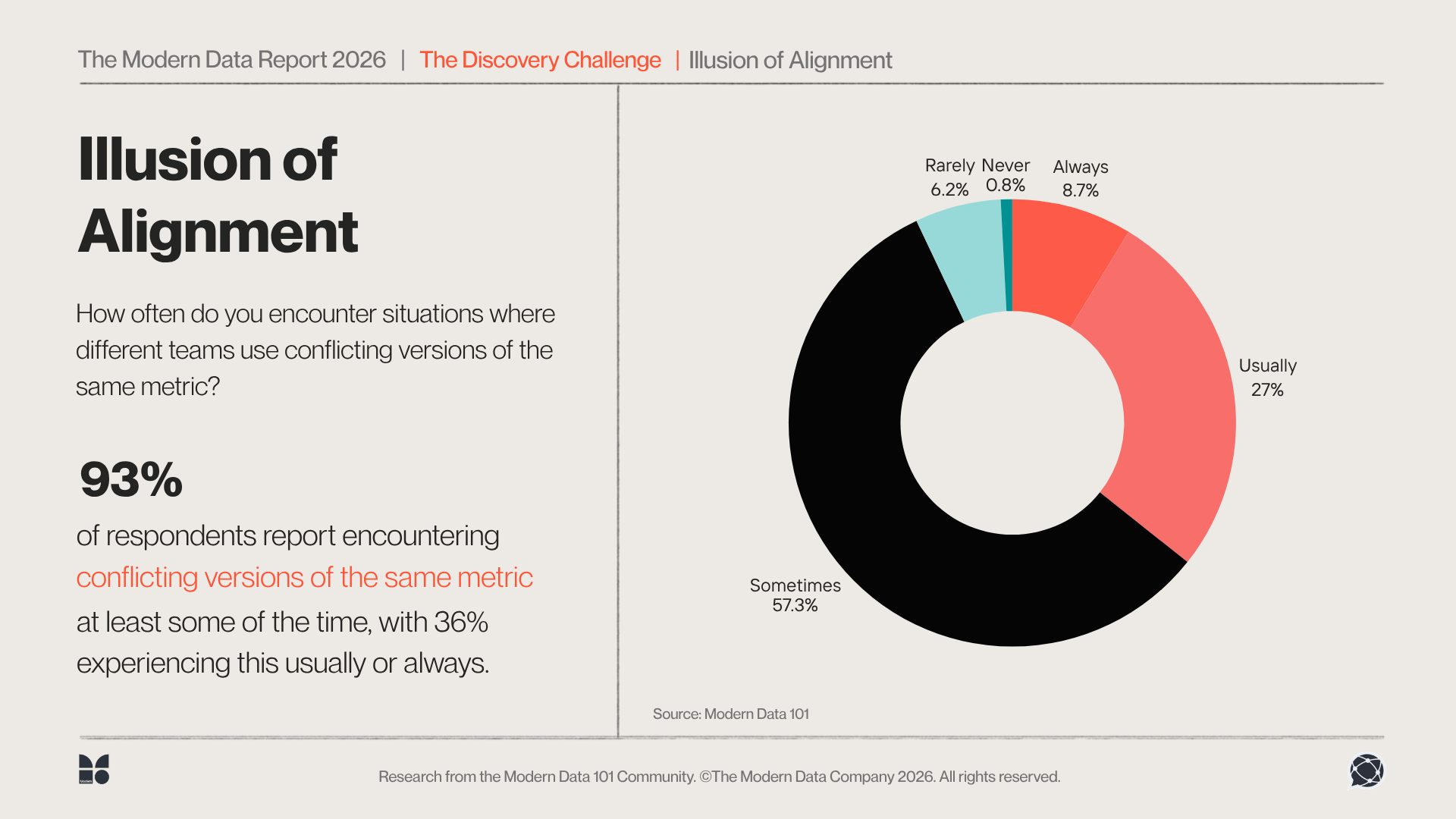
The report surveyed more than 540 data leaders and practitioners across 64 countries. Ninety-three percent report encountering conflicting metrics. Sixty-eight percent say their data isn’t trustworthy enough for AI to act on directly.
Animesh Kumar, Co-Founder and CTO of The Modern Data Company, draws a clear line between analytics-ready and AI-ready data. AI-ready data passes three tests:
- Fresh: current enough that a model isn’t reasoning about a world that no longer exists.
- Complete: granular enough to avoid brittle, logically incomplete outputs.
- Semantically rich: relationships, hierarchies, and intent are encoded in the data itself, not left for a human to infer.
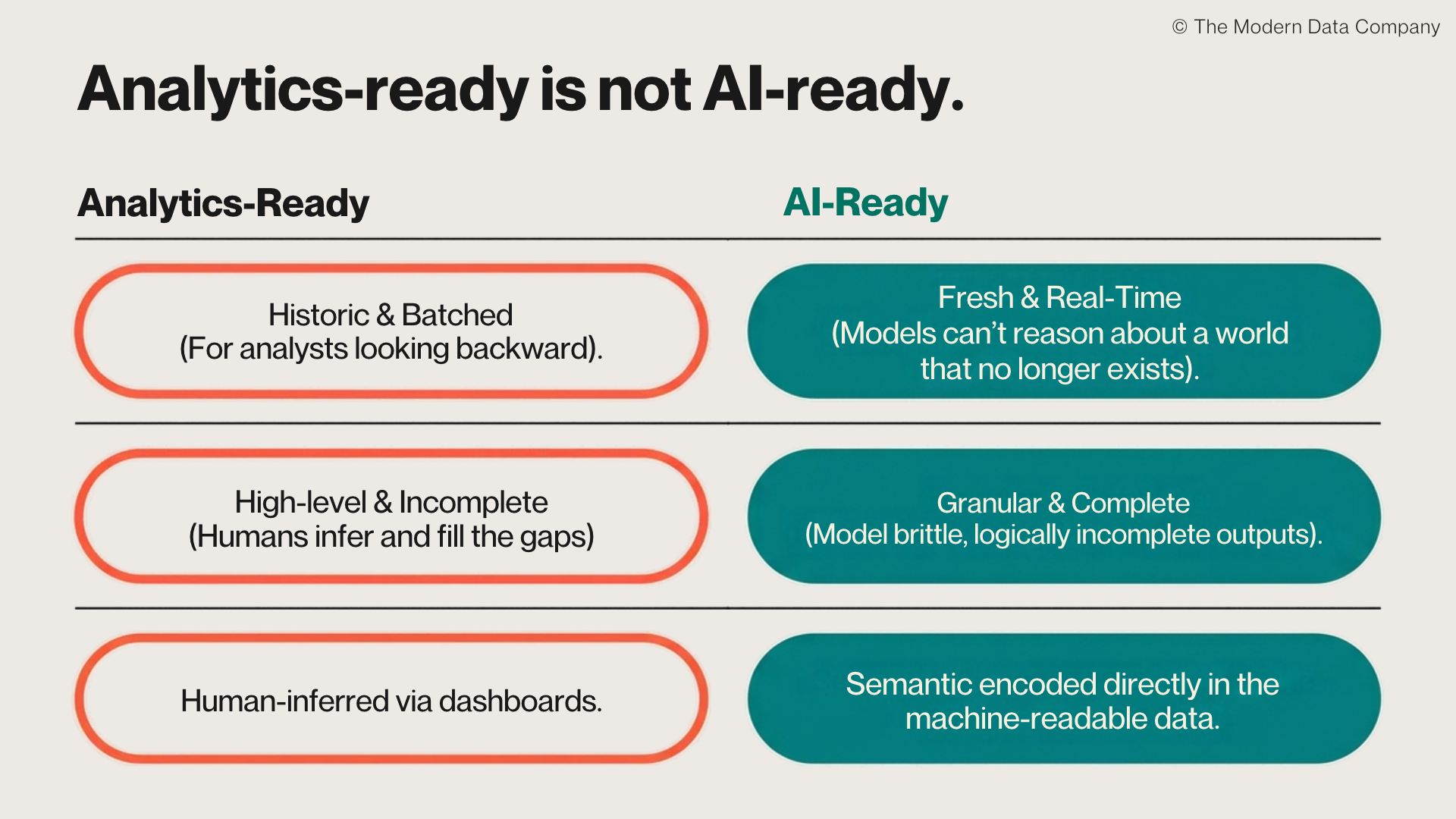
Data readiness for AI means the data explains itself, because no human will be there to explain it.
Why Is Data Readiness Harder for the Public Sector?
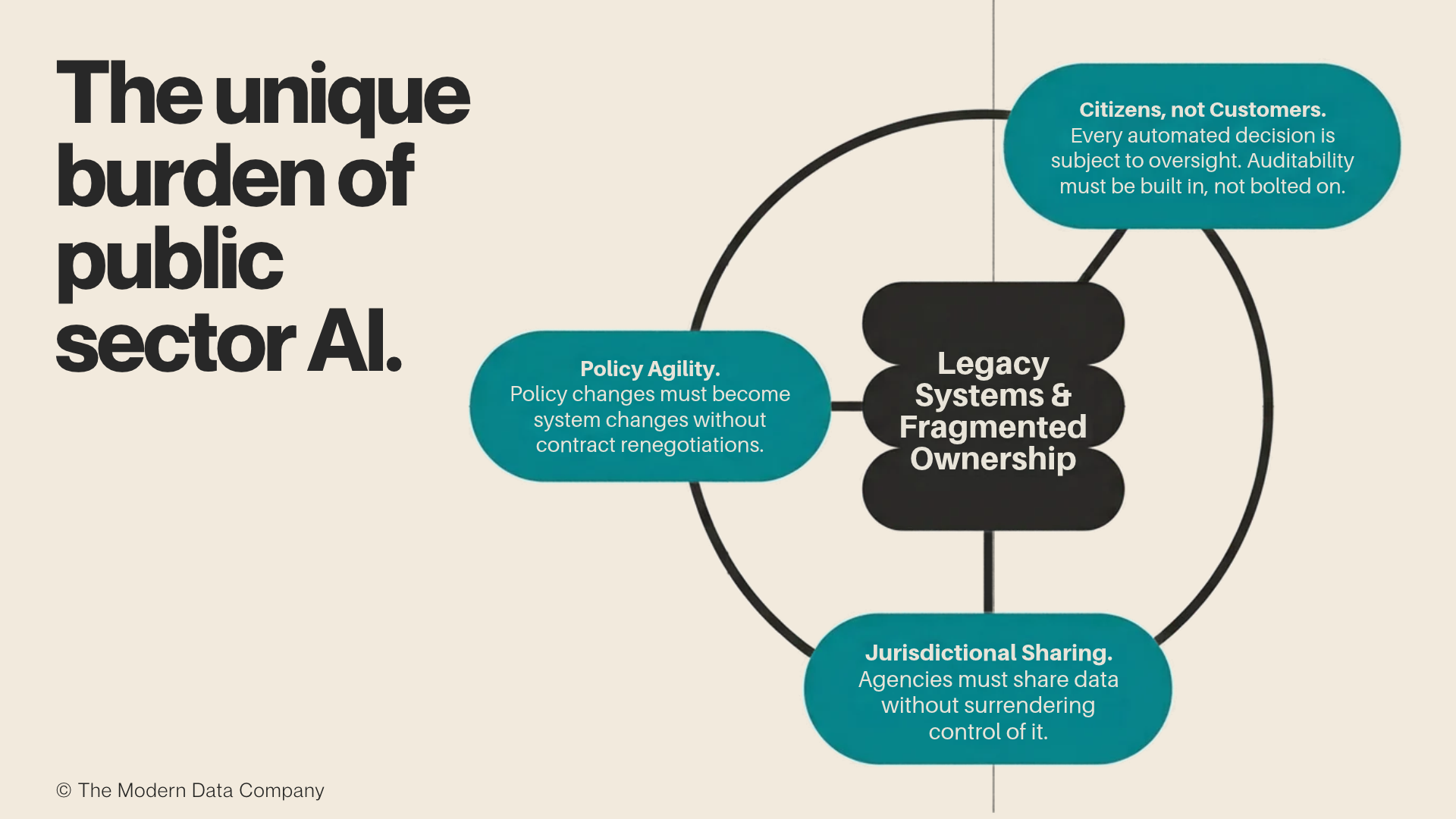
Every organization chasing AI readiness deals with legacy systems and fragmented ownership. Government carries an extra requirement. Agencies serve citizens and every automated decision is subject to oversight.
A review of public sector data stacks by Modern Data 101, the practitioner community supported by The Modern Data Company, names three requirements that follow directly from that distinction:
- Auditability. The public, inspectors general, auditors, legislators, and courts need to examine a decision rather than take it on faith. Under OMB M-25-21, high-impact federal AI uses also require documented risk management practices.
- Interoperability. Agencies routinely share data across programs and jurisdictions without surrendering control of it.
- Adaptability. A policy change has to become a system change without a contract renegotiation in between.
The data itself raises the stakes further. Criminal justice information (CJIS), protected health information (HIPAA, 42 CFR Part 2), federal tax information (IRS Publication 1075), and student records (FERPA) each carry their own access rules. Records retention and FOIA obligations extend to what AI systems produce.
None of that is achievable by adding a compliance layer on top of an unready data estate. Most states have not built that foundation yet. In a NASCIO and EY study of 46 states, only 22% had a dedicated data quality program. Seventy-two percent described their approach to data quality as reactive or merely aware.
Federal agencies show the same gap. In a March 2026 Market Connections survey of more than 200 federal IT executives, nearly 90% said they require logging and audit trails for agentic AI. Fewer than a third had implemented the oversight frameworks most of them called essential.
The Policy Context
Recent guidance makes data readiness a compliance question, not only a technical one:
- OMB M-25-21 (April 2025) requires AI use case inventories and risk practices for high-impact AI. Both depend on traceable data.
- OMB M-25-22 (April 2025) protects government data rights and discourages vendor lock-in.
- The NIST AI Risk Management Framework expects evidence of data provenance and quality.
- The Evidence Act (2018) created agency Chief Data Officers and data inventories.
- Zero Trust guidance, including the CISA Zero Trust Maturity Model, calls for data-level access control.
- State and local rules are growing, from the Texas Responsible AI Governance Act (effective January 1, 2026) to GovRAMP and TX-RAMP.
Data ownership belongs here too. An agency that can’t trace its data, or take it along when a contract ends, can’t prove auditability or interoperability.
In government, data readiness for AI is not a technical preference. It is the evidence an agency needs to defend every automated decision.
The Seven Stages of AI-Ready Data Architecture
Kumar and Travis Thompson, Chief Architect and Head of Engineering at The Modern Data Company, lay out AI readiness as a sequence, not a checklist. Each stage fixes the specific failure the previous stage left behind. Skip one, and the debt lands on the team that hits the wall two stages later, usually analytics and AI.
| Stage | What it establishes | What breaks without it |
|---|---|---|
| 1. Modular infrastructure | Storage, compute, and orchestration as swappable parts | Every change touches everything; no room to add new tools |
| 2. Central + distributed ownership | Domain teams own the data they understand best | A central team becomes a permanent bottleneck |
| 3. Unified data layer | One consistent interface across existing warehouses and lakes | Agents learn a dozen different schemas instead of one |
| 4. Governed, observable platform | Lineage, quality checks, and access policy enforced at the point of use | Small quality issues become organization-wide ones |
| 5. Semantic, context-aware layer | One canonical definition per metric and entity | Two governed, high-quality datasets still disagree on what “active case” means |
| 6. Self-service developer platform | Trusted data products any team can discover and reuse | Only the platform team can safely build anything, so nothing scales |
| 7. AI-native platform | Data products callable directly by agents, policy enforced at runtime | Agents inherit every unresolved ambiguity beneath them, at machine speed |
Each stage is a prerequisite for the next, so an agency is only as AI-ready as the lowest stage it has finished.
What Happens When You Skip a Stage?
At stage four, governance stops bad data from moving. It says nothing about whether two clean, well-governed systems agree on what a metric means. That is stage five’s job. A semantic layer, one shared set of business definitions that every tool and agent reads from, settles what “active case” means once.
Gartner puts a number on the gap. It predicts that by 2027, organizations that prioritize semantics in AI-ready data will increase agentic AI accuracy by up to 80% and reduce costs by up to 60%. The seven-stage sequence explains why that gain depends on what sits underneath. Semantics only pays off once governance is in place.
The cost of skipping stages shows up in plainer terms too. The Modern Data Report found that 89% of practitioners rank finding the right data among their top three-time drains. Seventy percent report rework within a single quarter.
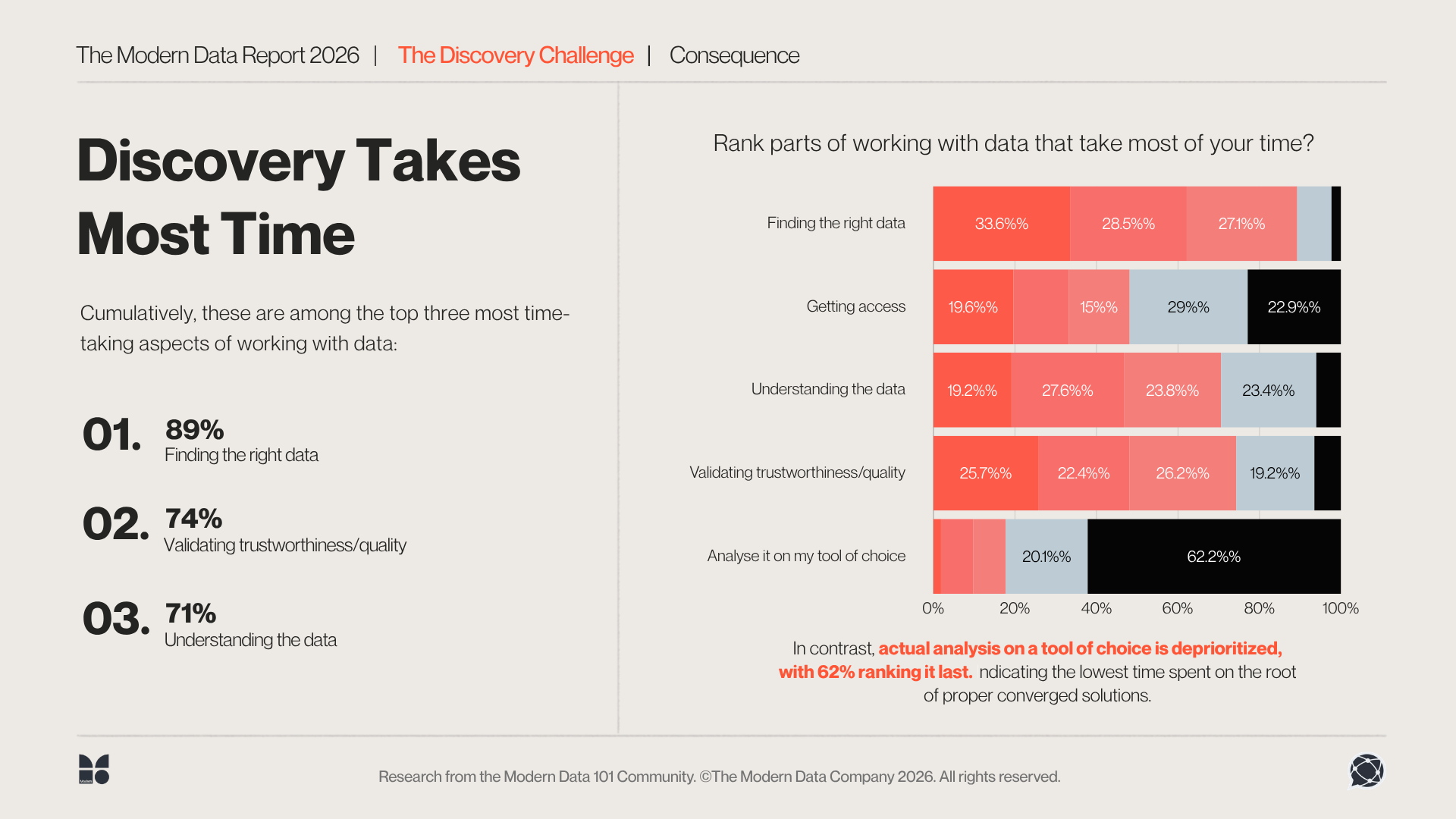
None of that is a tooling gap. It’s stages four and five, skipped, charging interest.
How DataOS Enables the AI-ready Data Architecture
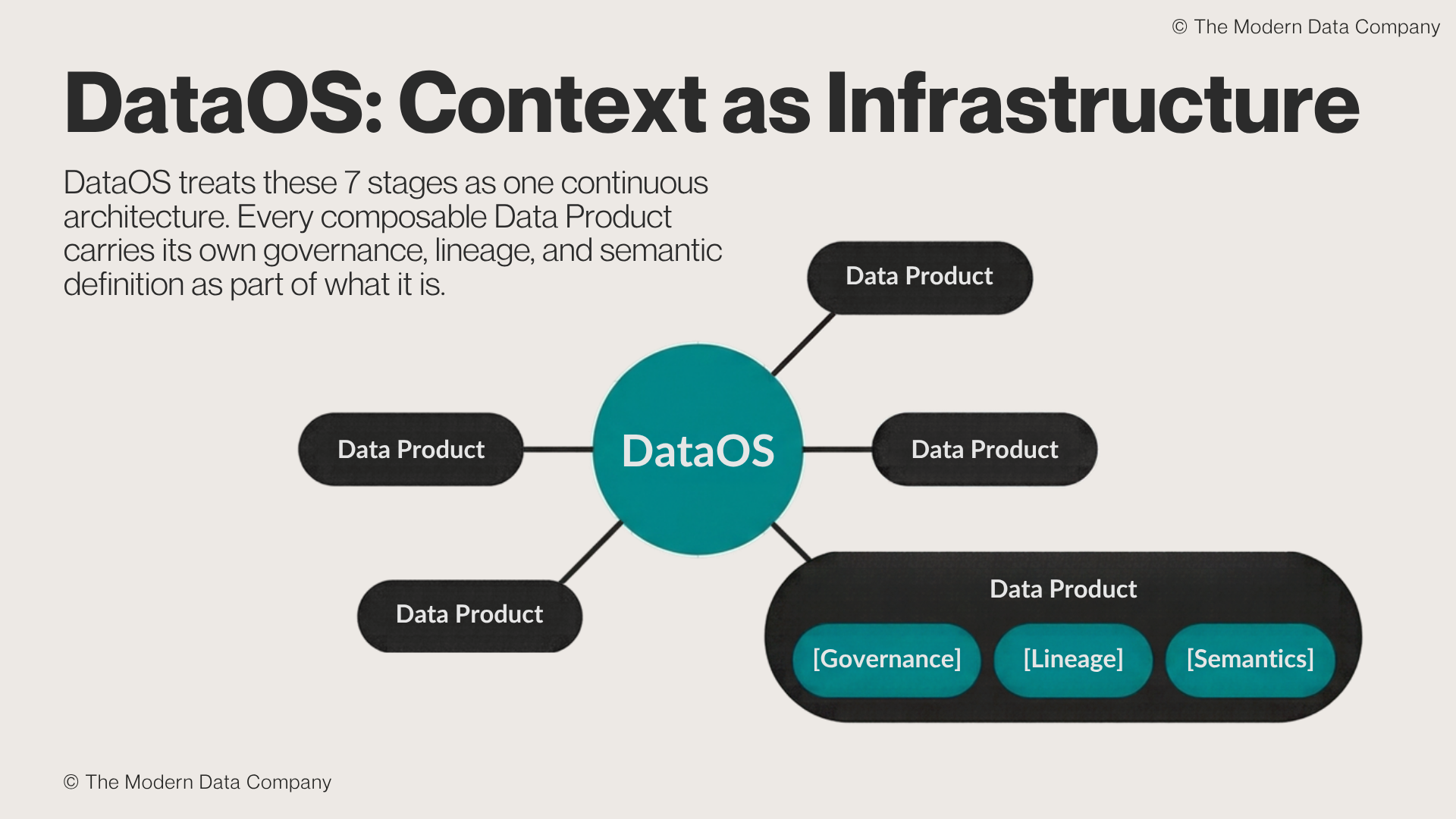
DataOS® for Public Sector treats the seven stages as one continuous architecture rather than seven separate purchases. It is built around data products, governed, semantically defined datasets built for a specific use, with lineage and access policy attached. A metric defined once reads the same way to an analyst, a dashboard, or an AI agent.
Treating context as infrastructure lets an agency add a new jurisdiction’s data or a new oversight requirement without rebuilding stages one through four. Lineage, the record of where data came from and how it changed, travels with each data product. So does its access policy. That is what makes auditability and interoperability practical, as the data product ecosystem grows.
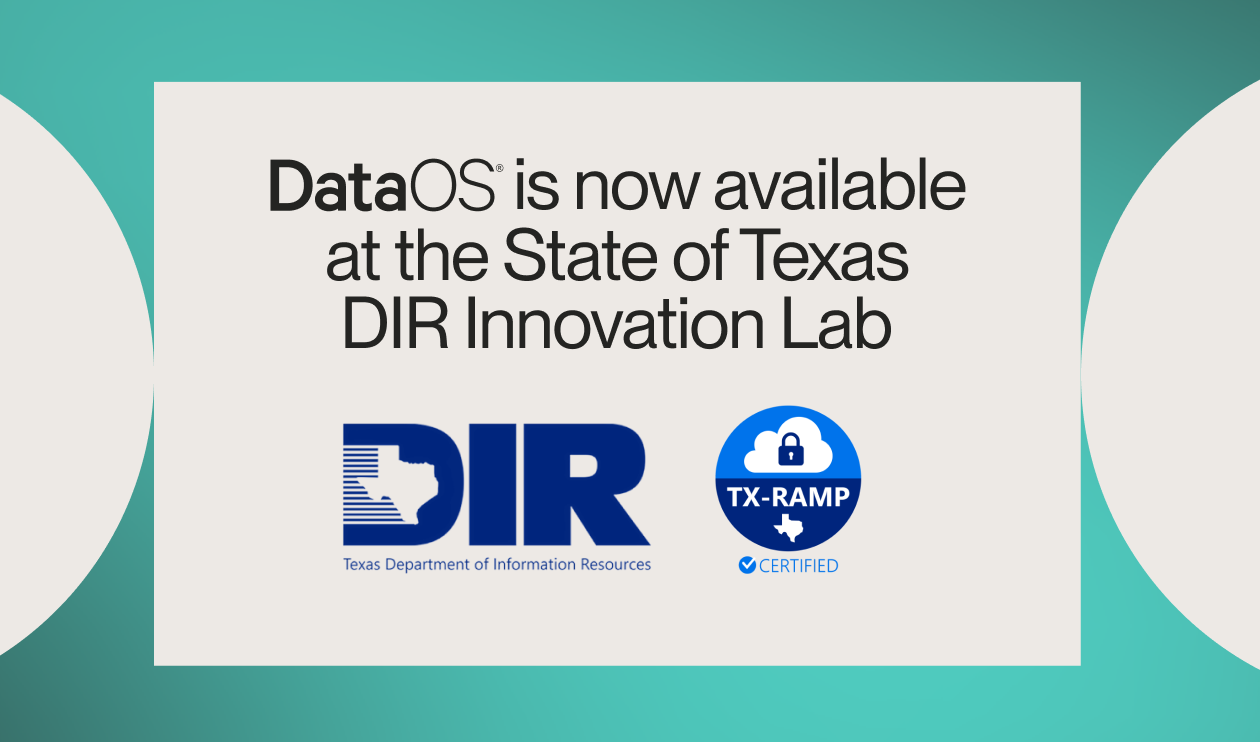
For agencies, DataOS works with existing systems rather than replacing them. That matters when budgets run on annual cycles and legacy systems can’t be switched off. DataOS is available through Carahsoft, NASA SEWP V, ITES-SW2, and NASPO ValuePoint, DIR-CPO-5687 and supports agency FedRAMP, TX-RAMP Level 2, CJIS, and NIST SP 800-171 requirements.
How to Assess Your Own Data Readiness for AI
Before the next AI pilot gets scheduled, find out which of the seven stages your agency is standing on. Most AI accuracy and governance problems trace back to data that was never made ready. The fix starts below the model, not inside it.
Start with seven questions. A “no” marks the stage to fix first.
- Modular infrastructure: Can we add or replace a storage, compute, or analytics tool without rebuilding what sits around it?
- Ownership: Do program offices own and publish their data, or does every request go through one central team?
- Unified access: Can an analyst or AI tool reach data across our warehouses, lakes, and legacy systems through one consistent interface?
- Governance: If an inspector general asked which data informed an automated decision, could we show the lineage, quality checks, and access policy in under a day?
- Semantics: Do our programs share one definition for terms like “active case,” “eligible household,” or “resolved incident”?
- Self-service: Can a program team find, trust, and reuse an existing data product without opening a ticket?
- AI-native: Can an AI agent call a governed data product directly, with access policy enforced at the moment it asks?
To score your answers against a structured benchmark, take the AI Readiness Scorecard.
The agencies that scale AI won’t be the ones with the best models. They will be the ones whose data could answer an inspector general before the model ever ran.



.png)