Embedding Data Governance: From Gatekeepers to Guardrails
Lorem ipsum dolor sit amet, consectetur adipiscing elit. Suspendisse varius enim in eros elementum tristique. Duis cursus, mi quis viverra ornare, eros dolor interdum nulla, ut commodo diam libero vitae erat. Aenean faucibus nibh et justo cursus id rutrum lorem imperdiet. Nunc ut sem vitae risus tristique posuere.

The Governance Paradox: Why Traditional Models Create Bottlenecks
The governance paradox appears when the controls created to build trust start creating distance between people and the data they need. Organizations invest in governance to create consistency, accountability, and confidence in decision-making, yet those same initiatives can earn a reputation for being slow, cumbersome, and disconnected from day-to-day business operations.
From my experience across data architecture, data modelling, and data-product design, I have come to believe that the biggest governance challenge is rarely the absence of policies. It is the distance between those policies and the people expected to work with them. The irony is hard to ignore: the very programs designed to build confidence in data can sometimes become an obstacle to using it effectively.
Most organizations don’t set out to create bureaucracy. It emerges gradually. New policies are introduced to reduce risk. Approval processes are added to maintain quality. Oversight committees are formed to establish standards. Individually, each decision makes sense. Collectively, however, they can create an environment where every request, change, or innovation must navigate a maze of reviews and dependencies before moving forward.
Figure 1. How governance bureaucracy accumulates
As a result, governance can become synonymous with waiting.
Business teams wait for approvals. Data teams wait for decisions. Leaders wait for insights. And while the organization is busy protecting its data, opportunities to create value often move faster than the processes designed to support them.
The problem is not governance itself. Organizations need governance more than ever. As data volumes grow and AI becomes increasingly integrated into everyday business processes, trust, accountability, and transparency are not optional. They are foundational. The real challenge lies in where governance lives and who owns it.
Best Practices for Embedding Governance into Everyday Data Workflows
Embedding governance best practices works when governance becomes part of the way teams already work, rather than a separate activity they must complete afterward. Ownership is clear, quality expectations are understood, and accountability is built into everyday decisions instead of being added as another review step.
In practice, that means four things happening together: clear guardrails, ownership close to the business domain, accountability within existing ways of working, and a culture in which transparency replaces unnecessary escalation. I increasingly see governance as a design responsibility, not simply a governance-team responsibility. Together, these elements turn governance from a checkpoint into a natural property of how work gets done.
Figure 2. The embedded governance model, layer by layer
From Centralized Control to Embedded Governance
Embedded governance shifts responsibility closer to the people who create, understand, and use the data, while central teams continue to define the enterprise standards and guardrails. This preserves consistency without forcing every decision through a centralized function, reducing the distance between governance and business context.
Figure 3. Centralized governance vs. embedded governance
The most successful organizations are now taking a different approach.
Instead of treating governance as a separate layer that sits above the business, they are embedding it directly into the teams closest to the data. Responsibility is shared by the people who understand the data best. Accountability is built into everyday workflows. Decisions happen closer to where value is created. Rather than relying on centralized control, these organizations focus on empowering teams with clear guardrails, defined ownership, and a culture of trust.
Figure 4. The current path: one request through centralized governance
Figure 5. The embedded path: the same request inside the domain team
Best Practices to Look for in the Embedding Governance Platform
Best platforms for embedding governance best practices should make governed behaviour the easiest behaviour. Embedded governance is still an operating model, not a product, but technology matters because it can either reinforce that model or make it unnecessarily difficult. The key question is not, “How many governance features does this platform have?” but, “Does it help teams work within clear guardrails without creating another layer of friction?”
A strong platform should make a few outcomes feel natural rather than exceptional:
- Ownership is visible and sits close to the teams responsible for the data.
- Policies and standards are applied consistently, regardless of where or how data is consumed.
- Trusted data is easier to discover, understand, and use without unnecessary dependency on a central team.
- Quality expectations are built into how data products are created and managed, rather than checked only after problems appear.
- Accountability and evidence are created as part of normal work, not assembled later through a separate exercise.
The practical test is simple: can teams move independently within agreed boundaries while governance remains visible and effective? Technology should not automate the governance bottleneck. It should help remove the need for the bottleneck in the first place.
Embedding Governance for AI Compliance and Regulatory Readiness
Embedding governance for AI compliance and regulatory readiness becomes essential as AI consumes, combines, and acts on information at a speed and scale that traditional analytics rarely required. As a result, conversations around AI compliance tools, regulatory expectations, and embedding governance are increasingly connected. Organizations need governance to remain close to the data and close to the point where that data is used.
The goal should not be to create a new approval structure for every AI initiative. It should be to make ownership, permitted use, accountability, and trust clear enough that the same governance principles continue to apply as new forms of consumption emerge. When those expectations are embedded in the operating model, regulatory readiness becomes a continuous capability rather than a project assembled after the fact.
For organizations, this is less about adding another layer of control and more about being able to demonstrate that data is understood, appropriately used, and accountable. That foundation becomes even more important as AI becomes part of everyday decision-making.
The Rise of the Governed Agent: Embedded Governance for AI
A governed agent, embedded within clear organizational guardrails, extends the same principles of ownership, accountability, and appropriate access to AI-driven work. Until recently, governance largely assumed a human consumer. AI agents challenge that assumption because they can discover information, combine sources, summarize findings, and increasingly act on behalf of users.
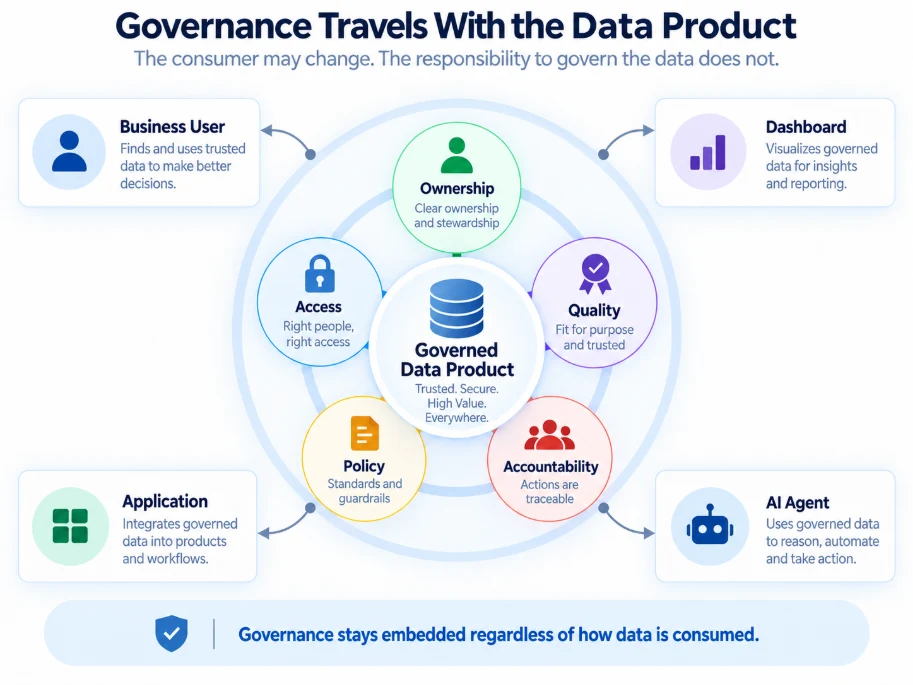
The question is no longer only, “Can this person access this data?” Organizations must also ask, “What should an AI agent acting on this person’s behalf be allowed to see and do?” A governed agent should operate within the same organizational boundaries and responsibilities that apply to people, while those boundaries are embedded closely enough to support autonomous work safely.
This is where embedded governance becomes especially valuable. The same guardrails that help domain teams move quickly can also help AI operate responsibly. Governance should remain connected to the data whether the consumer is a person, a dashboard, an application, or an intelligent agent. The consumer may change. The responsibility to govern the data does not.
Why Embedded Governance Wins: Speed, Trust, and Accountability
Embedded governance wins because it allows speed, trust, and accountability to advance together rather than forcing organizations to choose between them.
When governance is embedded, quality becomes everyone’s responsibility instead of someone’s job title. Trust is established through ownership rather than oversight. Collaboration replaces escalation. And governance transforms from a process that slows progress into a capability that accelerates it.
Figure 7. From bottleneck to accelerator
From Gatekeepers to Coaches: The Future of Data Governance
The future of governance is less about approving individual activities and more about creating the conditions for responsible autonomy. Organizations are expected to move faster, innovate continuously, and make decisions with confidence, so governance must balance control with agility, standards with autonomy, and trust with speed. Central governance teams should increasingly define enterprise guardrails, establish shared principles, coach teams, and intervene where risk genuinely requires it - not approve every individual decision.
Governance therefore moves from saying “yes or no” to helping teams act responsibly. For me, this is where data-product thinking and governance meet: data should be treated as a governed product, owned by the domains that understand it, and made available through a shared operating layer where policy, quality, lineage, discoverability, and access travel with the product by default. This platform-led, domain-oriented mindset allows self-service and control to reinforce each other rather than compete. It creates reusable, trusted data products that can be discovered, understood, and consumed consistently across analytics, applications, and AI. Governance then becomes the foundation that lets trusted data move faster not as a separate approval gate, but as an embedded capability across the data product lifecycle.