Adding the Missing Layer: How Banks Are Activating the Data Stack They Already Built
Lorem ipsum dolor sit amet, consectetur adipiscing elit. Suspendisse varius enim in eros elementum tristique. Duis cursus, mi quis viverra ornare, eros dolor interdum nulla, ut commodo diam libero vitae erat. Aenean faucibus nibh et justo cursus id rutrum lorem imperdiet. Nunc ut sem vitae risus tristique posuere.

Your bank has already made several key infrastructure calls, putting a platform like Snowflake, Databricks, or BigQuery in place. The question is whether that investment is delivering the value you expected across every team that needs it: compliance, risk, and the AI initiatives ready to scale.
The organizations moving the fastest are finding the answer in a data activation layer: the layer between your stack and your business that brings context, governance, and semantic meaning to the data you’ve already invested in. Not a replacement for what you’ve built. An accelerator for it.
This is where a data activation layer comes in. DataOS is purpose-built to deliver it.
What “Data Activation” Means for Banks
DataOS, from The Modern Data Company, layers on top of your existing stack with no migration needed. It enables data activation by creating a unified layer that connects your warehouses, lakes, and operational systems, while applying governance, semantics, and discoverability across them. Think of it as the operating system for your data infrastructure: standardizing how data is defined, accessed, and trusted across every team and tool. The result is data and platform teams that can build and manage data products for regulatory reporting, risk analytics, AI-powered credit decisions, and fraud detection, ready from day one.
The banking leaders, seeing the fastest results, made one decision differently: they activated their existing stack rather than rebuilding another. The difference showed up in weeks, not years.
Here is how banking data, tech, and business leaders are putting it to work today.
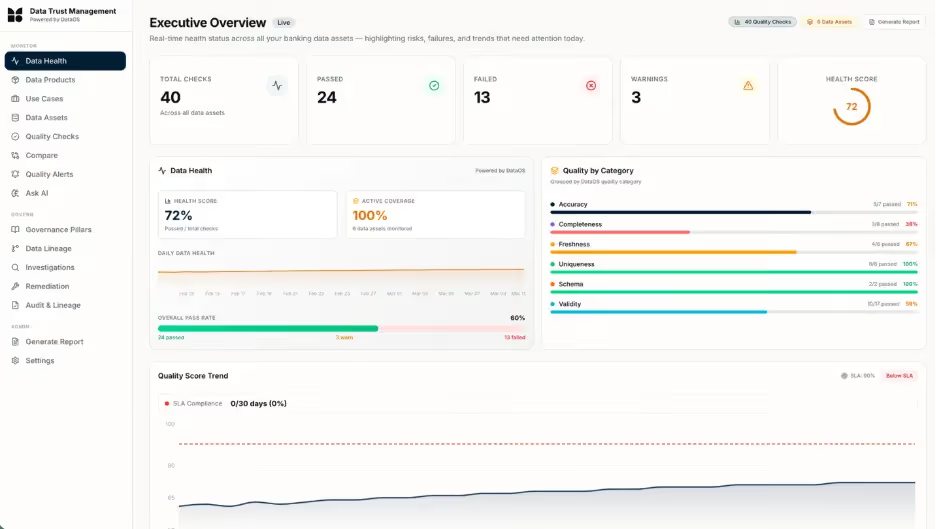
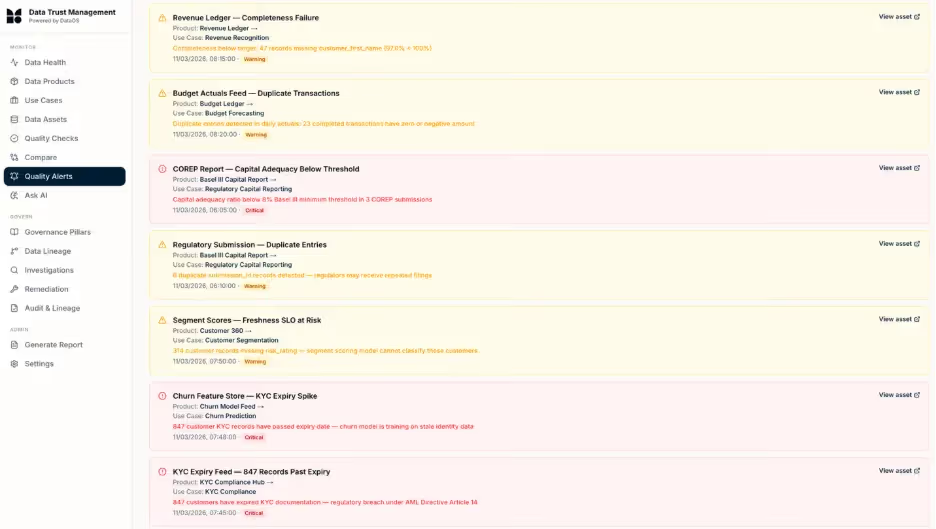
#1: Automated Data Quality Monitoring
The problem: Schema drift is one of the banking sector’s most expensive silent problems. It builds across system migrations, post-acquisition integrations, and routine vendor updates, undetected, until it surfaces inside a stress-test dataset or a BCBS 239 report.
“Banks face average annual losses of $13 million from data issues — with over 25% of global analytics teams reporting losses exceeding $5 million annually.” (IBM BCBS 239 compliance analysis (2024))
Left unchecked, it compounds. Field names drift, business rules conflict, and data formats fail to reconcile. By the time it’s visible, the fix is manual, time-pressured, and costly. And regulators notice.
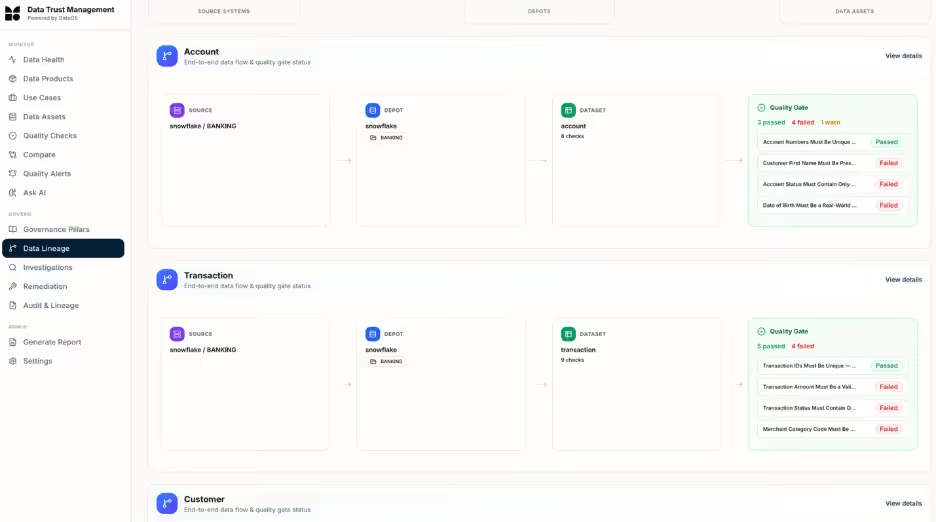
How DataOS solves it: DataOS monitors data quality continuously across every connected source. The moment schema drift or a quality violation appears, it gets flagged before reaching a risk model, a regulatory filing, or an examiner. The signal goes to the data team, not the audit finding.
What changes: Regulatory findings, BCBS 239 violations, and stress-test errors get caught at the source, not after the fact. When examiners trust your data, exam cycles shorten, and remediation costs fall. Compliance teams shift from reactive to strategic.
#2: Reusable Data Products Instead of Custom Pipelines
The problem: In most banks, the data team is the bottleneck for every business question, and the queue becomes the product.
When the compliance team needs a new regulatory report, it's a six-week wait. When risk needs a new exposure metric, it's another sprint. When a loan officer needs a customer view for a credit decision, it's another ticket and another delay. The data team isn't underperforming. They're operating exactly as a pipeline-first architecture demands. The architecture is the problem.
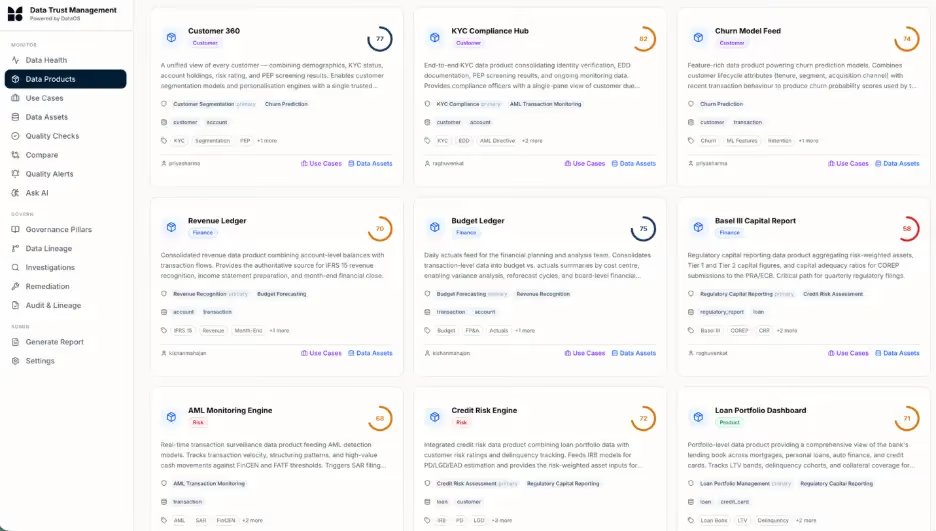
How DataOS solves it: With DataOS, data products (customer profiles, risk concentration views, regulatory profiles, AML/KYC datasets) are built once, centrally governed, and reused by every team that needs them. When the Chief Compliance Officer’s team needs a new regulatory report, the underlying data is already there, quality-checked, and governed. No rebuild. No queue. No sprint.
What changes: New reports and regulatory filings go from months to days. Each incremental use case costs a fraction of what it used to. Engineering capacity shifts toward new product launches, AI initiatives, and competitive differentiation. The data team stops being a queue and becomes a platform.
#3: Regulatory-Grade Lineage, Governance, and Monitoring
The problem: Regulatory compliance isn’t one problem. It’s three, and most banks handle all three manually, under time pressure.
First, there is lineage: examiners need to know where the data came from, how it was transformed, and who touched it. Second, there is governance: auditors need to confirm who has access and whether PII is properly classified. Third, there is monitoring: risk and compliance teams need continuous assurance that data hasn't drifted since the last check. In most organizations, answering all three requires manually pulling from multiple systems while the exam clock is running.
How DataOS solves it: With DataOS, every data asset carries automated lineage (source, transformation, owner, freshness) without manual cataloging. Governance policies are enforced at the data layer itself, not added on afterward. Quality monitoring runs continuously, so issues surface before they reach a filing.
“One major UK retail and commercial banking group cut metadata cataloging from weeks to minutes — a 160x improvement — and reduced PII tagging time by 700x after deploying DataOS.” (The Modern Data Company Solutions Team, 2025)
What changes: Examiner requests that used to take weeks to answer are now answered in hours. PII classification is automated, not a scramble. DQ issues surface before they hit a regulatory report. Over time, it lowers legal and compliance costs, reduces disruption across every exam cycle, and provides a compliance function that can scale without adding headcount.
#4: Self-Service Analytics Without the Data Engineering Queue
The problem: Business and compliance teams are moving at ticket speed, not business speed.
“According to the Modern Data Report 2026 — a survey of 540+ business leaders across 64 countries — 37% cite prioritization delays as their single biggest blocker when working with data teams.” (The Modern Data Report 2026 )
The CDO feels this from both sides. The business escalates because they can't get answers fast enough, and the data team escalates because the queue never clears. Everyone is frustrated. Nobody is wrong.
How DataOS solves it: DataOS delivers a semantic layer with standardized, governed business definitions, creating a common language between the platform your data team manages and the questions every other team need answered. Compliance officers run their own queries. Loan teams model their own credit scenarios. Risk analysts pull their own datasets, without touching the underlying infrastructure, without filing a ticket, without waiting.
What changes: Internal decisions move faster. Credit assessments and risk reviews happen at business speed. The data team stops being a bottleneck and becomes a platform, and that shift compounds. Better decisions, faster customer experiences, and a measurable competitive edge on time-to-answer.
#5: Trusted AI-Ready Data Layer
The problem: The AI pilot worked. The sandbox results were strong. Then it hit production.
“68% of data practitioners say their data isn't clean or trustworthy enough for AI operations — a challenge that runs especially deep in financial services, where model risk and regulatory accountability are non-negotiable.” (The Modern Data Report 2026 )
Credit risk models, fraud detection systems, and AML transaction monitoring don't fail because the AI underperformed. They fail because the data feeding the model is inconsistent across sources, ungoverned at the field level, and semantically ambiguous depending on which system it came from. The data team ends up running a two-year cleanup project instead of shipping AI.
How DataOS solves it: DataOS builds the AI-ready data layer alongside your existing systems, with no migration or multi-year cleanup required. Every data product is governed, discoverable, and semantically consistent from the start. Credit risk models, fraud detection, and AML monitoring activate on trusted data from day one. As the platform learns from usage patterns, the data layer keeps improving.
What changes: AI moves from pilot to production. Better credit risk models lower default rates. Sharper fraud detection reduces losses. These are measurable P&L outcomes that compound as AI applications multiply on top of an activated, trusted data foundation.
What This Looks Like in Practice
These aren’t capabilities that require a transformation program to unlock. Banks running DataOS typically activate their existing data stack with the first data products within 6 to 8 weeks.
What makes this work is that these five capabilities aren’t separate initiatives. They’re connected outcomes of a single architectural decision to layer activation on top of what’s already built. When the data layer is governed and semantically consistent, quality monitoring runs continuously, data products become reusable across teams, compliance functions answer examiner requests in hours, business teams stop waiting in queue, and AI initiatives move from pilot to production. Each capability builds on the last.
The organizations moving fastest all made the same call. They stopped treating data activation as a future-state ambition and started treating it as an operational capability they could act on right now. They didn’t wait for a greenfield moment or a perfect data environment. They activated the data they have.
For most banks, the heavy lift on infrastructure is largely behind them. The investment is real. The gap isn't infrastructure. It's activation.
Go Deeper
Know where you stand in 5 minutes. Take the AI-Readiness Scorecard.
Watch: Operationalizing Data Quality — A Playbook for Banking Leaders (On-demand webinar).