Revenue Realization Find the revenue you’re missing
With DataOS, Revenue Realization turns disconnected sales data into a real-time system that detects risk, identifies opportunity, and directs teams toward the highest impact actions at the account level.

Why this is hard
Revenue is rarely lost all at once. It declines quietly across thousands of accounts and interactions. Signals exist, but they are scattered across systems and teams.


How DataOS turns signals into action
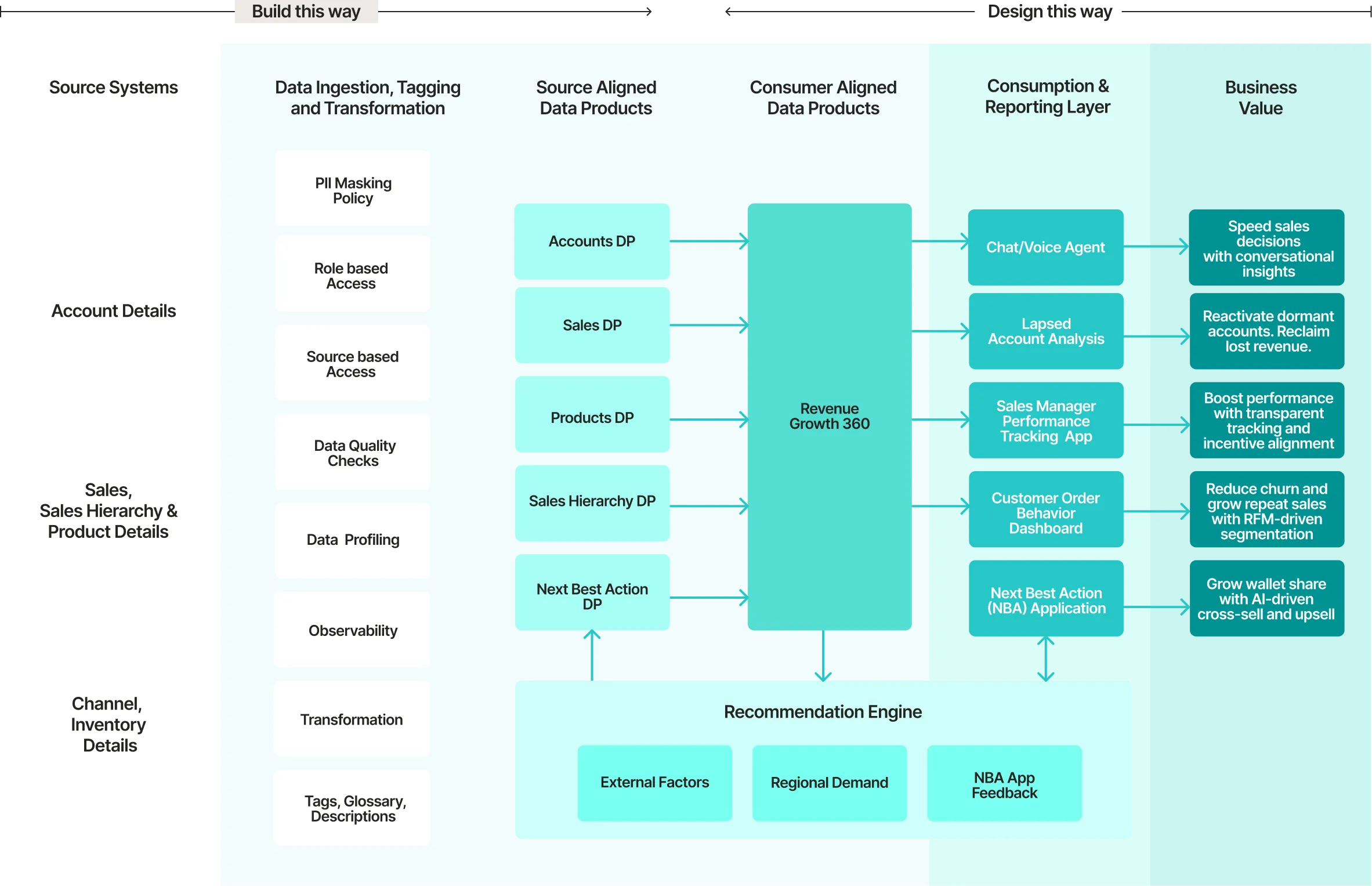
DataOS creates a single, governed view of revenue across accounts, products, and regions. Signals are unified, interpreted, and turned into clear actions. Teams no longer search for answers. They act on them. As conditions change, the system continuously updates priorities and recommendations. Everyone works from the same understanding of where revenue is at risk and where it can grow.
What better revenue execution looks like
DataOS provides continuous visibility and control your data environment.
Traditional Sales Execution
- Reports show what already happened
- Teams build lists manually
- Opportunities discovered late
- Sales relies on instinct
- Leaders depend on analysts
Revenue Realization With DataOS
- Signals surface in real time
- Accounts are prioritized automatically
- Risk and growth identified early
- Actions driven by data
- Answers available instantly
From signals to outcomes
Revenue Realization on DataOS continuously connects detection, prioritization, and action.

Proven impact
Organizations using Revenue Realization Engine see measurable improvements.


This system changes how revenue is managed.
Directs what to do next, not just what happened.
Focuses where revenue decisions are made.
Combines segmentation, recommendations, and performance tracking.
Improves with every action taken.
Leaders gain visibility while teams gain direction.
Frequently Asked
Questions
CRMs capture activity. Analytics platforms report on it. Revenue Realization Engine changes what happens next by directing actions based on real-time signals.
It monitors changes in customer behavior, transaction patterns, and engagement signals to detect early indicators of decline.
For each account, the system recommends the most relevant action such as which product to offer or which account to prioritize.
Most organizations move from days-long discovery cycles to identification in hours.Sales teams receive prioritized accounts and clear actions, reducing time spent on analysis and increasing time spent on execution.
Yes. Leaders can explore performance, account health, and trends in real time and get answers instantly.
The system tracks adoption across accounts and surfaces where intervention is needed to drive growth.
Impact begins as soon as signals are unified. Early wins include identifying dormant accounts and improving prioritization.