

What will separate enterprise AI leaders when every organization has access to many of the same models?
For Girish Hoogar, the answer is not simply better models or more compute. Competitive advantage will come from an organization's ability to orchestrate models, devices, infrastructure, workflows, and trusted data into an experience that works for the user.
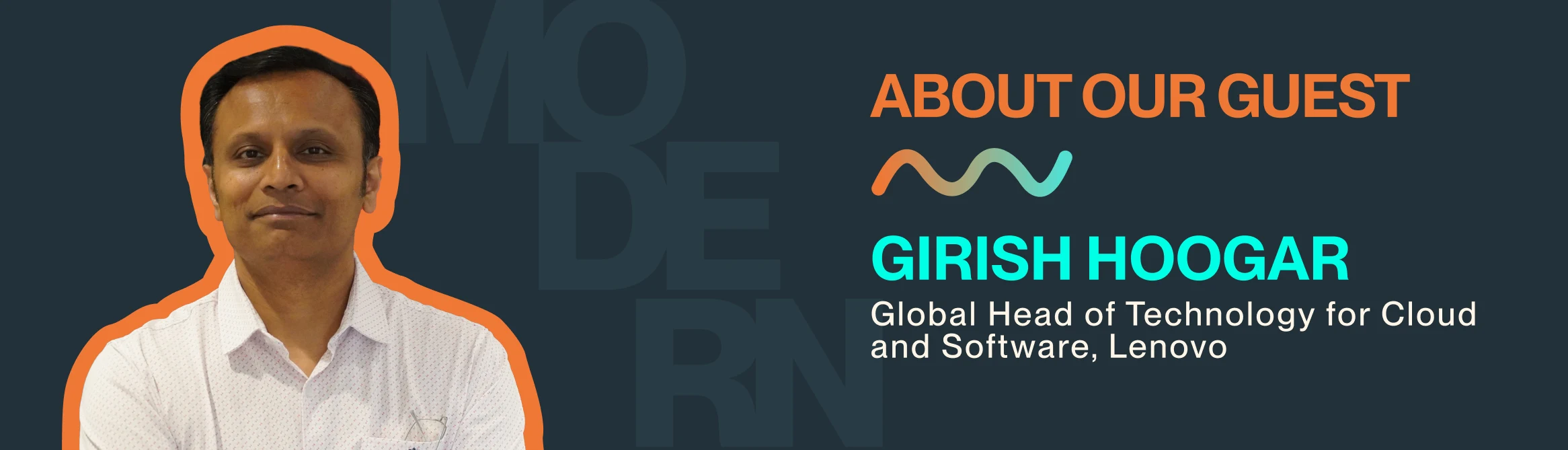
In this episode of the Modern Data Leaders series, Mithila Bhadbhade of The Modern Data Company speaks with Girish Hoogar, Global Head of Technology for Cloud and Software at Lenovo. They discuss Lenovo's hybrid AI strategy, why data turns AI orchestration into a business trust decision, how organizations should think about data ownership, and what Girish has learned from building platforms that operate at massive scale.
This conversation has been edited for length and clarity.
Putting intelligence in the right place
Mithila: At Lenovo, you adopt a hybrid AI strategy. What does hybrid AI mean to you?
Girish: At Lenovo, hybrid AI means delivering the right intelligence in the right place, whether it is on the device, at the edge, or in the cloud, while making it one seamless experience for the user.
We bring that strategy together through our UDS Hybrid AI Cloud Platform. At the heart of it is an orchestration layer with three core capabilities.
The first is the Hybrid AI Router. For every AI request, it determines in real time where the user's intent should go: locally on the device, at the edge, or in the cloud. While doing that, it has to balance privacy, speed, performance, cost, and the experience we want to deliver.
The second is our AI Token Exchange, which gives us a common way to meter and manage AI consumption across Lenovo solutions, applications, models, and devices. That creates a foundation to scale AI more responsibly.
The third, and most critical, is the Device and User Data Engine. It provides a governed, secure, and privacy-managed data foundation so AI experiences can use trusted device and user context in the right way.
Looking ahead, I don't believe success will be defined simply by access to the latest frontier models. The real differentiator will be the ability to orchestrate those models with the right device capabilities and trusted data to create the best possible user experience.
When AI orchestration becomes a trust decision
Mithila: We talk a lot about the AI itself: models, tokens, GPUs, and compute. But those systems are only as useful as the data and context they can access. How does the data layer change the orchestration challenge?
Girish: Data changes orchestration from a purely technical routing decision into a business trust decision.
It isn't enough for an AI platform to decide whether a request should run on the device, at the edge, or in the cloud. It also needs to understand which data is relevant, whether the user has consented to its use, whether that data is current and trustworthy, and which model or service is authorized to access it.
That is why data is so central to our UDS Hybrid AI Cloud Platform.
Our Device and User Data Engine brings together consented device telemetry, customer insights, product information, and enterprise data and turns them into governed data products.
At the heart of that engine is our partnership with The Modern Data Company through DataOS. DataOS helps make trusted data products discoverable and consumable across teams through standard interfaces while maintaining security, privacy, and governance.
The result is that our Hybrid AI Router can make smarter decisions, not only about which model to use or where to run it, but also about which trusted data should inform the interaction.
That's how we turn data from a collection of signals into a great device and user experience.
Keeping data ownership close to the business
Mithila: Once structured and unstructured data start coming together, ownership gets complicated very quickly. Who should own the data, and who is responsible for keeping it trustworthy and usable?
Girish: I don't think one central team should own all the data.
The business teams closest to the data understand its meaning and should own its quality and proper use. But enterprise accountability has to be shared.
The central technology and data organization, such as the CTO office, should provide the common platform, security controls, governance standards, and reusable services. Data owners in the business must make sure the data is accurate because they are close to it and understand how it is being used. Leadership has to be clear about the outcomes and accountability.
The key is avoiding two extremes.
You don't want a centralized model that becomes a bottleneck. But you also don't want a decentralized model where every team creates its own definitions and controls.
What you need is federated ownership on a common, trusted platform. That's what we're working toward at Lenovo.
Starting with the problem, not the technology
Mithila: It sounds like a lot of what you do is about finding ways to solve problems for teams and customers faster. How do you approach that?
Girish: Our approach is straightforward: it starts with the problem, not the technology.
We ask: Where is the friction for an employee, a developer, a customer, or a partner? And can we solve it once in a reusable way instead of repeatedly building point solutions?
At the core of the Cloud and Software group I lead is the UDS Cloud Platform. When we talk about a platform, we're talking about solving something in a reusable way so it can be used again and again.
I think of it like Lego pieces. You build something once, and it can become part of many different solutions.
For the UDS Cloud Platform, those common building blocks include device management services, data and insight services, developer tools, automation, monitoring, and security built in from the beginning.
A platform should make every product go faster. It shouldn't create another complicated layer that teams have to navigate.
We've also learned that adoption matters as much as invention. There are always new technologies coming out, but we have to ask how we upskill our engineers to use them, how we make those capabilities accessible, and how we measure whether they are actually improving efficiency or adding value for customers.
The outcome isn't simply greater efficiency. It's also being able to redirect talented people away from repetitive work and toward innovation and customer value.
Competing on the AI system, not a single model
Mithila: Looking ahead a few years, where do you think competitive advantage in enterprise AI will come from?
Girish: I believe competitive advantage will come less from access to a single frontier cloud model and more from the ability to orchestrate the entire AI system.
Models will become increasingly available and interchangeable.
What will really differentiate an organization is its ability to select the right model for each task, run it in the right place, whether that's on the device, at the edge, or in the cloud, and connect it with trusted data, enterprise workflows, and strong governance.
That requires an orchestration layer that can balance quality, latency, cost, privacy, and security.
Above all, it requires a governed data foundation so AI can use relevant information.
At Lenovo, this is the thinking behind our UDS Hybrid AI Cloud Platform. The Hybrid AI Router, AI Token Exchange, and Device and User Data Engine come together to make AI secure, cost-aware, scalable, and personalized across our device ecosystem.
Ultimately, the winners will be the organizations that build the best orchestration layer: one that can bring together constantly evolving models with the right data while still delivering a great customer experience.
Building for reuse at enterprise scale
Mithila: You've scaled and governed data flows across tens of millions of devices and users, helped build platforms that contributed to major e-commerce growth, and led global teams through significant revenue growth. What lessons have contributed most to your success?
Girish: One of the most important lessons I've learned recently is that scale does not come from technology alone.
It comes from aligning technology, business outcomes, operating models, and, most importantly, people around a common purpose.
When we scaled platforms to tens of millions of devices and users, trust and operational discipline mattered as much as the architecture.
When we built platforms that helped drive e-commerce growth, the lesson was that technology creates value only when it is tightly connected to business outcomes. You can invent, create solutions, and adopt new technologies, but if there isn't a business outcome behind them, you're not building appropriately.
Ultimately, it comes back to the user experience. You're building something for a user or customer to experience and value.
Another lesson is to build for reuse. The most powerful solutions aren't isolated wins. They become capabilities that many teams can use again and again.
And global leadership has taught me to be clear on the destination but flexible on the path. As a leader, you set the vision. You work with the team to establish the goals and how you're going to measure them. Then you get out of the way, because the team knows how to best execute.
Quick takes on modern data leadership
Mithila: What's a data myth you're tired of hearing as a modern data leader?
Girish: That more data automatically means better AI. That's not true. Trusted, relevant, and well-governed data matters more than volume.
Mithila: What's the hardest part about being a modern data leader?
Girish: Closing the gap between the data we have and the data we can truly trust, while moving fast enough to create meaningful value for our customers.
Mithila: What defines a modern data leader?
Girish: A modern data leader turns trusted data into differentiated device and user experiences while delivering measurable business value.
For more perspectives from leaders like Girish, join the Modern Data 101 community.