How DataOS Delivers on NASCIO’s Top 10 State CIO Priorities
Lorem ipsum dolor sit amet, consectetur adipiscing elit. Suspendisse varius enim in eros elementum tristique. Duis cursus, mi quis viverra ornare, eros dolor interdum nulla, ut commodo diam libero vitae erat. Aenean faucibus nibh et justo cursus id rutrum lorem imperdiet. Nunc ut sem vitae risus tristique posuere.
Why this matters: Ten priorities. One Solution.
Every year, NASCIO ranks the issues that keep state CIOs up at night. This year's list covers AI governance, cybersecurity, cloud strategy and more. Most of those priorities depend on the same thing: data that agencies can find, trust and govern. States don’t have a data shortage problem. They have a data activation problem: fragmented, hard to govern consistently, and hard to trust enough to put in front of an AI model or a new digital service. Our latest trends report showed that:
- 68% of data practitioners say their data isn’t reliable enough for AI
- 46% say finding the right data takes longer than using it
Source: The Modern Data Company, 2026 Interim Report
With DataOS®, state agencies get data they can trust and reuse across every program and AI initiative, without a multi-year rip-and-replace project. DataOS is an AI-native data operating system that layers over existing systems and turns scattered data into governed data products. It's TX-RAMP Level 2 certified, integrated with Leidos' HeadWay Mission OS™, delivered through Second Front's secure FedRAMP pathway, and available through Carahsoft's public sector contract vehicles. The result is one proven data foundation that supports every priority on the NASCIO list.
01. Artificial Intelligence / GenAI / Agentic AI / ML
The priority: Governance, use cases, security, data quality, and workforce skills. States must adopt AI with a data foundation that can support it.
How DataOS delivers: Every DataOS data product is AI-native from day one. Semantic context and quality controls travel with the data, so LLMs and agents draw from the same governed source of truth, not a shadow copy nobody trusts.
Proof point: Leidos integrates DataOS into HeadWay Mission OS™ to make federal agencies AI-ready, with no multi-year migration required.
02. Cybersecurity & Risk Management
The priority: Security frameworks, data protection, third-party risk, and whole-of-state cybersecurity remain a top operational concern for state CIOs.
How DataOS delivers: Access policy, ownership, and quality controls are built into every data product, not bolted on, and enforced automatically everywhere that product is deployed.
Proof point: DataOS holds TX-RAMP Level 2 certification from the Texas Cyber Command and aligns to FedRAMP, FISMA, CJIS, and NIST SP 800-171.
03. Budget / Cost Control / Fiscal Management
The priority: Budget reduction, constrained federal funding, and pressure to cut costs shape nearly every technology decision states make.
How DataOS delivers: No rip-and-replace: DataOS layers over the systems agencies already own, and every data product is built once and reused everywhere, cutting duplicate integration spend.
Proof point: Available through Carahsoft, NASA SEWP V, ITES-SW2, NASPO ValuePoint, and DIR‑CPO‑5687 for faster, lower-friction procurement.
04. Modernization
The priority: Enhancing, renovating, and replacing legacy platforms and applications without the disruption of a multi-year rewrite.
How DataOS delivers: DataOS activates legacy mainframes, databases, and SaaS systems as governed data products, modernizing the data layer first, without pausing operations.
Proof point: Supports incremental modernization for use cases like intelligent transportation systems and fraud detection.
05. Digital Government / Digital Services
The priority: Citizen-facing portals, identity management, and cross-agency collaboration all depend on consistent, trustworthy data.
How DataOS delivers: A shared semantic layer means every digital service (licensing, benefits, DMV) all work from the same governed definition of a citizen or a case.
Proof point: Built for cross-agency use cases like AI-driven citizen engagement and social service optimization.
06. Accessibility
The priority: Ensuring services, websites, publications, and tools are accessible and provable across the entire enterprise.
How DataOS delivers: The DataOS catalog lets compliance and program teams find and monitor accessibility data directly, without waiting on an engineering backlog.
Proof point: Turns accessibility compliance from a periodic audit into an ongoing, governed practice.
07. Identity & Access Management
The priority: Citizen and workforce access, authentication, and credentialing all hinge on knowing exactly who can see what.
How DataOS delivers: Granular, policy-based access control is enforced at the data product level and integrated with the identity systems agencies already run.
Proof point: One access policy, enforced consistently across every dashboard, API, and AI agent that touches the data.
08. Data Management & Analytics
The priority: Data governance, architecture, business intelligence, and predictive analytics: the discipline every other priority depends on.
How DataOS delivers: At the core of DataOS are governed data products with built-in lineage, ownership, quality, and access policy. It’s one architecture instead of a patchwork of tools.
Proof point: The same architecture that makes AI-readiness, cybersecurity, and analytics achievable together, not separately.
09. Consolidation / Optimization
The priority: Centralizing services, operations, resources, and data across agencies that have long operated as silos.
How DataOS delivers: DataOS runs as a governed layer across every agency’s existing systems, delivering an enterprise view without forcing shared infrastructure first.
Proof point: A faster path to “whole-of-state” thinking than a multi-year infrastructure consolidation program.
10. Cloud Services
The priority: Cloud strategy, scalable and elastic services, and avoiding vendor lock-in shape how states deploy everything else.
How DataOS delivers: DataOS runs across clouds and compute engines interchangeably; governance and semantic context travel with the data, regardless of where it sits.
Proof point: States choose cloud and deployment models on mission need and cost, not on where the data platform happens to run.
See DataOS in action: Ten priorities. One live demo.
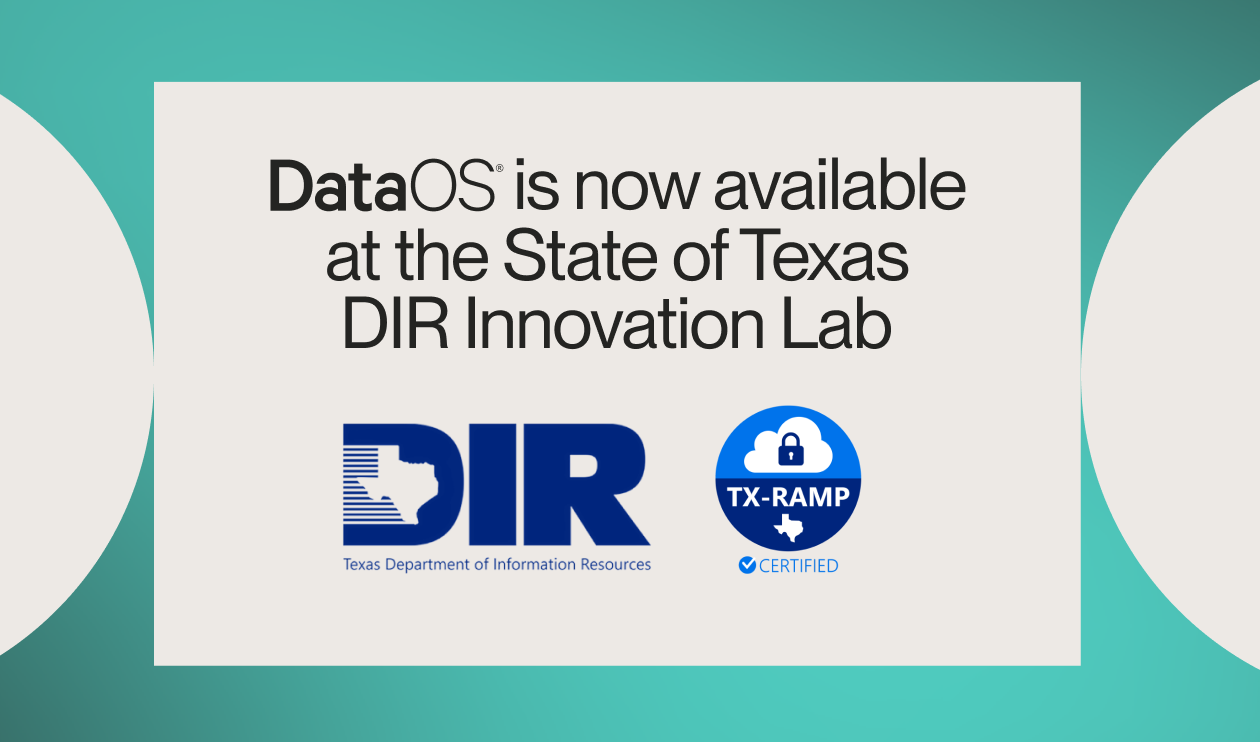
DataOS is available for a hands-on demonstration at the Texas Department of Information Resources (DIR) Innovation Lab in Austin, TX, the state’s own showcase space for evaluating emerging technology against real enterprise problems. With TX-RAMP Level 2 certification already in hand, the conversation can start with your use case, not the compliance paperwork.
Book a demo: innovation@dir.texas.gov
Sources
- NASCIO, “2026 State CIO Top 10 Priorities”
- The Modern Data Company 2026 research report
- TX-RAMP Level 2 certification, Aug. 2026
- Leidos/Modern Data Co. partnership, June 2026
- Texas DIR Innovation Lab



.png)