Why Cheaper AI Tokens Are Increasing Enterprise AI Costs
Lorem ipsum dolor sit amet, consectetur adipiscing elit. Suspendisse varius enim in eros elementum tristique. Duis cursus, mi quis viverra ornare, eros dolor interdum nulla, ut commodo diam libero vitae erat. Aenean faucibus nibh et justo cursus id rutrum lorem imperdiet. Nunc ut sem vitae risus tristique posuere.
.avif)
The token paradox: Exploring the hidden economics of agentic AI and the architectural forces driving rising costs
Every week, a new announcement hits the trend: Token prices dropped 40%, a new model matches GPT-4 at a tenth of the cost, AI is now affordable for every developer.
While the headlines are accurate, they are also deeply misleading.
The price per token has collapsed. But engineers watching their cloud bills will tell you what the press releases often skip.
Cheaper tokens did not make AI cheaper. In many organizations, cheaper tokens made AI more expensive.
Understanding why means stepping back from the unit price and looking at something far more consequential: the architecture of how AI is now being used.
The Equation is Not Adding Up
The cost of running an AI application has always resolved to one equation:
Cost = Price per token × Tokens per task.
For years, every conversation fixated on the first variable. It genuinely improved. Per-token prices have fallen roughly a thousandfold in three years.
In 2023, running GPT-4 cost approximately $60 per million output tokens. By 2026, frontier models (the largest, most capable AI models from major labs, carrying the highest per-token price) handle most enterprise tasks for less than a dollar per million tokens.
The second variable, tokens per task, moved in the opposite direction.
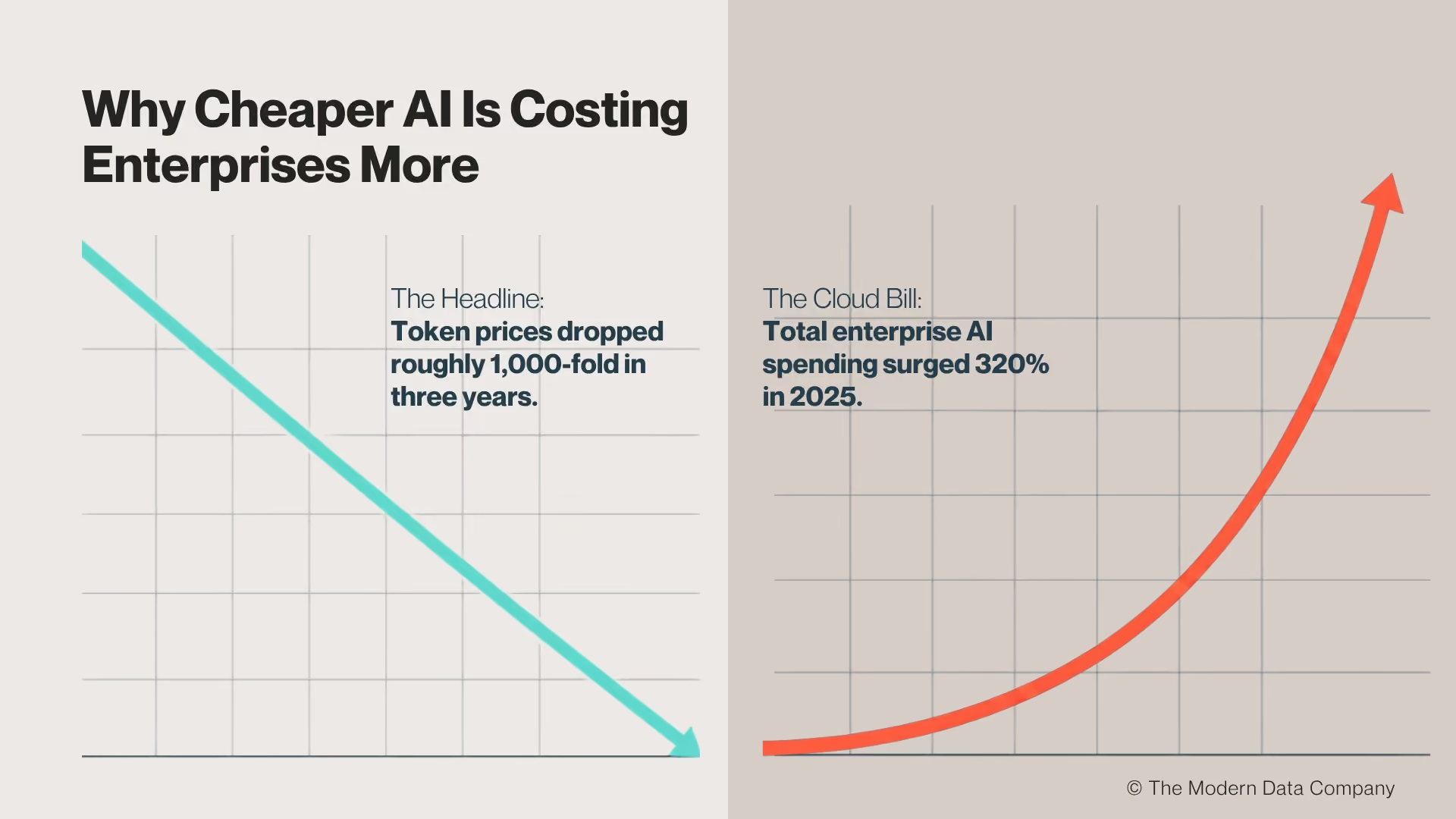
A 2024 AI interaction was simple: a user submits a prompt, the model responds, consuming roughly two thousand tokens. A 2026 agentic workflow (a multi-step AI process where an orchestrator decomposes a task, selects tools, calls sub-agents, validates outputs, and retries on failure, without step-by-step human instruction) looks nothing like that. Every one of those steps burns tokens.
Research from Microsoft and Stanford's Digital Economy Lab found that agentic tasks consume roughly 1,000 times more tokens than standard chat interactions. Cut the token price by 75%, deploy a system that consumes 250 times more tokens per task, and the math is unambiguous: you pay more.
The cost problem in agentic AI is not price per token. It is the explosion in tokens per task.
Where Are Tokens Being Spent in Enterprise AI
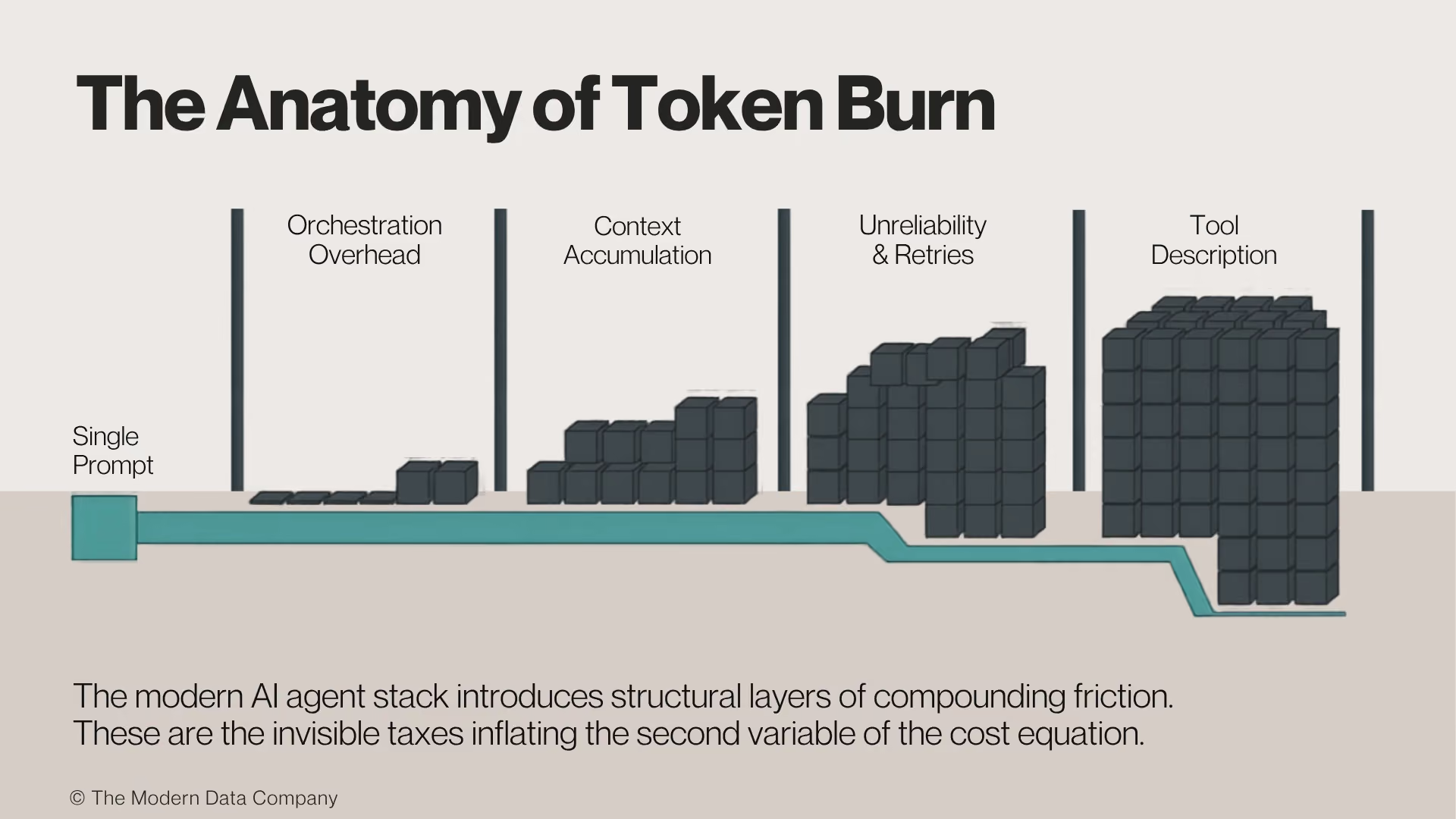
To understand why token consumption has scaled so dramatically, it helps to trace the structural layers of a modern AI agent stack and where the spending accumulates.
Orchestration Tax of Multi-Agent Pipelines
An orchestration layer is used by most production AI systems today. It’s a coordinator that decomposes tasks, manages state, and routes work between specialized components.
Anthropic's research reports that multi-agent systems use approximately fifteen times as many tokens as simple chat interactions. A three-agent pipeline consumes roughly 29,000 tokens to accomplish what a single-agent approach handles in 10,000.
Coordination overhead costs tokens at every handoff, and those costs compound. In a five-agent system with fifty reasoning steps operating on an 8,192-token planning document, context broadcasting alone generates over two million tokens of overhead, most of it unchanged context retransmitted at every synchronization boundary.
Orchestration is not free. Every agent handoff has a token cost, and those costs multiply with system complexity.
Context Accumulation becomes Increasingly Expensive
Agents are stateful. They accumulate history, including tool outputs, intermediate reasoning, and prior conversation turns, and that history travels through the context window at every inference call.
A twenty-step ReAct trace (a reasoning pattern where an agent alternates between reasoning steps and tool calls, logging each step in the context window) with tool outputs can easily hit 50,000 tokens of accumulated context.
At that point, the model spends more tokens reading its own history than reasoning about the current step. A 50-message thread with four agent handoffs means the fifth agent processes roughly 200 messages.
Token costs scale quadratically with handoff count. Microsoft's research found that token usage on the same task can vary by a factor of 30 across runs, and higher token usage does not reliably translate into higher accuracy.
More context does not mean better answers. It often means a more expensive wrong answer.
Retry Loops Create Context Overgrowth
Production AI systems fail when AI agents hallucinate tool schemas, get stuck in reasoning loops, overflow context windows, and misclassify problem severity. Each failure triggers a retry, and each retry re-prompts with a larger context.
Each ambiguous response may trigger another validation pass. None of this appears in initial cost estimates. Researchers call this the Unreliability Tax: the additional compute required to absorb the probabilistic uncertainty that agentic systems introduce into previously deterministic stacks.
A demonstration agent that works 80% of the time looks impressive. A production agent that fails 20% of the time is unusable. Pushing reliability from 80% to 95% typically manifests as a token cost instead of a quality improvement.
The Unreliability Tax is invisible in demos and unavoidable in production.
Tool Description Overhead
Latest AI agents access tools: APIs, databases, retrieval systems, code executors. Each tool must be described in the system prompt so the model knows when and how to use it. Tool count drives prompt size.
Anthropic's own research notes that agent accuracy degrades significantly beyond fifteen tools and collapses beyond fifty, while token cost grows linearly with tool count. The result is systems where the system prompt alone consumes tens of thousands of tokens before a single user word is processed.
Every tool added to an agent is a cost that runs on every call, whether or not that tool is used.
Frontier Model Misallocation
While this one’s not always playing out, it is the most quietly expensive breakdown in enterprise AI: Misallocation of tasks to models. When organizations default to frontier models for every task regardless of complexity, they pay frontier prices for work a much smaller model would handle equally well.
Enterprise data from AI infrastructure platforms shows that in early 2025, roughly 73% of enterprise token volume was being routed to the two most expensive model tiers. A standard FAQ response that could run on a model priced at $0.04 per million tokens was instead running on a reasoning engine priced at $180 per million: a 4,500-fold cost multiplier for identical quality output.
Routing governance is the most immediate lever on enterprise AI cost.
Jevons Paradox and the Token Economy
The economic force driving all of this has a name that predates the internet by 160 years. In 1865, economist William Stanley Jevons observed that as coal-burning engines became more efficient, total coal consumption rose rather than fell.
Greater efficiency made coal economically accessible for applications that had previously been too expensive to pursue. Each efficiency gain expanded demand more than it reduced per-unit consumption: the Jevons Paradox (the finding that increases in resource efficiency tend to increase total resource consumption by expanding the range of economically viable uses).
The AI token market is following the same arc. When GPT-4 cost $60 per million output tokens, organizations were careful. They deployed AI only where the return was unambiguous. As prices fell, economically impossible use cases became viable, then affordable, then ubiquitous.
Total enterprise AI spending surged 320% in 2025 even as per-token prices continued to fall. Inference costs fell approximately 1,000-fold. Demand rose roughly 10,000-fold. Cheaper tokens did not reduce spending, but unleashed it.
Microsoft CEO Satya Nadella acknowledged the dynamic directly when DeepSeek released its low-cost model: "Jevons Paradox strikes again." Lower unit costs are an invitation to consume more, not a mechanism for spending less.
The scale of what is coming makes this structural. Goldman Sachs Research estimates that by 2030, agentic AI will multiply token consumption twelve times on the consumer side alone, projecting to 120 quadrillion tokens processed per month across enterprise and consumer adoption.
Gartner forecasts worldwide generative AI spending reaching $644 billion in 2025, a 76.4% increase from 2024. Anthropic's annualized revenue reportedly grew from $9 billion at the end of 2025 to over $44 billion by May 2026. The unit price is falling. The total spend is accelerating.
Jevons Paradox is not a quirk of this moment. It is the structural condition of the AI economy, and every architectural decision an enterprise makes either works with it or against it.
The Cloud Parallel of Jevons Paradox
The comparison engineers keep reaching for is cloud computing. When AWS launched in 2006, compute got dramatically cheaper. The promise was that organizations would pay only for what they used and pay less than they had for owned infrastructure.
Both claims were true at the unit level. Total compute spending rose anyway, because cheaper compute enabled architectural complexity that had been previously impractical. Monolithic applications became microservices. Batch jobs became real-time pipelines.
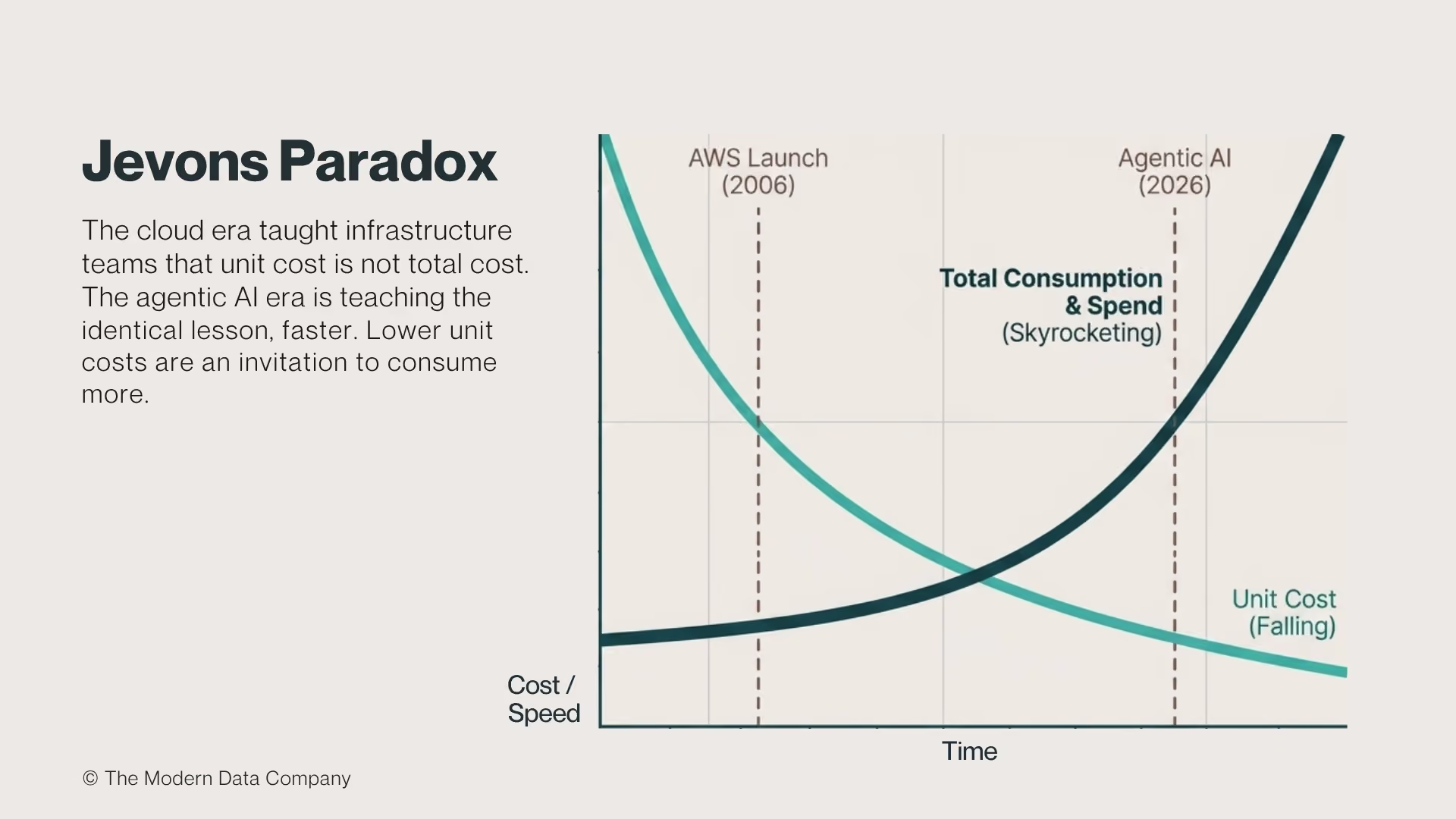
Simple websites became globally distributed systems with dozens of dependent services. The unit cost of a server-hour fell. The number of server-hours consumed multiplied. The AI pattern is identical. Unit token cost fell. Tokens per task multiplied. Complexity absorbed the savings, and then some.
The cloud era taught infrastructure teams that unit cost is not total cost. The agentic AI era is teaching the same lesson, faster.
How DataOS Reduces the Token Cost in Enterprise AI Projects
The cost dynamics above are not a model problem. They are a data architecture problem. The orchestration tax, the context accumulation problem, and the retry loop all share a root cause: agents reconstructing understanding at inference time because the data they are reasoning over carries no pre-packaged semantic context.
DataOS addresses this at the source. Its Data Product Hub delivers governed, semantically enriched data products to AI agents, so agents do not need to reconstruct meaning from raw schema on every call.
Field-level definitions, quality certifications, lineage, and access policy travel with the data product itself. The agent queries a context that is already defined and already governed. It does not burn tokens interrogating the schema or retrying because it misread what a field means.
Enterprise deployments using pre-defined semantic context layers have reduced input token consumption by up to 90% compared to dynamic schema discovery. For an organization running thousands of agent interactions daily, that reduction is the difference between a sustainable AI program and one that collapses under its own inference costs.
DataOS reduces the token cost of agentic AI by eliminating the work agents do to understand data they should have been handed correctly from the start.
Three Levers on the Token Cost Problem
Understanding the problem is easier than solving it. The solutions, though, are clearer than most budgeting conversations suggest.
Model routing is the most immediate lever. Match task complexity to model capability rather than defaulting to frontier models for everything. Production data suggests approximately 85% of enterprise queries are handleable by budget-tier models without measurable quality degradation. A routing architecture that reserves frontier models for the 5-15% of tasks requiring deep reasoning can reduce the AI bill by 60-80% without user-facing impact.
Observability and attribution are the second lever. Measuring at the model level tells you what you spent. Measuring at the workflow level tells you where it went and whether it was worth it. Cost-per-workflow, not cost-per-model, is where waste becomes visible.
The missing piece in most organizations is authorization before the spend: a governance layer that requires justification for routing a task to a frontier model, not a reporting layer that shows the damage afterward.
Architectural discipline is the third. Not every problem needs an agent. Not every agent needs five sub-agents. Not every workflow needs a validation pass, a retry loop, and a reflection cycle. The most expensive AI system is the one making the most unnecessary calls.
Orchestration layers that cost more than the work they orchestrate are an architectural problem, not a pricing problem, and those costs should be modeled before deployment, not discovered in the invoice.
The organizations that treat token consumption as a design variable, not an incidental side effect, are the ones building AI systems that stay economically sustainable as they scale.
The New Token Economics
What is emerging is a new way of thinking about AI economics. In the same way cloud architects learned to reason about request latency, data transfer costs, and service call patterns, AI architects are learning to think in tokens per workflow, retry overhead budgets, and coordination costs across agent pipelines.
This shift requires instrumentation at the call level, budget attribution per team and per workflow, deliberate model selection policy, and organizational willingness to treat AI cost governance as a first-class engineering concern. The teams doing that work now are the ones who will still be running their AI programs profitably when the investment runway that currently underwrites model pricing comes to an end.
The token price dropped, yet the bill went up. The second variable in the cost equation, tokens per task, is the one that determines whether enterprise AI becomes foundational infrastructure or an expense that proves impossible to justify.




.webp)